
How to Choose the Right Dehumidifier for Your Space
Not every space requires the same type of dehumidifier. Choosing the right dehumidifier depends on several factors, including room size, temperature, humidity level, application, ventilation, and the amount of moisture that needs to be removed. Selecting a unit based only on its appearance or basic capacity can result in poor moisture control, unnecessary energy consumption, or inadequate performance.
Whether you need a dehumidifier for a home, office, warehouse, commercial facility, or industrial application, understanding your requirements is the first step toward choosing the right solution. A properly selected dehumidifier can help maintain a comfortable environment, protect materials and equipment, reduce moisture-related problems, and improve overall indoor conditions.
Why Choosing the Right Dehumidifier Matters
Excess humidity can affect both people and property. High moisture levels may contribute to condensation, dampness, unpleasant odours, mould growth, corrosion, and deterioration of moisture-sensitive materials. In industrial and commercial environments, uncontrolled humidity can also affect manufacturing processes, product quality, storage conditions, and equipment performance.
A dehumidifier works by removing excess moisture from the air and helping maintain a more controlled humidity level. However, every application has different requirements. A compact unit suitable for a bedroom may not be powerful enough for a large warehouse or production area. Similarly, an industrial dehumidifier may be unnecessary for a small residential room.
The objective is to select a dehumidifier that provides sufficient moisture-removal capacity without using more energy or equipment than necessary.
1. Consider the Size of the Space
Room or area size is one of the most important factors when selecting a dehumidifier. The larger the space, the greater the volume of air that may need to be treated.
For small bedrooms, offices, bathrooms, and other compact areas, portable dehumidifiers may provide an effective solution. They can be suitable where flexibility, easy operation, and convenient moisture control are important.
Medium-sized rooms and commercial spaces may require units with higher moisture-removal capacity. Large warehouses, manufacturing facilities, storage areas, and industrial environments generally require high-capacity systems designed for continuous operation.
However, floor area alone should not determine the selection. Ceiling height, room configuration, air movement, ventilation, and the number of moisture sources can also influence the required capacity.
2. Understand the Humidity Level
The existing humidity level is another important consideration. A space with slightly elevated humidity may require a different solution from an environment experiencing severe moisture problems.
Using a humidity meter or hygrometer can help determine the current relative humidity. This information can provide a better understanding of how much moisture needs to be removed and how frequently the dehumidifier may need to operate.
Maintaining a suitable humidity level can help create a more comfortable indoor environment while reducing the risk of condensation and other moisture-related issues. For specialised commercial and industrial applications, the required humidity range may be determined by the specific process, product, or storage requirement.
3. Identify the Application
The intended application plays a major role in choosing the right dehumidifier. Residential and commercial environments often have different requirements from industrial facilities.
For homes and offices, factors such as low noise, compact size, ease of operation, and energy efficiency may be important. For warehouses and storage facilities, reliable moisture control may be required to protect stored materials and products.
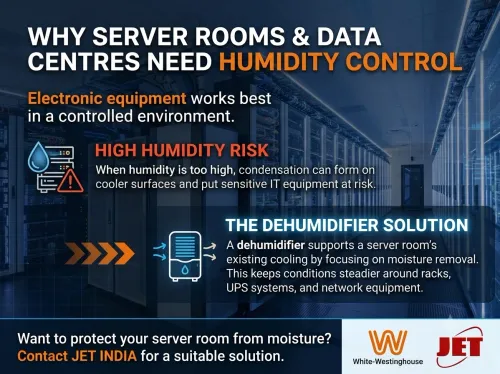
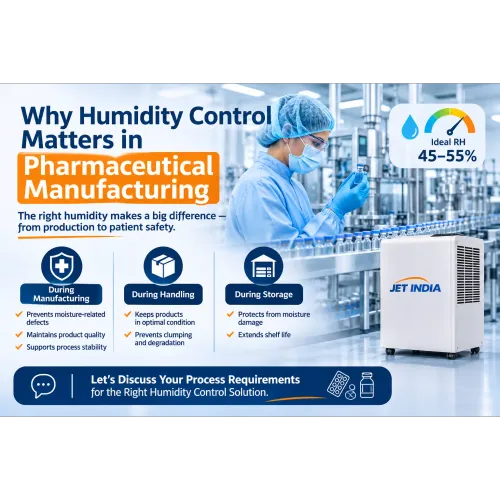
Industrial applications can have much more demanding requirements. Manufacturing processes, pharmaceutical facilities, food processing areas, laboratories, equipment rooms, and other specialised environments may require precise humidity control and continuous operation.
For demanding environments, industrial dehumidifiers are designed to provide higher-capacity moisture removal for commercial and industrial requirements.
4. Check the Moisture Load
The amount of moisture entering a space directly affects dehumidifier requirements. Moisture can come from several sources, including people, open doors and windows, ventilation, wet materials, production processes, washing operations, and external air infiltration.
For example, a room with frequent door openings may continuously receive humid outside air. A manufacturing facility may generate moisture as part of its production process. A warehouse may receive wet products or materials that release moisture into the surrounding air.
If the moisture load is high, a small portable unit may struggle to maintain the desired humidity level. In such situations, a higher-capacity or industrial dehumidification solution may be more appropriate.
5. Consider Temperature Conditions
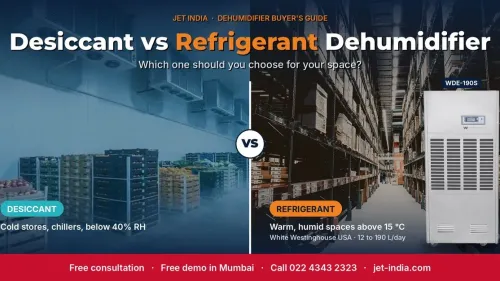
Temperature can influence the performance of a dehumidifier. Different technologies perform differently under different temperature conditions, so it is important to consider the operating environment before selecting a unit.
Some spaces may have relatively warm and humid conditions, while others may experience low temperatures. Warehouses, cold rooms, storage facilities, basements, and industrial areas can have significantly different operating conditions from standard residential environments.
Providing information about the expected temperature range can help determine which type of dehumidification technology is appropriate for the application.
6. Choose Between Portable and High-Capacity Solutions
Dehumidifiers are available in a range of capacities and configurations to suit different applications.
Compact portable dehumidifiers can be suitable for homes, bedrooms, offices, small commercial areas, and other spaces where flexibility and portability are important. They are generally easy to install and operate.
For larger spaces, high-capacity dehumidifiers can provide greater moisture-removal performance. These systems may be suitable for warehouses, production facilities, commercial buildings, storage areas, and other demanding applications.
Before selecting a specific model, it is useful to review the available dehumidifier products and compare their capacities and intended applications.
The right choice depends on the required moisture-removal capacity, operating conditions, desired humidity level, and application.
7. Think About Energy Efficiency
Energy consumption is an important consideration, particularly when a dehumidifier is expected to operate for extended periods. Selecting a unit that is correctly sized for the application can help avoid inefficient operation.
An undersized dehumidifier may need to operate continuously while still failing to achieve the desired humidity level. An unnecessarily oversized unit may also result in higher initial costs and may not be the most appropriate solution for every application.
The goal is to select a system that provides the required moisture-removal performance while operating efficiently under the expected conditions.
8. Consider Continuous Operation Requirements
Some applications require dehumidification for only a few hours each day, while others may require continuous operation. This distinction should be considered when selecting equipment.
Residential users may operate a unit periodically to control humidity in specific rooms. Commercial and industrial facilities, however, may need continuous moisture control to protect products, materials, equipment, or production processes.
For continuous applications, factors such as durability, drainage options, controls, maintenance requirements, and long-term operating performance become particularly important.
9. Look at Maintenance and Drainage
Ease of maintenance should also be considered. Depending on the type and application, a dehumidifier may collect a significant amount of water during operation.
Portable units commonly use a collection tank, which needs to be emptied periodically. Some models may provide continuous drainage options for greater convenience.
Larger systems can be configured with suitable drainage arrangements for longer or continuous operation. Regular cleaning and maintenance can also help maintain performance and extend equipment life.
10. Get Professional Guidance
Choosing the right dehumidifier can sometimes be difficult because capacity requirements depend on several factors. Simply selecting a unit based on room size may not provide an accurate solution for applications with high moisture loads or specialised operating conditions.
Professional guidance can help evaluate the space, humidity level, temperature, application, moisture sources, and operating requirements before recommending a suitable solution.
Learn more about JET INDIA and its approach to providing dehumidification solutions for different applications, from compact requirements to demanding industrial environments.
Find the Right Dehumidifier for Your Requirements
The right dehumidifier is not necessarily the largest or most powerful model. It is the one that matches the actual requirements of your space and application.
Before choosing a dehumidifier, consider the size of the area, current humidity level, temperature, moisture sources, application, operating hours, drainage requirements, and desired humidity conditions. These factors can help determine the appropriate capacity and type of dehumidification system.
From compact portable dehumidifiers for homes and offices to high-capacity solutions for warehouses, commercial facilities, and industrial applications, choosing the right equipment can help improve moisture control, performance, and energy efficiency.
Not sure which dehumidifier is right for you? Get a free quote from JET INDIA and share your space details, application, humidity concerns, and operating requirements. Our team can help you understand your dehumidification needs and choose a suitable model for your application.
Call for Inquiry: 022 4343 2323
Email: inquiry@jetindia.co.in
You can also request a free quote and share details about your space, application, humidity concerns, and operating requirements. Our team will help you understand your dehumidification needs and identify a suitable solution.