

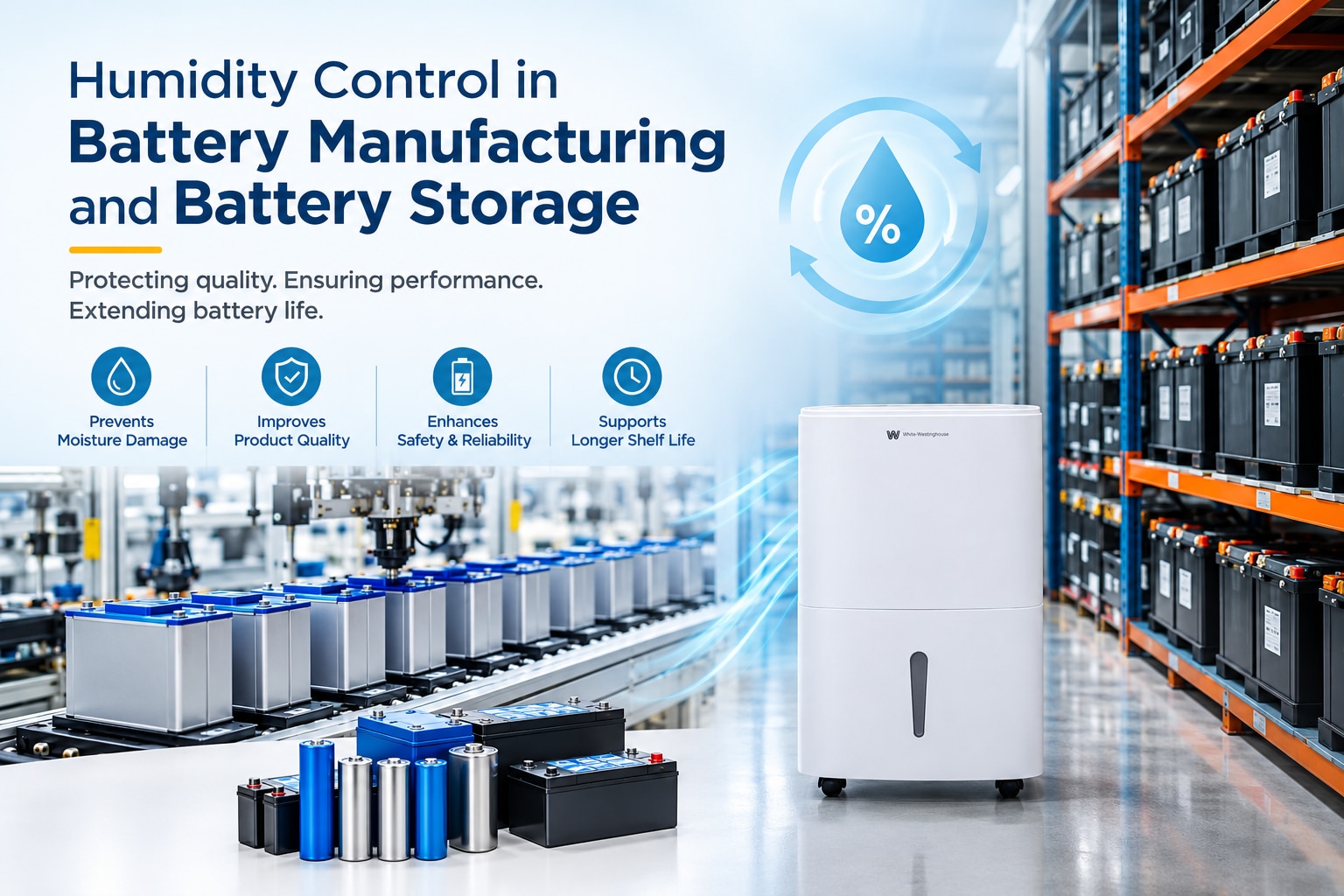
 Batteries look sealed, even though. People are often surprised when we explain that many battery troubles we receive come from the air inside the room.
The calls all sound similar. A dealer opens a monsoon delivery. Sees white crust on battery terminals. A pack assembler finds BMS boards failing tests that had passed last week. A cell line hunts for a capacity drop that turns out to be water, a bit of water that entered before the battery was sealed. Different problems, different causes.
This guide explains where moisture damages batteries, what humidity levels each part of a battery plant or store should have, and how to choose a dehumidifier for the task. Because we are an industrial dehumidifier supplier, we will also be honest about what our range can. Cannot do.
Water and batteries really do not get along.
Start with lithium‑ion batteries. The electrolyte salt in batteries reacts with even tiny amounts of moisture and creates hydrofluoric acid. That acid attacks the cathode, damages the layer on the anode,e and produces gas. Later, batteries show swelling, higher internal resistance, and a shorter cycle life. Electrode coatings and separators also absorb moisture, so on a day they pull water from the air within minutes. Once the battery is sealed, that water stays locked inside forever.
Lead‑acid batteries have their weak spots. Dry‑charged plates oxidise when they pick up moisture before filling,g so a battery that stayed in a damp godown for three months may not give its rated charge on the day. Terminals, lugs and connectors rust. Steel racks and battery trays begin to rust when surface humidity rises above about 60% RH.
Then there is everything around the battery. BMS boards, harnesses, connectors, cartons and labels. Cartons become soft and collapse in stacks. Labels peel. Barcodes stop scanning at dispatch. None of this is dramatic. All of it costs money.
In a battery plant, every zone needs a number.
The driest space in a lithium plant is the room where electrodes are coated, batteries are assembled,d and electrolyte is filled. These rooms operate below 10% RH, 1 to 2% or lower, and are usually specified by dew point, commonly around -40 °C. That is the realm of desiccant dehumidifiers. A refrigerant dehumidifier cools air below its dew point. Its coil would freeze long before it reaches those numbers. If someone offers you a unit for a lithium dry room, ask them to show you the numbers.
The dry room is a small part of the building. Everything around it is where a refrigerant industrial dehumidifier finds its purpose:
Raw material stores: cathode and anode powders, foils and separators should be kept at 40 to 45% RH, so they arrive at the dry room in good shape and do not cake.
Ante‑rooms and corridors that feed the room: every gram of water you remove here is a gram that the expensive desiccant system does not have to handle. Air in Mumbai at 30 °C and 70% RH contains 18.7 g of water per kg of air. Lowering the ante‑room to 25 °C and 50% RH reduces that to 9.9 g/kg. Half the moisture load disappears before the air reaches the dry room door.
Module and pack assembly, BMS and electronics: keep humidity at 40 to 50% RH. Do not go low either. Below 30% RH static electricity becomes a problem around electronics so this band has a lower limit as well, as an upper limit.
Lead‑acid plants: one honest exception is plate curing chambers, which need humidity on purpose, so keep dehumidifiers out of them. However, dry‑charged plate stores and finished goods areas need air,r and that is where we usually come in.
Most battery damage happens after the factory.
Here is the part people underestimate. A battery can leave the plant in good condition and still be damaged in a distributor's godown, a dealer's showroom, om or an EV workshop store.
During the monsoon, ambient humidity in cities such as Mumbai and Chennai can stay at eighty to ninety percent relative humidity for weeks. Rolling shutters remain open all day for loading. Stock waits on the floor. Most cell and battery datasheets ask for dry storage,e and many set the humidity ceiling somewhere around sixty to seventy‑five percent relative humidity. Check your datasheet. Our advice for battery stores is simpler: keep humidity between forty‑five and fifty‑five percent. That keeps metal parts below the sixty percent level where corrosion speeds up.
Condensation is the trap. Air at thirty degrees Celsius and seventy percent relative humidity has a dew point of twenty‑three point nine degrees Celsius. So a pallet of batteries wheeled out of a twenty‑two degrees Celsius air‑conditioned store into that loading bay will sweat within minutes. Water appears on terminals. Water appears inside cartons. The fix is a dry buffer zone where battery stock can warm up before it meets outside air,ir and keeping humidity down in the air‑conditioned store too.
UPS battery rooms, telecom shelters and solar storage containers have an issue. They usually are. People assume that is enough. That is not always true. An air‑conditioner unit switches off once the temperature is satisfied, and humidity quietly creeps up overnight.
Dew point monitoring tells you what a wall gauge will not. A relative humidity reading on its own can fool you because it changes with temperature. The same sixty percent relative humidity holds eight point seven grams per kilogram of water at twenty degrees Celsius and twenty‑one point four grams per kilogram at thirty‑five degrees Celsius. That is then double the moisture behind an identical number on the display.
So for battery work, dew point monitoring is worth the effort. Put a logger in the cell storage,e the ante‑room, and the loading bay. Check it every shift during the monsoon. If the dew point in the battery store climbs above the temperature of your surfaces, you will get condensation, whatever the relative humidity says. Most of our units have a built‑in humidistat, so once you know your target, the machine holds it for you.
Now pick the industrial dehumidifier for each area.
Here is a rough sizing guide for choosing a dehumidifier for your application in a battery plant or store. Treat capacity as a starting point. Door traffic, open shutters and roof leaks change the answer, which's why we would rather see the space first.
Small rooms: BMS labs, UPS battery rooms and sample stores. For rooms up to a hundred square feet,t the AWHD‑12L White Westinghouse Dehumidifier (twelve litres per day) handles a sealed battery room or a small test lab well. If the room has a door that opens often, step up to the AWHD‑20L White Westinghouse Dehumidifier (twenty litres per day).
Mid‑size stores, QC labs and dealer godowns: A dealer’s battery stockroom or a QC and testing area usually suits the thirty to forty litre range. The AWHD‑306L White Westinghouse Dehumidifier (thirty litres per day) and the AWHD‑307L White Westinghouse Dehumidifier (thirty litres per day) both fit here. For a room or a damp basement store, the AWHD‑40L White Westinghouse Dehumidifier (forty litres per day) gives you more headroom.
Pack assembly floors, ante‑rooms and production stores: This is where most battery plants need their capacity. The WDE 606 White Westinghouse Dehumidifier (sixty litres per day) and the WDE‑603T White Westinghouse Dehumidifier (sixty litres per day) suit ante‑rooms and raw material stores. For assembly floors,s look at the WDE 702 White Westinghouse Dehumidifier (seventy litres per day) or the WDE 100 White Westinghouse Dehumidifier (one hundred litres per day).
Large Distribution centres. Big battery warehouses with loading docks need output. The WDE 110S White Westinghouse Dehumidifier (one hundred ten litres per day) is a good base unit. The WDE150S White Westinghouse Dehumidifier (one hundred fifty litres per day) and the WDE‑190S White Westinghouse Dehumidifier (one hundred ninety litres per day) handle the leakiest spaces. In a godown, two or three units spread along its length usually beat one big unit in a corner.
You can compare the range on our industrial dehumidifier category page.
Talk to Our Team
If you are looking for an industrial dehumidifier supplier who will actually walk the plant with you, tell us what you store, how large the rooms are, and what problems you have seen. We will return with the industrial dehumidifier units sized for your space.
📞 Call for inquiry: 022 4343 2323
✅ Free consultation, wherever your plant is in India
🏭 Free demo of the product, available in Mumbai only
