

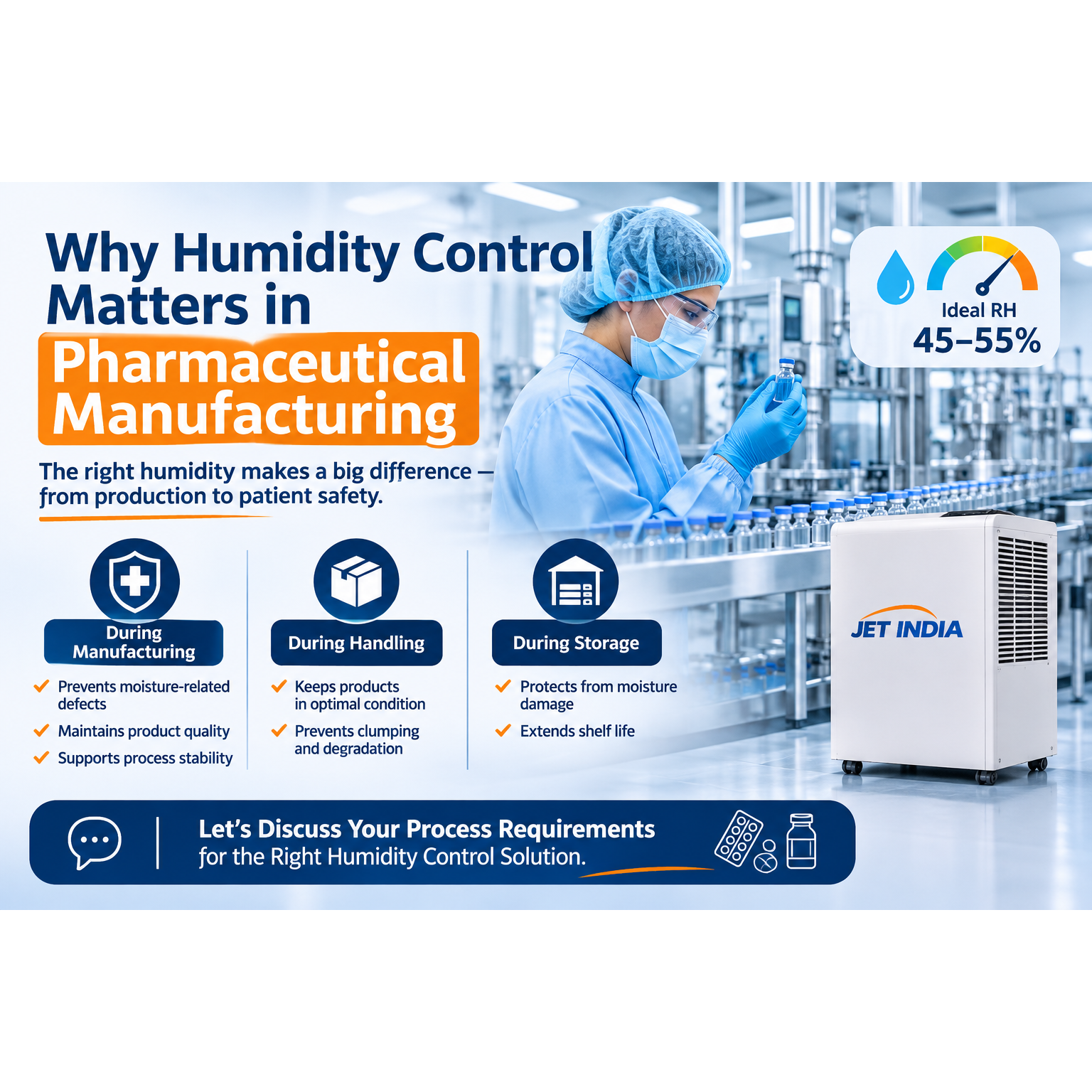
Pharmaceutical manufacturing requires precise environmental conditions to maintain product quality, safety, and effectiveness. Among the various environmental factors, humidity plays a crucial role in ensuring consistent production. Maintaining appropriate humidity levels helps protect raw materials, prevent contamination, preserve product stability, and improve manufacturing efficiency.
Humidity refers to the amount of moisture present in the air. Both high and low humidity can create challenges in pharmaceutical facilities. Excessive moisture may cause product degradation, microbial growth, and material damage, while extremely dry conditions can increase static electricity and affect powder handling.
For pharmaceutical companies at @location, effective humidity management is particularly important for maintaining controlled environmental conditions and meeting pharmaceutical quality standards. Installing a suitable industrial dehumidifier helps protect moisture-sensitive products and supports consistent manufacturing operations.
1. Protects Product Quality and Stability
One of the main reasons humidity control is important in pharmaceutical manufacturing is its impact on product quality and stability. Many pharmaceutical ingredients are moisture-sensitive and can undergo chemical or physical changes when exposed to unsuitable humidity levels.
For example, tablets, capsules, and powdered medicines may absorb moisture from the surrounding air. This can affect their texture, hardness, dissolution rate, and shelf life. Excess moisture may also trigger chemical reactions such as hydrolysis, potentially reducing the effectiveness of active pharmaceutical ingredients (APIs).
Maintaining controlled humidity levels with an industrial dehumidification system helps preserve pharmaceutical products during manufacturing, packaging, and storage. Pharmaceutical manufacturers at @location can benefit from reliable humidity control solutions to minimize product rejection and quality-related losses.
2. Prevents Microbial Growth and Contamination
Moisture creates favourable conditions for the growth of microorganisms such as bacteria, mould, and fungi. Pharmaceutical manufacturing facilities must maintain strict hygiene standards to minimize contamination risks, particularly during the production of sterile medicines and sensitive pharmaceutical formulations.
High humidity can lead to condensation on walls, ceilings, equipment, and other surfaces. These damp conditions may encourage microbial growth and create additional cleaning challenges.
Proper humidity control helps reduce moisture-related contamination risks and supports a cleaner production environment. Pharmaceutical companies at @location should integrate effective dehumidification equipment with proper sanitation, air filtration, and validated cleanroom procedures.
3. Improves Powder Handling and Processing
Powders are widely used in pharmaceutical manufacturing for tablet production, capsule filling, and other formulations. Their physical properties can be significantly influenced by surrounding humidity levels.
When exposed to excessive moisture, pharmaceutical powders may become sticky, form lumps, or lose their free-flowing properties. This can create difficulties during mixing, blending, granulation, compression, and filling operations.
Poor powder flow can also result in inconsistent product weights and variations in ingredient distribution, affecting dosage accuracy.
Maintaining appropriate humidity with an industrial dehumidifier helps preserve powder characteristics, supports smooth processing, and improves consistency across production batches. This makes humidity control equipment an important investment for pharmaceutical manufacturing facilities at @location.
4. Reduces Static Electricity
Although high humidity creates moisture-related problems, extremely low humidity can also affect pharmaceutical manufacturing. Dry air increases the possibility of static electricity buildup, especially when powders, plastic materials, and packaging components move across equipment surfaces.
Static charges can cause pharmaceutical powders to stick to machinery, containers, and production surfaces. This may lead to material wastage, inaccurate filling, and difficulties during equipment cleaning.
Maintaining suitable humidity levels helps reduce static electricity accumulation and supports smoother material handling. The ideal humidity range depends on the specific pharmaceutical product and manufacturing process.
5. Supports GMP and Regulatory Compliance
Good Manufacturing Practices (GMP) require pharmaceutical manufacturers to maintain controlled environmental conditions to ensure consistent product quality and safety.
Humidity is an important environmental parameter that may need to be monitored and controlled depending on the product, manufacturing process, and facility requirements.
Manufacturers must establish suitable environmental limits, maintain monitoring records, investigate deviations, and implement corrective actions when necessary.
An effective humidity control system helps pharmaceutical companies maintain documented environmental conditions and demonstrate compliance with applicable quality and regulatory requirements. Pharmaceutical manufacturers at @location can strengthen their environmental management practices through reliable industrial humidity control solutions.
6. Enhances HVAC System Performance
Heating, Ventilation, and Air Conditioning (HVAC) systems play an essential role in pharmaceutical manufacturing facilities. They help regulate temperature, humidity, air circulation, and filtration to maintain suitable production conditions.
Modern HVAC systems may include cooling coils, humidifiers, dehumidifiers, and automated control systems to manage moisture levels effectively.
Integrating reliable humidity sensors allows facility operators to monitor environmental conditions continuously and respond to fluctuations. Proper humidity management also supports cleanroom operations and protects moisture-sensitive materials.
Choosing the right industrial dehumidifier at @location can help pharmaceutical facilities maintain the required humidity conditions while supporting their existing HVAC systems.
7. Minimizes Production Losses and Operational Costs
Uncontrolled humidity can result in damaged raw materials, rejected batches, equipment maintenance issues, and production interruptions. Moisture-sensitive ingredients may become unsuitable for processing, while static electricity can contribute to material wastage.
These problems increase manufacturing expenses and negatively affect production schedules.
Investing in an appropriate industrial dehumidification system helps minimize these risks, improve operational efficiency, and reduce unnecessary product losses. Pharmaceutical companies looking for cost-effective humidity control solutions at @location should consider equipment that meets their specific production requirements.
8. Maintains Packaging Quality and Shelf Life
Humidity control is equally important during pharmaceutical packaging. Tablets, capsules, and packaging materials can be affected by excessive moisture exposure.
High humidity may compromise certain packaging materials, including paper-based components, labels, and moisture-sensitive protective films. Finished medicines may also absorb moisture before they are properly sealed, potentially affecting their stability and shelf life.
Maintaining suitable humidity during packaging helps protect pharmaceutical products. Manufacturers can also use moisture-barrier packaging, desiccants, and appropriate sealing technologies for additional protection.
An efficient dehumidifier for pharmaceutical packaging areas helps maintain controlled environmental conditions and supports product quality.
Best Practices for Humidity Control in Pharmaceutical Facilities
Pharmaceutical manufacturers should follow a systematic approach to maintain consistent humidity levels. Important practices include:
- Continuous monitoring: Install calibrated humidity sensors in critical production and storage areas.
- Efficient HVAC systems: Use suitable humidification and dehumidification equipment to maintain predefined humidity limits.
- Regular maintenance: Inspect HVAC components, filters, cooling coils, and dehumidifiers to ensure reliable operation.
- Environmental mapping: Conduct temperature and humidity mapping to identify variations across different facility areas.
- Proper documentation: Maintain monitoring records and investigate deviations from established environmental limits.
- Product-specific requirements: Set humidity levels according to product sensitivity, manufacturing processes, and applicable regulatory guidelines.
Conclusion
Humidity control is a vital part of pharmaceutical manufacturing because it directly affects product quality, stability, contamination prevention, and operational efficiency. Both excessive and insufficient moisture can create challenges for raw materials, production equipment, finished medicines, and packaging processes.
Implementing effective HVAC systems, continuous environmental monitoring, and reliable dehumidification solutions helps pharmaceutical manufacturers maintain suitable production conditions and protect product quality.
Looking for effective humidity control solutions for your pharmaceutical manufacturing facility? Contact JET INDIA today to find the right industrial dehumidifier for your needs and maintain optimal humidity levels for a controlled production environment at @location and across India.