

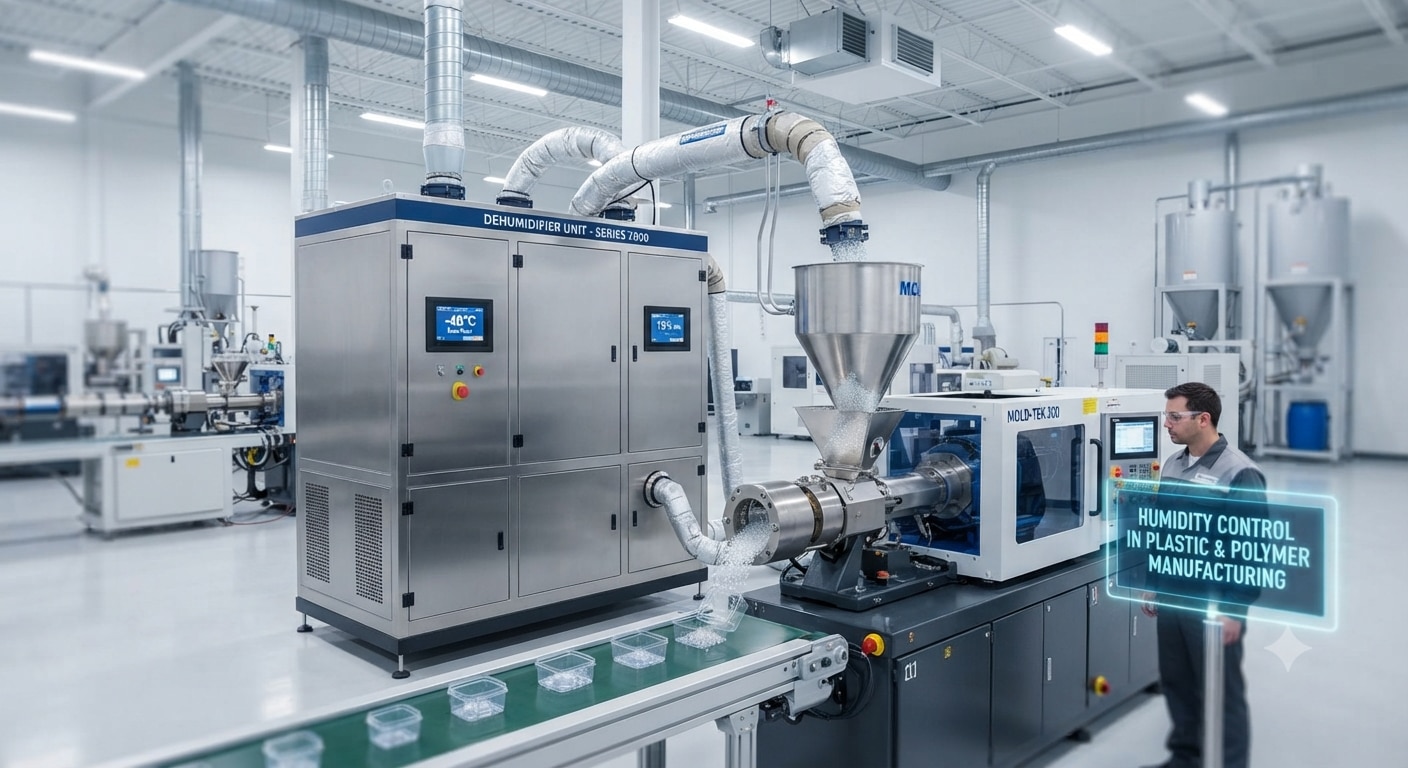
 Ask any moulding supervisor in Mumbai what changed in June, and you'll get the same one-word answer. Rejects. The same press, the same tool, the same resin grade that ran clean in February suddenly starts throwing silver streaks, bubbles, and parts that snap when they should flex. Nobody touched the process. The air changed.
Plastic and polymer manufacturing is far more sensitive to moisture than most people outside the industry realise. Some resins pull water straight out of the air. Chilled moulds sweat. Tool steel rusts on the rack. And finished parts, cartons and control panels all suffer quietly in a humid shed. As an industrial dehumidifier supplier working with plants across India, we get these calls every monsoon, usually after a batch has already gone wrong. So here's a plain guide to where humidity hurts a plastics unit, and what you can actually do about it.
Some plastics drink water. Others just get wet.
Not every polymer reacts to moisture the same way. Polyethylene and polypropylene are largely non-hygroscopic. They don't absorb water into the pellet, though they can still pick up surface moisture and condensation, especially when cool bags are opened on a warm, damp floor.
Then there are the hygroscopic ones. Nylon (PA6 and PA66), PET, polycarbonate, PBT, ABS, acrylic (PMMA) and TPU all absorb moisture into the material itself. Leave an open bag of nylon in a humid godown over a long weekend and it's carrying a lot more water than your datasheet allows.
Why does that matter? Because when wet resin hits a hot barrel, the water turns to steam. You get splay and silver streaks on the surface, bubbles and voids inside, and a dull, patchy finish. With PET, polycarbonate and nylon it's worse, because at melt temperature the water actually breaks the polymer chains. That's hydrolysis. The part looks perfect. It just cracks under load, and that's the kind of defect your customer finds, not your QC.
Your resin dryer is doing more work than it should
Most plants already run hopper dryers or desiccant resin dryers for hygroscopic grades, and that's the right call. Let's be clear upfront: a room dehumidifier doesn't replace a resin dryer. They do different jobs.
But a dryer can only work with what you feed it. Resin that's been sitting in a store at 75% RH arrives at the hopper wetter, so drying takes longer, power use climbs, and on a busy shift the dryer can fall behind. Dried material in an open hopper, a leaky conveying line or a half-used bag starts soaking moisture back up from the room. So a damp store quietly undoes the dryer's work, every single day.
Keeping the resin store and the area around the drying station dry is the cheap half of this problem. It doesn't need anything exotic. It needs the room held below about 55% RH, consistently, right through the monsoon.
Sweating moulds are a dew point problem, not a chiller problem
This is the one that costs the most money, and it's simple physics.
Moulds are usually cooled with chilled water to keep cycle times short. On a normal monsoon afternoon in a Vasai or Bhiwandi unit, the shop floor might sit at 30°C and 70% RH. The dew point of that air is about 24°C. Which means any mould surface colder than 24°C will collect condensation. Water on the cavity face gives you water marks, streaks and surface defects. Water on the tool steel gives you rust.
So what do most plants do? They turn the chiller water warmer until the sweating stops. Problem solved. Except now every cycle is longer, and across three shifts that adds up to a lot of parts you didn't make.
This is where dew point monitoring earns its keep. Bring the air around the press down to 45% RH at the same 30°C and the dew point drops to roughly 17°C. That's about seven degrees of headroom you can hand back to the chiller. The mould runs colder, cycles get shorter, and the cavities stay dry.
One honest caveat. Our range is refrigerant-type, and refrigerant dehumidifiers work best in warm spaces, down to about 40 to 45% RH. If your moulds run really cold, say below 15°C, you'll usually need a desiccant system or an enclosed mould area as well. We'd rather tell you that at the survey stage than sell you a machine that can't get there.
Tools in storage rust faster than anyone expects
A good injection or blow mould is one of the most expensive things in your building. And it's usually stored on a rack in the corner, sprayed with rust preventive and forgotten until the next order comes in.
Steel corrosion speeds up sharply once surface humidity goes above about 60% RH. In a Mumbai monsoon, an unconditioned tool room sits well above that for weeks on end. The result? Pitting on cavity surfaces, rust on ejector pins and slides, and hours of polishing before the tool can go back on the press. For high-gloss or transparent parts, a pitted cavity can mean re-texturing or a scrapped insert.
A dedicated mould store held below 55% RH is one of the easiest wins in a plastics plant. It's normally a small, closed room, so it doesn't need a big machine either.
Finished parts, packaging and panels feel it too
Nylon parts keep absorbing moisture after moulding, and as they do they change size and flexibility. Mould a nylon clip in a dry week, pack it in a damp one, and it may measure differently at your customer's incoming inspection than it did at yours. Not a defect, technically. Still a rejection.
Corrugated boxes soften and lose stacking strength. Printed cartons and labels curl. Film and laminate rolls pick up moisture before conversion. And the drives, PLCs and control panels on every press don't like condensation one bit. None of this is dramatic on its own. Added up over a season, it's real money.
Matching the industrial dehumidifier to each area of your plant
Every plant is laid out differently, but most plastics units break down into the same few zones. Here's how our White Westinghouse range lines up with them. All capacities below are litres of moisture removed per day.
QC labs, small mould stores and instrument rooms
For a closed QC lab, a moisture analyser room or a small tool store, a compact unit is enough. The AWHD-12L (12 L/day) and AWHD-20L (20 L/day) suit tight rooms where you just need to hold RH steady.
Resin stores, packing rooms and mid-size mould stores
For a medium resin store or packing area with doors opening through the shift, look at the AWHD-306L (30 L/day), the AWHD-307L (30 L/day) or the AWHD-40L (40 L/day).
Press bays, drying stations and production floors
Around injection moulding presses, extrusion lines and resin drying stations, the moisture load is a lot higher. The WDE-603T (60 L/day), WDE 702 (70 L/day) and WDE 100 (100 L/day) are each a solid dehumidifier for industrial applications like these.
Large godowns and high-load production halls
For big raw-material godowns, open production halls or older sheds that leak air, step up to the WDE 110S (110 L/day), WDE150S (150 L/day) or WDE-190S (190 L/day). You can also browse our full industrial dehumidifier range here.
Sizing isn't only about floor area, though. It depends on how often doors open, how many people work in the space, whether there's a loading dock, and what RH you're aiming for. That's why we'd rather see the space than guess from a drawing.
Get these four things right before you buy
Measure first. Put a logging hygrometer, ideally one that shows dew point, in each zone for a week. You'll be surprised how different the resin store and the press bay really are.
Close the space where you can. A dehumidifier in an open shed with the shutters up all day is fighting the entire monsoon. PVC strip curtains or air curtains on busy doorways make a big difference.
Plan the drainage. Industrial units pull out a lot of water. Give them a drain point or a continuous drain line instead of relying on someone to empty a tank.
Target the right number. Below 55% RH for resin and mould stores. Around the press, aim for a dew point a few degrees under your coldest mould temperature.
Talk to Our Team
Not sure which unit your plant needs? That's exactly what we're here for. JET INDIA is the authorised distributor of White Westinghouse USA dehumidifiers, and we supply plastics and polymer units right across India.
- Free consultation: tell us about your resin store, press bay or mould room and we'll suggest the right capacity.
- Free product demo: available in Mumbai only.
- Call us for an inquiry: 022 4343 2323
- Visit our office: Contact Us / Visit Our Office
- Explore Our Commercial Dehumidifiers
