
Humidity control is an important part of pharmaceutical manufacturing, processing, packaging, and storage. In pharmaceutical environments, maintaining suitable temperature and humidity conditions can help protect raw materials, finished products, packaging materials, and sensitive processes from moisture-related problems.
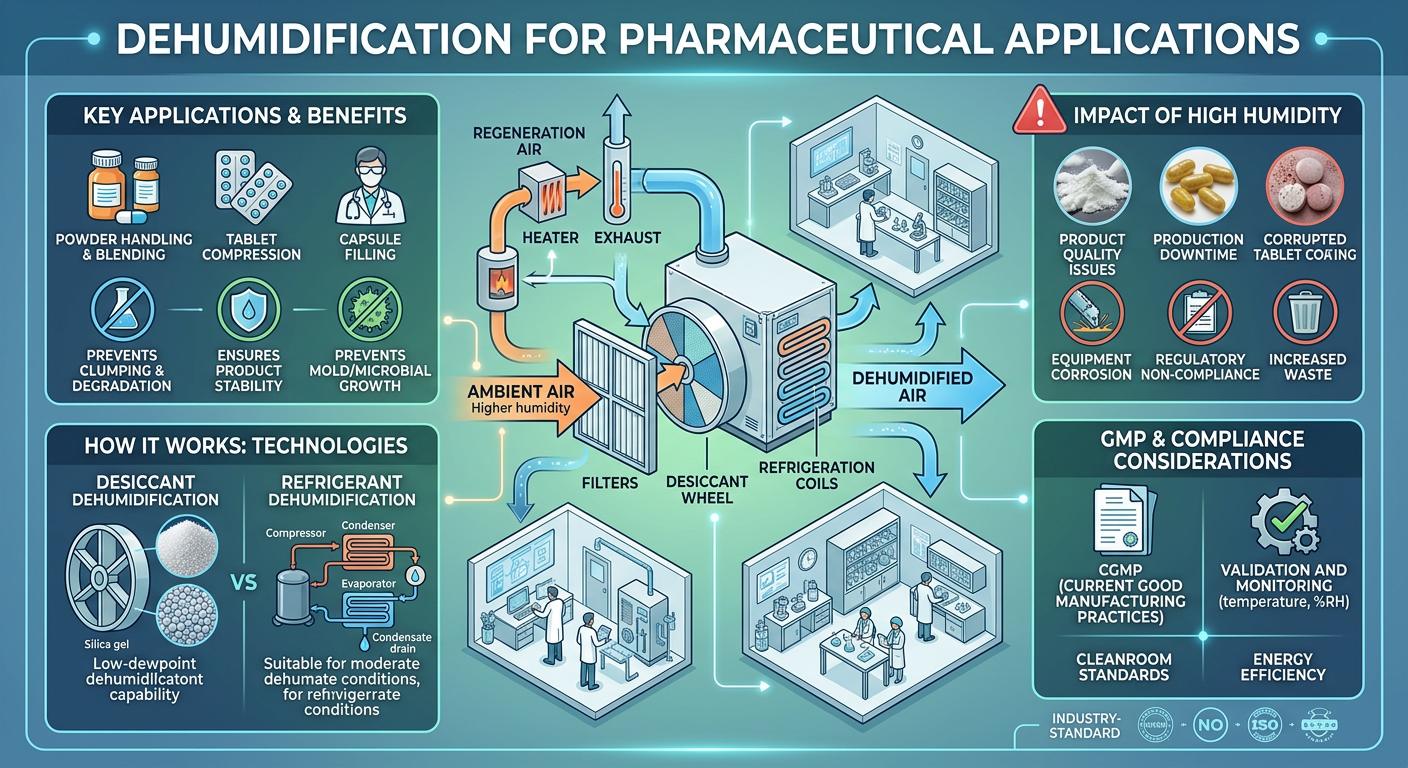
Excess moisture in the air can influence the physical properties of hygroscopic materials, powders, granules, tablets, capsules, and other pharmaceutical products. It can also contribute to issues such as material caking, sticking, degradation, corrosion, microbial concerns, and changes in product handling characteristics. For facilities operating under controlled environmental conditions, effective dehumidification can therefore be an important part of maintaining consistent production and storage conditions.
JET INDIA provides industrial dehumidification solutions for pharmaceutical facilities and other controlled environments in @Location. Our solutions are designed to help businesses manage excess moisture and maintain more stable humidity conditions for a wide range of applications.
Why Humidity Control Matters in Pharmaceutical Facilities
Pharmaceutical manufacturing involves materials and processes that can be sensitive to environmental conditions. While temperature is routinely monitored and controlled, humidity also deserves close attention, particularly where hygroscopic materials or moisture-sensitive products are involved.
When relative humidity increases, materials that readily absorb moisture from the surrounding air can take up water vapour. Depending on the material and process, this may affect its flowability, consistency, stability, or handling characteristics.
For example, powders can absorb moisture and become difficult to handle. They may form lumps, cake inside storage containers, or create flow problems during processing. Granules may behave differently during compression or filling, while certain tablet formulations can become more susceptible to sticking and picking during production.
Packaging materials can also be affected by uncontrolled humidity. Moisture can influence the dimensions, flexibility, strength, or handling characteristics of some materials. In storage areas, maintaining appropriate environmental conditions can help reduce the risk of moisture-related deterioration.
This makes humidity management an important consideration for pharmaceutical production and storage facilities.
Applications Where Dehumidification Can Help
Pharmaceutical facilities can contain several areas where humidity control is required. The appropriate dehumidification approach depends on the process, room conditions, moisture load, temperature, air changes, and required humidity level.
Common applications include:
- Pharmaceutical manufacturing areas
- Tablet and capsule production rooms
- Powder and granule processing areas
- Raw material storage rooms
- Finished product storage areas
- Packaging areas
- Dispensing rooms
- Weighing and sampling rooms
- Quality control and laboratory areas
- Clean and controlled environments
- Production and process rooms
- Warehouses and distribution areas
Each application can have different environmental requirements. A storage room, for example, may have a very different moisture load from an active manufacturing area with frequent personnel movement, air infiltration, cleaning operations, or moisture-generating processes.
Protecting Hygroscopic Pharmaceutical Materials
Many pharmaceutical materials are hygroscopic, meaning they can absorb moisture from the surrounding environment. If the ambient humidity is too high, these materials can gradually take up moisture during handling or storage.
Moisture absorption can influence powder flow, particle behaviour, weighing, mixing, compression, and packaging. In some cases, materials may become sticky or form agglomerates, making them more difficult to process consistently.
Maintaining controlled humidity can help create a more stable environment around these materials. Rather than allowing room conditions to fluctuate significantly throughout the day, a suitable dehumidification system can help manage moisture levels and provide greater environmental consistency.
This can be particularly valuable in facilities where product quality and repeatable processing conditions are important.
Humidity Control During Tablet and Capsule Manufacturing
Tablet and capsule manufacturing can involve moisture-sensitive ingredients and formulations. Changes in environmental humidity may affect the way materials behave during processing.
High humidity can contribute to sticking and picking during tablet compression in certain formulations. Powders and granules may also become less free-flowing, potentially affecting feeding and filling operations.
For capsule production and handling, environmental conditions can also influence the properties of capsule shells and other moisture-sensitive materials.
The appropriate humidity range depends on the specific formulation, process, equipment, and manufacturer's requirements. Dehumidification should therefore be selected based on actual process conditions rather than relying on a general humidity setting for every pharmaceutical application.
Dehumidification for Pharmaceutical Storage
Humidity control is not limited to manufacturing areas. Storage environments can also benefit from effective moisture management.
Raw materials, packaging components, intermediates, and finished products may spend significant periods in warehouses or storage rooms. If humidity levels become excessive, moisture-sensitive materials can be affected during storage even when the manufacturing process itself is properly controlled.
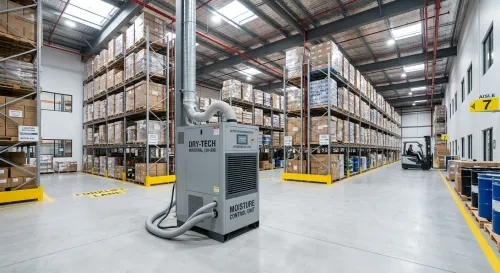
A dehumidification system can help maintain more stable conditions within storage areas, particularly during humid weather or in facilities where outside air enters frequently through doors, shutters, loading bays, or ventilation systems.
Properly assessing the building envelope and moisture load is important when selecting a system. A dehumidifier operating in a tightly controlled storage room has a very different workload from one operating in a warehouse with frequent door openings and substantial outside-air infiltration.
Why Professional Dehumidifier Selection Matters
Choosing a dehumidifier based only on room size may result in an unsuitable system. The required capacity depends on more than the floor area of the room.
Factors that can influence dehumidifier selection include:
- Room dimensions and volume
- Existing temperature and relative humidity
- Desired humidity level
- Outside-air infiltration
- Door and shutter openings
- Number of air changes
- Number of people occupying the space
- Moisture generated by processes
- Cleaning and washdown activities
- Equipment and machinery
- Building insulation and sealing
- Required operating hours
A professional assessment can help determine the actual moisture load and identify the appropriate dehumidification technology and capacity.
JET INDIA works with businesses to understand their application and environmental requirements before recommending a suitable dehumidification solution.
Refrigerant and Desiccant Dehumidification
Different pharmaceutical applications may require different dehumidification technologies.
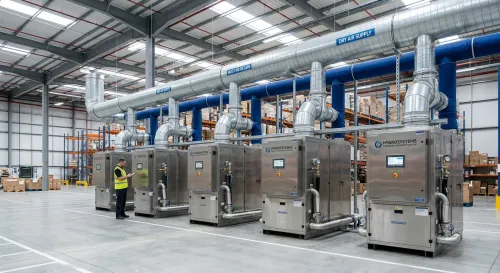
Refrigerant dehumidifiers remove moisture by cooling air below its dew point so that water vapour condenses and can be collected or drained. They can be suitable for many applications where the operating temperature and required humidity range are compatible with refrigeration-based dehumidification.
Desiccant dehumidifiers use a moisture-adsorbing material to remove water vapour from the air. They can be particularly useful where lower humidity levels are required or where the operating conditions are not suitable for conventional refrigerant dehumidification.
The choice between technologies should be based on the required humidity level, room temperature, moisture load, process requirements, and operating conditions.
Humidity Monitoring and Process Control
Effective humidity management starts with knowing what is actually happening inside the facility.
Relative humidity and temperature should be monitored at appropriate locations, particularly in areas where moisture-sensitive materials are handled or stored. Sensors should be positioned to represent the actual environment experienced by the product or process rather than simply measuring conditions near a doorway or other convenient location.
For critical applications, continuous monitoring and data logging can provide greater visibility into environmental fluctuations. This can help facility teams identify humidity trends, investigate deviations, and understand how environmental conditions change during different shifts, production activities, or weather conditions.
Humidity control and monitoring can therefore work together: sensors provide information about the environment, while the dehumidification system provides a means of managing excess moisture.
Dehumidification Solutions in @Location
Businesses operating pharmaceutical facilities in @Location may experience significant seasonal and daily variations in humidity. External weather conditions, building design, ventilation, air infiltration, and operational practices can all contribute to the moisture load inside a facility.
A dehumidification system should therefore be selected according to the specific application rather than using a one-size-fits-all approach.
JET INDIA provides dehumidification solutions for pharmaceutical facilities and other controlled environments in @Location. We can help businesses evaluate their humidity-control requirements and identify a suitable system based on the space, process, operating conditions, and desired environmental parameters.
Whether you require humidity control for a pharmaceutical production room, raw material store, packaging area, warehouse, laboratory, or another controlled environment, understanding the moisture load is an important first step.
Talk to JET INDIA About Your Pharmaceutical Dehumidification Requirements
Maintaining appropriate humidity is an important consideration for pharmaceutical manufacturing and storage. By managing excess moisture, facilities can work toward more consistent environmental conditions and reduce the risk of moisture-related problems affecting materials, products, packaging, and processes.
JET INDIA provides industrial dehumidification solutions for pharmaceutical and other controlled environments in @Location.