

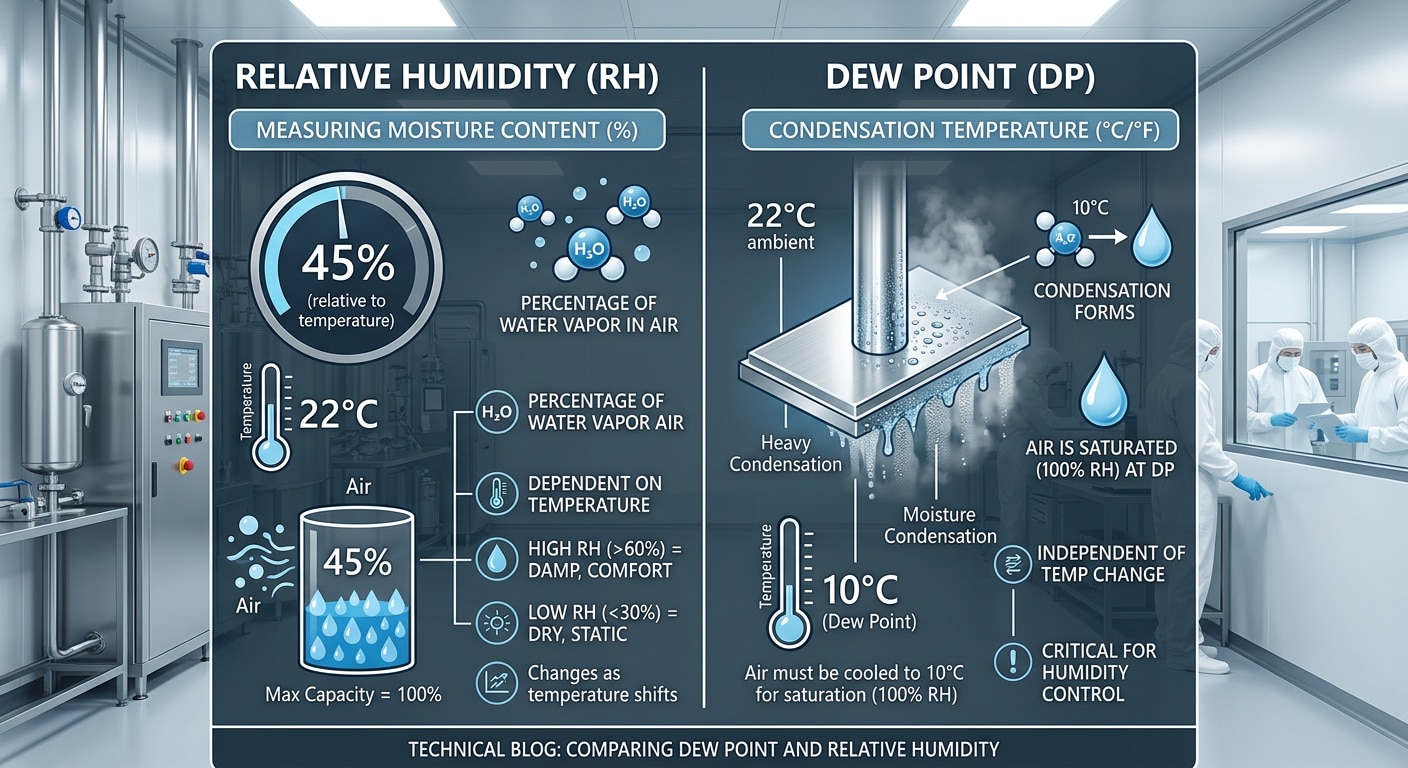
 Everyone quotes a percentage. Almost nobody quotes a temperature.
Every plant has a hygrometer somewhere. Taped to a pillar, screwed in next to the switchboard, occasionally still sitting in its box on a shelf. Ask the maintenance in charge what humidity the process needs and the number comes straight back. Fifty-five percent. Sixty. Whatever the SOP says.
Then ask what temperature that number applies at.
That is usually where the conversation stops. And the gap between a percentage and the condition it was supposed to describe is behind a surprising share of the moisture problems we get called out for. Rusted stock. Caked powder. A cold room that drips onto the pallets every afternoon.
Relative humidity isn't wrong. It's just incomplete by itself. Dew point is the number that finishes the sentence, and as an industrial dehumidifier supplier, it's the number we'd much rather you quoted us.
Relative humidity is a percentage of something that keeps moving
RH compares the water vapour in the air right now against the most that air could hold at whatever temperature it happens to be. Change the temperature and you've changed the bottom half of that fraction, even though not one gram of water has gone anywhere.
Which is how the same reading ends up describing two completely different rooms:
60% RH at 20 °C: about 8.7 grams of water per kilo of dry air.
60% RH at 35 °C: about 21.4 grams. Two and a half times as much.
Same number on the display. Two and a half times the water. If you sized a machine, wrote a storage SOP, or signed off on a supplier's guarantee using the percentage alone, you don't actually know which of those two rooms you bought equipment for.
This is also behind the call we get every monsoon, usually from a night supervisor. Humidity was fine at 6 pm and it's touching 85% at 2 am, so what broke? Nothing broke. The shed cooled down. The air is carrying the same water it was carrying eight hours ago. There's just less room in it now.
Dew point is just a temperature, and it doesn't lie
Dew point is the temperature you'd have to cool the air down to before water starts coming out of it. Get there, and you're at 100% RH by definition.
The useful part is that it only moves when moisture actually moves. Heat the room, cool it, run the fans, watch RH swing forty points over a day. The dew point sits exactly where it was until something physically adds or removes water vapour. That's why process engineers, desiccant designers and anyone specifying compressed air talk in dew point and treat RH as a comfort reading.
It also settles the condensation question without anyone having to make a judgement call. Air at a 24 °C dew point, a chilled water line running at 20 °C: that pipe will sweat. Not might. Will. Anything colder than the dew point collects water, and once you start looking at a plant that way, a lot of the mystery goes out of the job. Find your coldest surface, compare it with your dew point, and you already know whether you have a problem.
What the confusion actually costs
Condensation on cold surfaces. Cold rooms, chillers, chilled water lines, doors that open forty times an hour, steel parts coming out of refrigeration into a warm shed. All of them spend part of the day below the dew point of the air around them. You get wet ceilings, floors people slip on, corroded fittings and batches nobody wants to sign for. Nudging RH down a few points doesn't reliably fix it. Getting the dew point under your coldest surface does.
Rust. Steel starts corroding in earnest once humidity at the surface crosses roughly 60%, and most of the rust we're shown on machined or plated stock isn't really a storage failure at all. The part came out of a cool area into warm wet air and condensed a film of water on itself in about ninety seconds.
Anything that drinks moisture. Powders, effervescent tablets, capsules, salt, sugar, milk powder, spices, seeds, tea, plywood, cartons. They all trade moisture with the air until they settle at equilibrium, and that equilibrium follows the vapour pressure, which is another way of saying it follows the dew point. Caking, clumping, soft cartons, weight complaints: it usually traces back here.
Electronics and coatings. PCB lines, powder coating booths, paint shops, battery work. These fail in ways nobody can reproduce when the spec is written loosely, and a dew point limit is really the only version of the spec worth having.
Mould. Mould has no interest in your room average. It grows where the humidity at the surface exceeds roughly 70%, and a cool north wall reaches that level long before the meter on the opposite wall looks worrying.
Writing a spec nobody can argue with later
Three habits will save you most of the trouble.
Never write RH without a temperature. “50% RH” is an opinion. “22 °C at 45% RH” is a specification, which corresponds to a dew point of roughly 9.5 °C.
Write the dew point when condensation or a hygroscopic product is involved. “Room dew point to be held at or below 12 °C” can't be interpreted two ways, is easy to verify, and doesn't care how hot the shed gets in May.
Go and measure your coldest surface. Measure it, don't estimate it. Your dew point target needs to sit under that reading with two or three degrees to spare.
Now pick the industrial dehumidifier
The dew point you're aiming for decides the technology, which is where all of this stops being theory and starts costing money.
Refrigerant (condensing) units pull air over a cold coil, the water condenses out, and it drains away. They're efficient, cheap to run, and will comfortably hold a space at 40 to 45% RH, which means dew points somewhere around 5 to 10 °C. Take the ambient below about 15 °C and output falls off while the coil starts icing up.
Desiccant units adsorb the moisture onto a rotor instead. You need one if the target is below roughly 40% RH, or if the space itself is cold. Sub-zero dew points, dry rooms, chilled stores: desiccant, no argument.
For most of what we get asked about in India, though, a properly sized refrigerant unit does the job. Warehouses, production halls, packing rooms, QC labs, basements, cold store lobbies. You can see the full industrial dehumidifier range here.
Rough sizing guide: picking a dehumidifier for industrial applications
Small rooms, labs, server rooms, record archives and instrument stores
- AWHD-12L White Westinghouse Dehumidifier — 12 Litres/Day
- AWHD-20L White Westinghouse Dehumidifier — 20 Litres/Day
Mid-size stores, QC labs, packing rooms and basements
Production areas, godowns and process rooms
Large warehouses and leaky, high-load spaces
One caution about those numbers. Litres per day is measured at a stated test condition, usually a warm and wet one, so two machines carrying the same figure on the box can behave quite differently under the conditions you actually run. Send us your room volume, your target, roughly how much outside air leaks in and what's throwing off heat, and we'll size it properly instead of off the sticker.
Based in Mumbai? We'll bring a unit to you. Free demo of the product is available in Mumbai only, so call us, and we'll fix a slot. Contact us here.
