

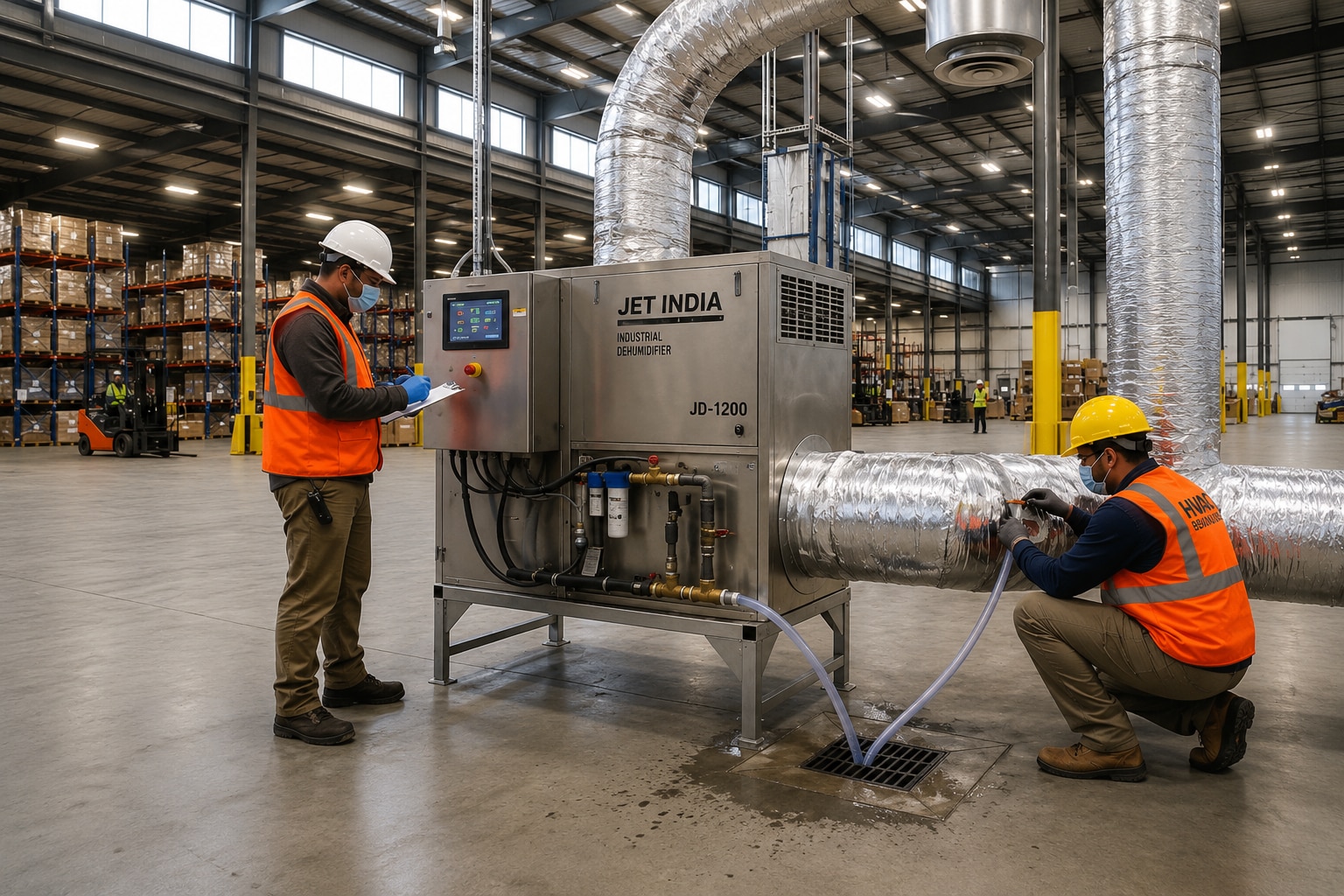
The budget finally gets approved. The dehumidifier shows up on a Tuesday. Somebody wheels it into a corner, plugs it in, and everyone goes back to whatever they were doing. Then, about two months later, we get the phone call. "Your machine isn't working."
And here's the thing — nine times out of ten, the machine is working just fine. It's the installation that's letting everybody down.
An industrial dehumidifier isn't a table fan. You don't just switch it on and walk away. It's process equipment, and it needs the same care you'd give a compressor or a chiller: proper sizing, a sensible spot to sit, somewhere for the water to go, a decent power supply, and someone actually checking it works after it's switched on. Get those right and the unit will hold your humidity for years without complaint. Get them wrong on day one and you'll spend the next decade blaming the machine for something you did to it.
So here are the mistakes we run into most often in Indian factories, godowns, cold stores and pharma units — and, more to the point, what to do instead.
Mistake 1: Sizing by floor area instead of moisture load
This is the big one. Somebody measures the room, finds a sizing chart online, matches the square footage, and orders. Simple, right?
Except floor area tells you almost nothing about how much water you actually need to pull out of the air.
What matters is the moisture load — how much vapour keeps walking into the space every hour. It comes in through doors and gaps. It comes in on wet product straight off the line. It comes off the floor after washdown, off people, off open tanks. And it comes from outside on the worst day of the monsoon, not on the pleasant January afternoon when somebody happened to take a reading.
Put it this way: a 5,000 sq ft dry-goods warehouse with sealed shutters and a 5,000 sq ft food processing hall that gets hosed down twice a shift need completely different machines. The chart doesn't know that. You do.
What to do instead: Work out your load in litres per day, not square feet. Count your door openings. Think about your product. And design for peak monsoon — for most of coastal India that means 85–90% RH outside, not the 60% you see in winter. Then pick a unit with a bit of headroom on top of that. Undersizing is easily the most expensive mistake on this list, because the only real fix is buying a second machine.
Mistake 2: Parking it in a corner
Dehumidifiers dry air. Not rooms. Air.
The only air the machine can do anything about is the air that physically passes through it. So if you shove the unit into a dead corner behind a rack, you'll end up with a lovely dry pocket around the machine while the far end of the hall stays exactly as damp as it was.
We've walked into warehouses and measured 48% RH two metres from the dehumidifier, then walked to the opposite wall and measured 71%. Same room. Same machine. Same afternoon.
What to do instead: Put the unit where its discharge air can sweep down the length of the space and return. Keep the intake clear — no pallets, no drums, no shelving parked in front of it. In long or L-shaped rooms, you're usually better off either ducting the discharge to the far end or running two smaller units placed diagonally instead of one big one in the middle. And once it's running, take RH readings at three or four points around the room. Not just next to the machine, where the number always looks good.
Mistake 3: Treating the drain as an afterthought
A 150 litres/day dehumidifier makes — no surprises here — up to 150 litres of water a day. That's six full buckets before lunch.
And yet we keep finding units running on the internal tank with nobody assigned to empty it. So the machine trips on a full tank at two in the morning and sits there doing nothing until the day shift wanders past and notices.
The other version of this one is the drain hose that runs slightly uphill, or kinks behind a leg, or empties into a floor drain that backs up every washdown.
What to do instead: Plumb a proper gravity drain from day one. Consistent downward fall, no low points where water can sit and turn into a science experiment. If the nearest drain happens to be higher than the outlet, fit a condensate pump — they're cheap. In cold stores, insulate or trace-heat the line so it doesn't freeze up. And glance at the drain path once a month. It takes thirty seconds.
Mistake 4: Running a dehumidifier in a leaky building
You can't dehumidify the outdoors. Nobody can.
If the shutter door stays open all shift for forklift traffic, or there's a 40 mm gap under the personnel door, or an exhaust fan is quietly sucking humid outside air in through every crack in the wall — the machine will run flat out and still lose. It's condensing water as fast as it can. It just can't outrun what's coming in.
This is the one that gets blamed on the equipment more than any other, and it's rarely the equipment.
What to do instead: Seal the building before you commission the unit, not after. Door seals, brush strips, close up the cable and pipe penetrations, strip curtains or air curtains on the openings that see real traffic. Have a look at your ventilation too — an exhaust fan running without matched make-up air will pull humid air in from wherever it can find it. Do all that and you'll often discover you need less dehumidification capacity than you were bracing yourself for.
Mistake 5: Forgetting about room temperature
Refrigerant dehumidifiers work by condensing moisture onto a cold coil, and how well they do that depends a lot on how warm the air hitting that coil is. Rated capacity is normally quoted at 30°C and 80% RH. At 15°C the very same machine will pull noticeably less water. Below about 10°C the coil starts icing up unless the unit has proper defrost control.
Which is why sticking a standard unit in a 4°C cold room and expecting nameplate performance is a recipe for disappointment.
What to do instead: Match the technology to the temperature. For normal spaces — 18°C and up — a refrigerant unit is efficient and easy on running cost. For chilled rooms and genuinely low-temperature work, you want hot-gas defrost or a desiccant system. Just tell your supplier the real operating temperature of the room. Not the outdoor temperature. The room.
Mistake 6: No humidistat, or a setpoint somebody made up
Leaving a dehumidifier on continuous mode forever burns electricity and can over-dry sensitive product. But running it at a setpoint nobody can actually justify isn't much better.
We've seen 40% RH targets in ordinary warehouses that would have been perfectly happy at 55%. We've also seen 60% targets in powder handling areas that genuinely needed 45%. Both cost money, in different ways.
What to do instead: Set the target from the product, not from habit. General warehousing usually sits fine at 50–55% RH. Electronics, powders and hygroscopic ingredients typically want 40–45%. Archives and equipment rooms tend to land around 45–50%. Then use the built-in humidistat, and mount the sensor away from the discharge air so it reads the room instead of the machine. Log it for the first two weeks so you know the setpoint is actually being held rather than just displayed.
Mistake 7: Leaving no room to service it
Filters need cleaning. Coils need washing. Sooner or later somebody's going to need to get behind the thing with a spanner.
Bolt it 100 mm off a wall with a pallet stack parked in front and none of that happens on schedule. And a clogged filter can knock a third off your capacity while the compressor works harder to deliver what's left.
What to do instead: Leave a minimum of 300–500 mm around the intake and discharge faces, and keep the service panel accessible. Paint or tape a keep-clear zone on the floor — it sounds fussy, but it works. Then put filter cleaning on the PM calendar: fortnightly in dusty environments, monthly everywhere else.
Mistake 8: Skipping commissioning entirely
Plugging it in isn't commissioning.
Without a baseline, you've got no way of telling whether the machine is performing well, slowly drifting, or quietly on its way out.
What to do instead: Note the RH and temperature at a few points before you switch on, then log the pull-down over the first 48 hours. How long does it take to reach setpoint? How often does it cycle once it's there? Write it down. That baseline becomes your early-warning system — the day pull-down starts taking twice as long, you'll know something needs attention long before anyone starts complaining about damp cartons.
So which unit do you actually need?
Since sizing is where good installations begin, it helps to think in tiers.
For smaller enclosed spaces — server rooms, QC labs, record rooms, packing bays, site offices — the compact AWHD-12L (12 Litres/Day) and AWHD-20L (20 Litres/Day) will usually do the job. Need a bit more? The AWHD-306L (30 Litres/Day), AWHD-307L (30 Litres/Day), and AWHD-40L (40 Litres/Day) handle mid-sized rooms with a fair bit of door traffic.
For production areas, medium warehouses, and storage halls where the doors are opening all day, the mid-capacity range does the heavy lifting — the WDE-603T (60 Litres/Day), WDE 606 (60 Litres/Day) and WDE 702 (70 Litres/Day).
And when the load is properly industrial — food processing halls, cold storage anterooms, big godowns, pharma plants, indoor pool halls — you'll want the high-capacity units: the WDE 100 (100 Litres/Day), WDE-110P (110 Litres/Day), WDE 110S (110 Litres/Day), WDE150S (150 Litres/Day) and WDE-190S (190 Litres/Day).
The full range is on our Industrial Dehumidifiers page. And if you're honestly not sure which tier your application falls into — that's a much better question to ask before you order than after.
Talk to Our Team
Almost every mistake on this list costs nothing to prevent and quite a lot to fix. A ten-minute conversation about your room, your doors, your product and your target RH will get you further than any sizing chart on the internet.
Call us on 08048038959. Please keep the 0 before dialling the number. For a free consultation and sizing recommendation. Our engineers will help you pick the right capacity, suggest where to place it and how to route the drain, and talk you through commissioning it properly.
Free product demo available in Mumbai only. Come and see a White Westinghouse dehumidifier running in real conditions before you commit to anything.
Free Consultation | Contact Us | Call for Inquiry | Call Us | Email Us
Contact Us / Visit Our Office Explore Our Commercial Dehumidifiers
