
Excess humidity can have a significant impact on industrial operations, affecting raw materials, machinery, packaging, finished products, storage conditions, and overall production efficiency. In many industrial environments, maintaining the right level of humidity is essential for protecting products, preserving equipment, improving working conditions, and supporting consistent manufacturing processes. When moisture levels become too high, businesses may experience condensation, corrosion, material deterioration, packaging issues, microbial growth, and other moisture-related challenges.
Industrial dehumidification systems provide an effective way to manage excess moisture and maintain controlled environmental conditions. By continuously removing unwanted moisture from the air, industrial dehumidifiers can help create a more stable environment for warehouses, manufacturing facilities, pharmaceutical units, food-processing plants, storage areas, and a wide range of other industrial applications.
For businesses operating in @location, effective humidity management can be especially important during periods of high ambient moisture. A properly designed industrial dehumidification system can help maintain more stable indoor conditions despite changes in the external environment.
Why Humidity Control Matters in Industrial Environments
Humidity is the amount of moisture present in the air. While a certain level of humidity is normal, excessive moisture can create challenging conditions for industrial processes and storage facilities. Temperature fluctuations can also cause moisture in the air to condense on surfaces, machinery, products, walls, ceilings, and packaging.
Uncontrolled humidity can affect the quality and durability of raw materials and finished products. Materials that are sensitive to moisture may absorb water from the surrounding air, potentially changing their physical properties or reducing their usable life. In storage facilities, prolonged exposure to high humidity can also contribute to deterioration and other environmental problems.
Effective humidity management helps businesses maintain more consistent environmental conditions and reduce the risks associated with excess moisture. This is particularly relevant for industrial facilities in @location, where seasonal and environmental conditions can make moisture control an important operational consideration.
Protecting Raw Materials and Products
Many raw materials require carefully controlled storage conditions. Paper, textiles, chemicals, powders, metals, plastics, food ingredients, pharmaceutical materials, and other moisture-sensitive products can be affected by excessive humidity.
For example, moisture can influence the condition of powders and hygroscopic materials, while high humidity may contribute to corrosion of metal components. Packaging materials may also lose their intended performance when exposed to uncontrolled moisture for extended periods.
Industrial dehumidifiers can help maintain suitable humidity levels within storage and production areas, helping businesses protect valuable materials and minimize moisture-related deterioration.
Supporting Manufacturing Processes
Humidity can influence several stages of industrial production. Depending on the application, uncontrolled moisture may affect processing conditions, material handling, drying, coating, assembly, storage, and packaging.
A controlled environment can help production teams maintain more predictable operating conditions. Dehumidification may be particularly useful in facilities where moisture-sensitive materials are processed or where temperature and humidity need to remain within defined operating ranges.
By reducing excess moisture, industrial dehumidification systems can contribute to a more stable production environment and support consistent process performance.
Reducing Corrosion and Moisture-Related Damage
High humidity can create favorable conditions for corrosion, particularly when moisture comes into contact with metal surfaces. Machinery, tools, electrical components, storage racks, pipelines, and other industrial assets may be exposed to moisture in humid environments.
Over time, uncontrolled moisture can contribute to equipment deterioration and increase maintenance requirements. Keeping humidity under control can help create a drier environment around sensitive equipment and stored materials.
For facilities where machinery and metal components are particularly vulnerable to moisture, an appropriately designed dehumidification system can form an important part of the overall environmental-control strategy.
Dehumidification for Warehouses and Storage Facilities
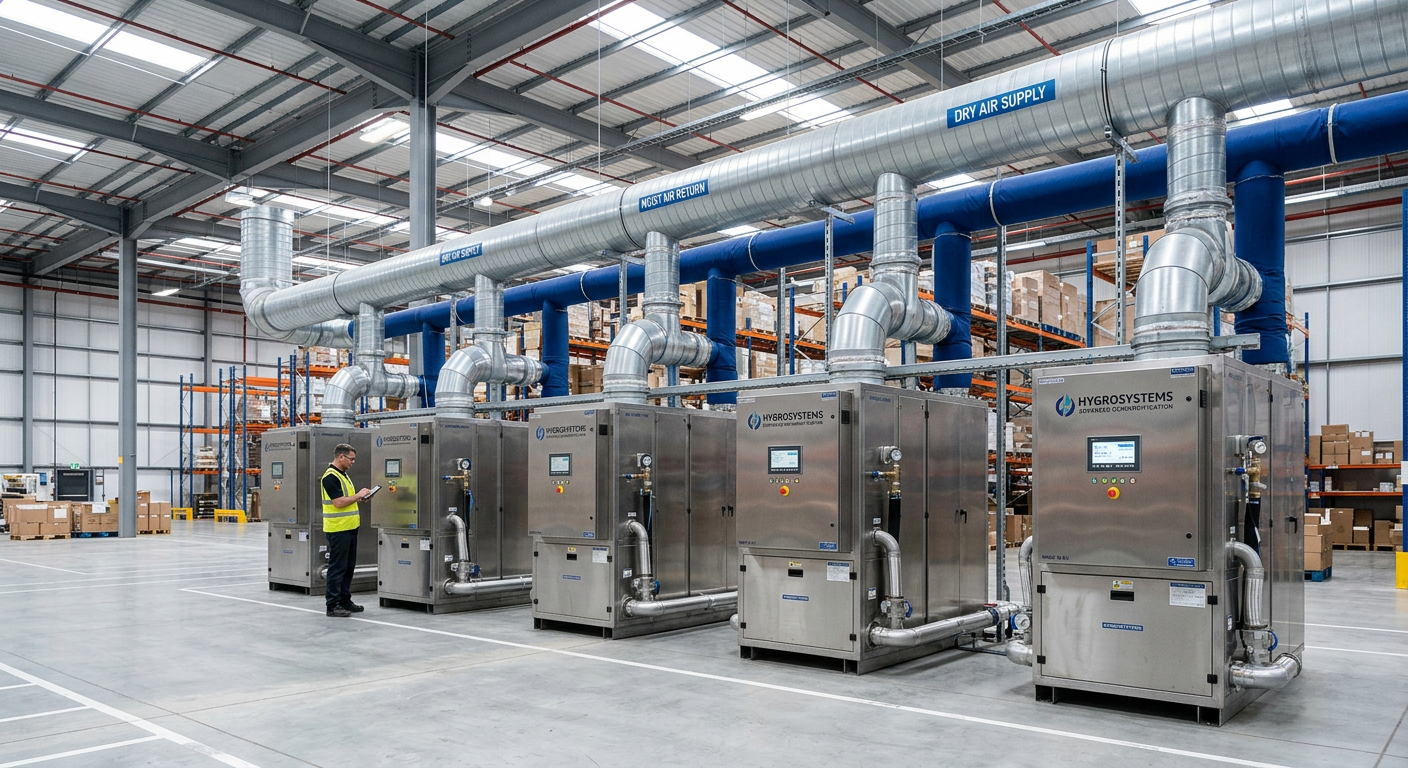
Warehouses often contain large quantities of raw materials, packaging materials, components, and finished products. Maintaining suitable storage conditions can be challenging, particularly in regions with high ambient humidity or during humid seasons.
Excess moisture can enter storage areas through ventilation, doors, air leakage, and normal environmental conditions. Without adequate moisture control, humidity levels may rise and create unfavorable storage conditions.
Industrial dehumidifiers can help warehouses maintain a more controlled atmosphere by removing moisture from the air. This can be useful for warehouses storing moisture-sensitive materials, metal products, packaging, electronics, pharmaceuticals, food products, and other industrial goods.
Pharmaceutical and Healthcare Applications
Pharmaceutical manufacturing and storage environments often require carefully controlled conditions. Moisture can affect certain raw materials, formulations, powders, packaging materials, and finished pharmaceutical products.
Humidity control can therefore be an important part of maintaining suitable environmental conditions in pharmaceutical facilities. Industrial dehumidification systems can help control moisture levels in manufacturing areas, storage rooms, processing spaces, and other areas where environmental conditions need to be carefully managed.
The specific humidity requirements can vary depending on the product, process, facility design, and applicable standards. A properly selected dehumidification solution should therefore be designed around the individual requirements of the application.
Food Processing and Storage
Food-processing facilities can also benefit from effective humidity management. Moisture levels can influence the handling, processing, storage, and packaging of various food products and ingredients.
In certain applications, excessive humidity may contribute to condensation, product-quality concerns, caking of powdered ingredients, packaging difficulties, or unfavorable environmental conditions.
Dehumidification can help provide a more controlled environment for production and storage areas. By managing excess moisture, facilities can support better process conditions and protect moisture-sensitive ingredients and products.
Packaging and Product Protection
Packaging plays an important role in protecting products throughout manufacturing, storage, transportation, and distribution. However, packaging materials themselves can be sensitive to environmental humidity.
Paper, cardboard, labels, films, and other packaging components may respond to changing moisture conditions. Excessive humidity can influence their strength, dimensional stability, appearance, and handling characteristics.
Maintaining appropriate humidity within production and packaging areas can help create more consistent conditions for packaging operations. This is particularly important for industries where packaging quality and product protection are critical.
Creating Better Environmental Conditions
Humidity control is not only about protecting products and machinery. A controlled indoor environment can also contribute to better operating conditions within industrial facilities.
High humidity can make an environment feel uncomfortable and can contribute to condensation on surfaces and equipment. Managing moisture can help create a cleaner, drier, and more controlled workplace environment.
The appropriate humidity range depends on the application, facility, materials, equipment, and process requirements. A professional assessment can help determine the most suitable approach for each industrial facility.
Choosing the Right Industrial Dehumidification System
Every industrial facility has different humidity-control requirements. Factors such as room size, air volume, temperature, moisture load, operating hours, process conditions, ventilation, door openings, and the nature of the materials being stored or processed can influence system selection.
Choosing a dehumidifier based only on room size may not provide the desired results. A proper application assessment helps determine the required moisture-removal capacity and suitable system configuration.
JET INDIA can help businesses evaluate their industrial humidity-control requirements and identify a suitable dehumidification approach based on the specific application.
For industrial facilities in @location, selecting a system according to local environmental conditions and the facility's specific moisture load can help achieve more reliable humidity control.
A Reliable Approach to Moisture Management
Effective industrial dehumidification is about more than simply removing moisture from the air. The system should be appropriately selected, installed, and operated according to the conditions of the facility.
A well-planned solution can help businesses manage humidity more effectively across manufacturing areas, warehouses, storage facilities, pharmaceutical units, food-processing plants, packaging areas, and other industrial spaces.
With suitable humidity control, businesses can work toward reducing moisture-related problems, protecting valuable materials and equipment, and maintaining more consistent environmental conditions.
Talk to JET INDIA About Your Dehumidification Requirements
If excess humidity is affecting your industrial facility, products, machinery, storage conditions, or production processes, an industrial dehumidification solution may help provide better moisture control.
JET INDIA offers industrial dehumidification solutions designed to address different moisture-control requirements across a variety of industrial applications. Whether you need humidity control for a warehouse, manufacturing facility, pharmaceutical unit, food-processing plant, packaging area, or another industrial environment, selecting the right system begins with understanding your specific application.
If you are looking for an industrial dehumidification solution in @location, contact JET INDIA to discuss your humidity-control requirements and explore a suitable solution for your facility.
Call for Inquiry
Phone: 022 4343 2323
Email: inquiry@jetindia.co.in