

Here's a quick test. Walk onto your shop floor right now and ask anyone what the humidity is. You'll probably get a shrug. Maybe a guess. Or someone will point at a dusty little dial on the wall that nobody has checked, cleaned or calibrated since the day it went up.
And that's the whole problem, really. Humidity is the one thing in a factory that damages everything it touches — cartons, powders, adhesives, coatings, PCBs, steel, labels, finished stock sitting in the warehouse — but it does the damage slowly. Nobody blames the air. People blame the supplier, the operator, the machine, the batch. The air just carries on quietly ruining things.
The fix isn't expensive or complicated. You need to know what to measure, where to put the sensors, how often to look, and what to actually do when the number goes the wrong way. Let's go through it.
First, Know Which Number You Actually Need
People say "humidity" like it's one thing. It isn't. There are three numbers here, and mixing them up is where most factories trip.
Relative Humidity (RH) is the one everybody quotes. It's the percentage of moisture the air is holding compared to what it could hold at that temperature. Useful — but here's the catch. It moves when temperature moves, even if the actual water in the air hasn't changed one bit. Room cools down overnight, RH climbs. Sun comes up, RH drops. Same water. Different reading. That trips people up constantly.
Dew point is the temperature at which that air starts condensing. It doesn't swing around with room temperature, which makes it far more honest. So if your worry is water forming on a chilled mould, a cold pipe, a stainless tank or the inside of a cold-room door — look at dew point. Not RH.
Absolute humidity is simply how much water is in the air, in grams per kilogram of dry air. This is the number you want when you're sizing a dehumidifier, or working out how much moisture strolls in through the loading bay every time the shutter goes up.
Easy way to remember it: RH for your process limits, dew point for condensation, absolute humidity for sizing equipment.
What You Actually Need to Buy
You don't need a lab. Three levels of kit will cover almost any plant — and honestly, the whole lot usually costs less than one bad week of moisture-related rejects.
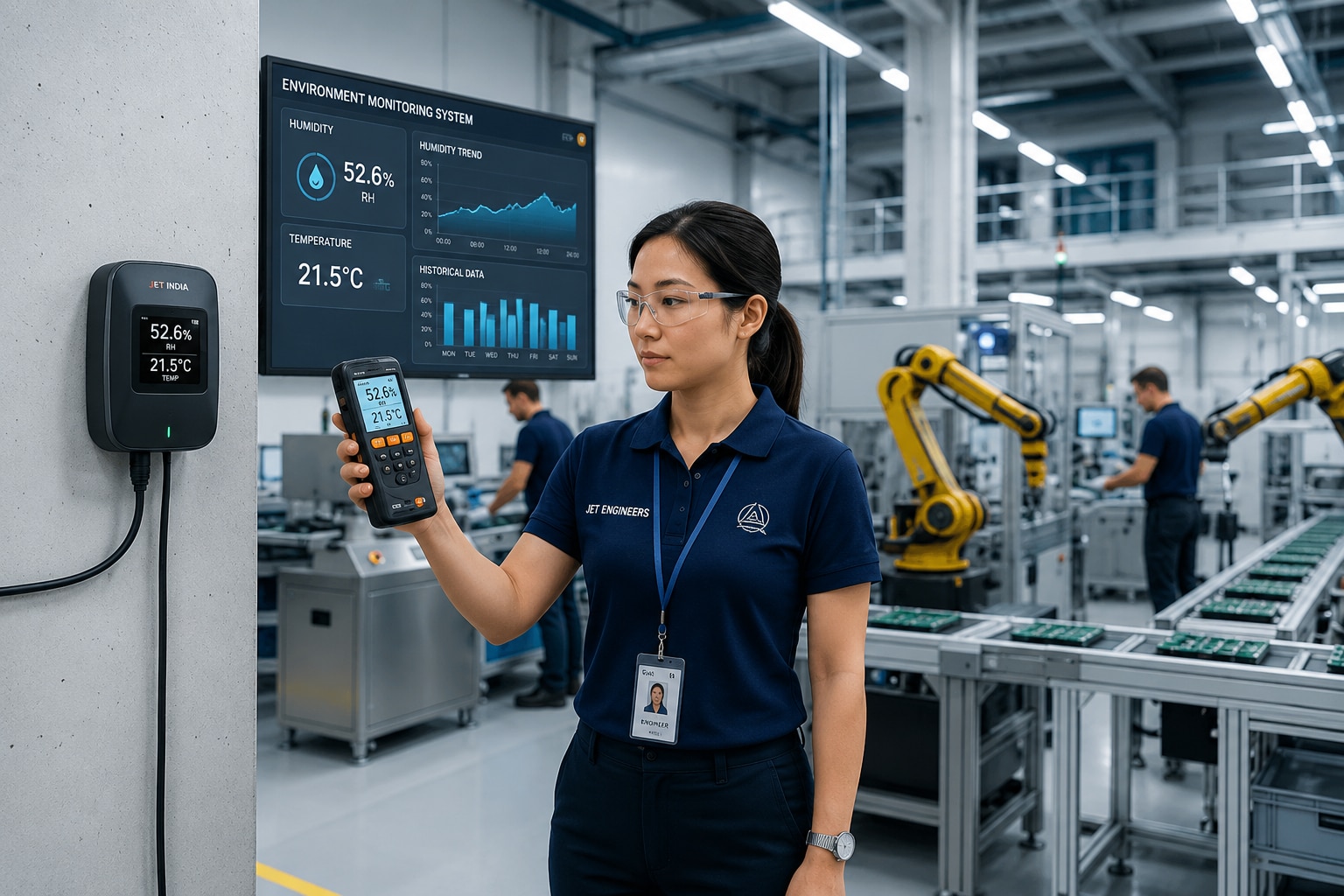
Digital thermo-hygrometers are your starting point. Wall-mounted, clear display showing RH and temperature, one in each production zone at working height. Get units with min/max memory so a supervisor can walk in at 8 am and see what happened at 2 am. And check the spec — you want ±2–3% RH accuracy. If the datasheet is vague about accuracy, it's a decoration, not an instrument.
Data loggers are where things get interesting. A spot reading tells you one moment. A logger tells you the story. Set it to record every 5 to 15 minutes and within a week you'll spot things you'd never catch by eye: the spike every single time the dock shutter opens at shift change, the slow overnight climb when the HVAC shuts off, the monsoon baseline that creeps up in June and simply never comes back down.
Standalone USB loggers are fine for audits or a two-week trial. For anything permanent, go with wireless sensors that push readings to a dashboard and fire off an SMS or email when a limit is crossed. That extra spend is worth it, because it changes humidity from something you find out about later into something you get told about now.
A reference instrument keeps everyone honest. A handheld psychrometer or portable dew-point meter lets you cross-check the fixed sensors, sweep the floor for damp pockets, and prove your numbers during an audit. In pharma, food or medical device plants, make sure it comes with a traceable calibration certificate — you'll be asked for it.
One more thing. If you already run a BMS or SCADA system, feed RH and dew-point transmitters straight into it. Humidity then sits right next to temperature and pressure as a proper process parameter, with trends, alarms and history built in. That's the strongest setup there is.
Sensor Placement Is Where Most Plants Get It Wrong
This is the bit that gets rushed, and it's the bit that decides whether your data means anything at all. One sensor near the office door tells you about the office door. That's it.
Split the plant into zones and treat each one on its own merits. Raw material stores, mixing and blending, the line itself, drying or curing areas, packing, finished goods, the QC lab, the electrical and server rooms — they all behave differently and most of them want different set points.
Inside each zone, mount sensors at working height, around 1.2 to 1.5 metres, where the product and the people actually are. Keep them out of direct sun, away from AC grilles and fan discharge, clear of anything hot, and at least a metre off external walls and doors.
Then put sensors near the doors, docks, drains and fresh-air intakes as well. That's where moisture gets in. Think of those as your leak detectors.
Don't ignore what's happening above your head, either. Warm damp air rises. If you're stacking on high racking, a sensor at floor level can read perfectly fine while the top pallets sit in a completely different, much wetter microclimate. Tall warehouse? Measure high and low.
And put one sensor outside. Sounds unnecessary, but it gives context to everything else — especially through the monsoon, when outdoor dew points in a coastal city like Mumbai stay high for weeks and every door opening becomes a moisture event.
How Often to Check, and What to Do About It
Continuous logging is the goal. On top of that, have an operator note a manual reading at the start of every shift. That manual entry matters more than it sounds — it keeps humidity in the daily conversation instead of buried in a file nobody opens.
Set three limits per zone, not one. A normal operating band. A warning level that triggers a check. A critical level that stops or diverts production. Write them on the wall next to the sensor, and spell out the response for each one. "High humidity" isn't an instruction anybody can follow. "Above 65% RH — close the dock shutter and switch the unit to continuous" is.
Look at the trends weekly, not just after something goes wrong. You're hunting for slow drift, seasonal shifts, spikes that repeat at the same time each day, and any zone that's been quietly out of spec for a month. Nearly every moisture failure shows up in the logs long before it shows up in the product.
And calibrate. Sensors drift — roughly 1% RH a year, faster in dusty or chemically harsh air. Once a year against a reference or a salt-solution check is the bare minimum; every six months is better for your critical zones. An uncalibrated sensor is genuinely worse than no sensor at all, because it makes you confident about a wrong number.
Measuring Is Half the Job. Fixing It Is the Other Half.
Data doesn't dry anything out. Once your monitoring shows which zones run wet and by how much, the answer is a properly sized dehumidifier in those zones — and now you can size it on real numbers instead of a hunch.
For smaller, high-value spaces — QC labs, instrument rooms, electrical panels, server and UPS rooms, small stores — something modest does the job. The AWHD-12L (12 litres/day) and AWHD-20L (20 litres/day) suit these rooms nicely. Where the load is a bit heavier — a packing bay, a small drying room, a records archive — look at the AWHD-306L (30 litres/day), AWHD-307L (30 litres/day) or AWHD-40L (40 litres/day).
Mid-sized production halls, assembly lines and medium warehouses need more pull. The WDE-603T (60 litres/day), WDE 606 (60 litres/day) and WDE 702 (70 litres/day) are the workhorses here — they'll hold a steady RH band right through a full shift.
For big factory floors, high-ceiling warehouses, cold-store anterooms and any process throwing off serious moisture, step up to the WDE 100 (100 litres/day), WDE-110P (110 litres/day), WDE 110S (110 litres/day), WDE150S (150 litres/day) or WDE-190S (190 litres/day). These are built for continuous industrial duty and work well on humidistat control, so your monitoring and your dehumidification end up as one loop instead of two separate jobs.
Want to see the full range side by side before you decide? Have a look through our Industrial Dehumidifiers.
Talk to Our Team
Not sure where the sensors should go, what set points your process really needs, or which capacity fits your floor area? Tell us about your plant and we'll work it out with you. No obligation, no pressure.
Free consultation on humidity monitoring and dehumidifier sizing for your facility
Free product demo — Mumbai only. See a White Westinghouse unit running at your site before you commit.
Call for inquiry: 08048038959. Please keep the 0 before dialling the number.
Free Consultation | Contact Us | Call for Inquiry | Free Demo in Mumbai | Call Us | Visit Our Office
