

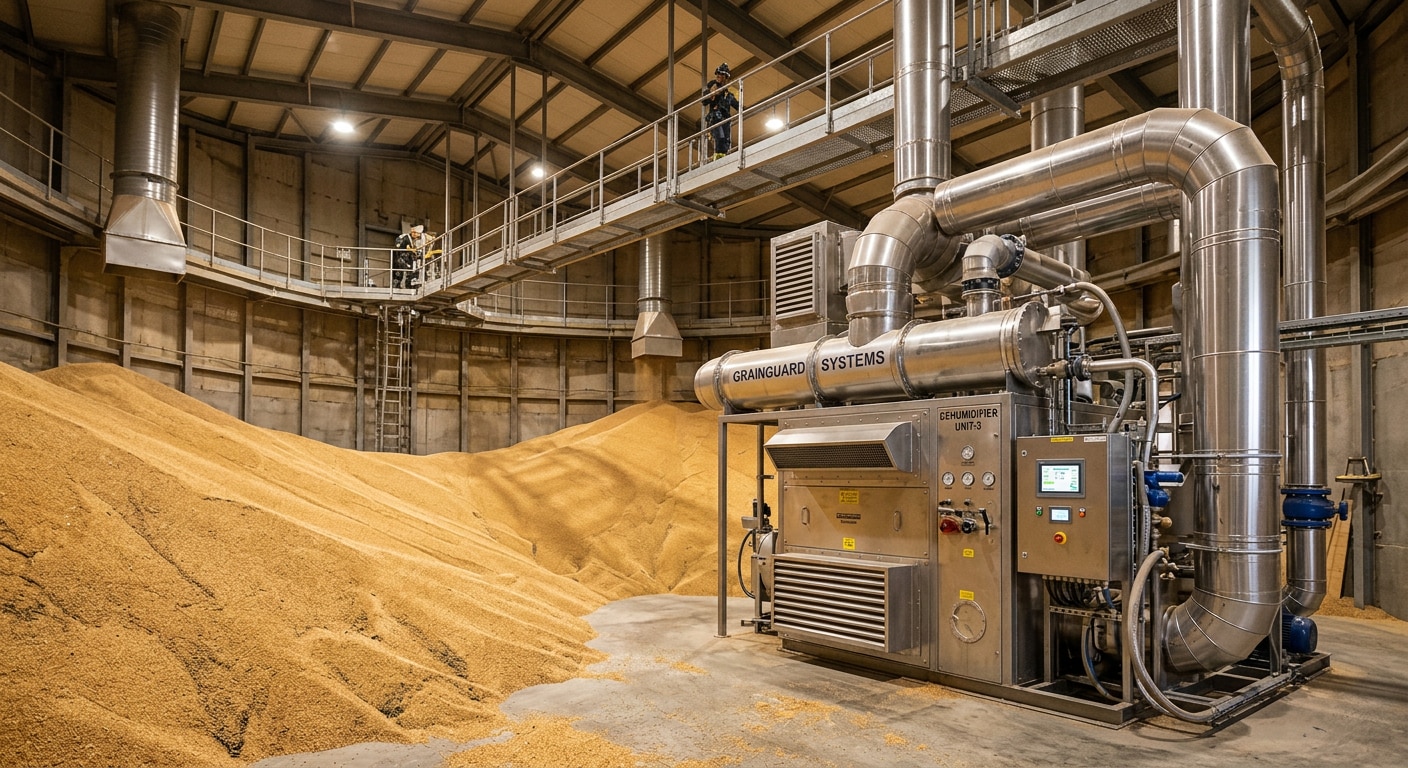
Ask anyone who runs a godown in India what keeps them up at night, and you'll rarely hear "theft" or "power cuts." You'll hear something far less dramatic: moisture. A warehouse can be spotless, well-guarded and fully insured, and still lose lakhs of rupees worth of wheat to a monsoon week nobody planned for. Grain doesn't spoil loudly. It spoils quietly, from the inside of the stack outward, and by the time you can smell it, the damage is already several tonnes deep.
That's the uncomfortable truth about grain storage. The commodity you're protecting is hygroscopic — it breathes. It pulls moisture out of the air when the air is damp, and gives it back when the air is dry. Which means the air inside your facility isn't just the space around your stock. It is part of your stock's condition. Control the air, and you control the grain.
Grain doesn't sit still — it exchanges moisture with the air
Every grain has what's called an equilibrium moisture content: the moisture level it will naturally drift towards, given the temperature and relative humidity around it. Store wheat at 75% RH and it will slowly climb to roughly 14–15% moisture, no matter how well it was dried before it arrived. Store the same wheat at 55–60% RH, and it will settle comfortably around 11–12%, which is where it needs to be for safe long-term holding.
That difference of two or three percentage points sounds trivial. It isn't. It's the difference between grain that holds for eight months and grain that develops hot spots by week six. Paddy and rice behave the same way, sitting safe around 12–14%; maize is notoriously more sensitive; pulses, oilseeds and spices each have their own threshold. But the underlying principle never changes — grain moisture follows air humidity, and if you're not managing the air, you're not managing the grain.
Here's what makes Indian conditions especially punishing. Ambient relative humidity in Mumbai, Kolkata, Chennai, Kochi and most of coastal India sits between 80% and 95% for four months of the year. Inland, humidity swings hard between day and night. Grain that was dried perfectly at the mill can absorb enough moisture in a single humid fortnight to cross into the danger zone — and once it does, drying it back down is expensive, slow, and often damages quality.
The four losses that humidity causes
Mould and mycotoxins - This is the one that costs the most and gets discussed the least. Storage fungi — Aspergillus and Penicillium species — need a water activity of roughly 0.70 to get going, which corresponds to about 70% relative humidity in the air around the grain. Below that, they're dormant. Above it, they multiply. Aspergillus flavus is the real problem child: it produces aflatoxin, a carcinogen with strict regulatory limits in India and even stricter ones in export markets. One rejected consignment on aflatoxin grounds can wipe out a season's margin and put a buyer relationship in doubt. And you can't wash it off, sort it out or heat it away.
Insects - Weevils, lesser grain borers, khapra beetle — every stored-grain pest breeds faster in warm, damp conditions. Damp grain also supports the fungal growth that some of these insects feed on, so the two problems reinforce each other. Facilities that hold RH in the 50s consistently report longer intervals between fumigation cycles, which means lower chemical costs and less residue risk.
Caking, clumping and flow problems - Moisture makes grain and milled products stick. In a silo or hopper, that means bridging and rat-holing that stall discharge. In bagged storage, it means the bottom layers of a tall stack compress into a solid mass. In flour, atta, besan and spice powders, it means lumping that gets your product rejected at the packing line before it ever reaches a customer.
Weight, germination and grade - Grain that has to be re-dried loses weight — and you sell by weight. Seed grain that has absorbed moisture loses germination percentage, which is the entire value of seed stock. And graded grain that slips a grade on moisture or damaged-kernel count fetches a lower price at the same volume. These aren't dramatic losses. They're the slow leak that shows up as a margin you can't quite explain.
Why ventilation alone doesn't solve it
The instinct in most facilities is to open up and run exhaust fans. In dry weather, that helps. During the monsoon, it actively hurts — you're pulling in air at 90% RH and pushing it across your stock. Ventilation only removes moisture when the outside air is drier than the inside air, and for a large part of the Indian year, it simply isn't.
Air conditioning isn't the answer either. AC is built to remove heat; moisture removal is a side effect that stops the moment the thermostat is satisfied. In a warehouse with high thermal mass and low occupancy, the compressor cycles off long before the air is dry — and you're left with a cool, damp space, which is arguably worse than a warm, damp one, because cool surfaces invite condensation.
Then there's sweating: warm humid air meeting cool silo walls, metal roof sheets or the underside of a tarpaulin, condensing into droplets that fall directly onto the grain surface. That's how you get a perfectly good silo with a mouldy crust on top.
A dehumidifier does the one job the other two don't. It removes water from the air continuously, independent of temperature, and holds the space at a target RH. That's the whole point.
Choosing the right capacity for your facility
Grain facilities are rarely one big open space — they're a set of zones with very different requirements, and the sensible approach is to match capacity to each.
For quality control labs, seed stores, sample rooms, weighbridge offices and small cold-chain anterooms, compact units do the job well. The AWHD-12L (12 Litres/Day) and AWHD-20L (20 Litres/Day) suit smaller enclosed rooms, while the AWHD-306L (30 Litres/Day), AWHD-307L (30 Litres/Day) and AWHD-40L (40 Litres/Day) handle seed storage rooms and packing prep areas where germination and moisture spec really matter.
For mid-sized godowns, bagging halls, milling floors and dispatch bays — the spaces with doors opening constantly and forklifts moving through — you need more extraction and more airflow. The WDE-603T (60 Litres/Day), WDE 606 (60 Litres/Day) and WDE 702 (70 Litres/Day) are built for exactly this kind of working environment.
For large warehouses, silo enclosures, bulk storage sheds, and export consolidation areas, choose high-capacity industrial units. The WDE 100 (100 Litres/Day), WDE-110P (110 Litres/Day) and WDE 110S (110 Litres/Day) cover large floor areas, and where you're fighting monsoon load across a very big volume, the WDE150S (150 Litres/Day) and WDE-190S (190 Litres/Day) give you the headroom to hold setpoint even when the doors are open half the day.
If your operation is large enough that you're thinking in terms of zones rather than rooms, browse the full Industrial Dehumidifier range — that's where the units designed for continuous heavy-duty duty cycles live.
Getting it right in practice
A few things set apart facilities that solve this from those that keep fighting it. Target 55–60% RH rather than chasing the lowest possible number — over-drying costs you saleable weight. Put humidity sensors at floor level, mid-stack height, and near the roof, because the readings will differ more than you'd expect. Keep continuous drainage plumbed in so nobody has to empty a tank during a busy shift. Seal the obvious leaks — dock gaps, roof vents, cable entries — before adding capacity, since a dehumidifier can't win against an open building. And run through the monsoon rather than switching on after you notice a problem; recovery always costs more than prevention.
Talk to Our Team
Every facility is different — stack height, roof type, door traffic, commodity and season all change the sizing maths. We'll help you work it out properly instead of guessing.
Call for Inquiry: 08048038959. Please keep 0 before dialling the number..
Book a Free Consultation — a moisture-load assessment for your godown or silo, at no cost.
Free Demo of the Product — Mumbai only — see a unit running in your own facility before you commit.
