

Here's a conversation we have almost every week. A factory manager calls up, describes rusting tools, peeling labels, and a store room that smells like a wet towel, and then says the line we've heard a thousand times: "But we already have air conditioning."
Fair enough. On paper, the two machines look like cousins. Both hum. Both have compressors and coils. Both pull moisture out of the air. So why would anyone buy a second box when the first one is already running?
Because they were built to solve two different problems. An air conditioner exists to make air cooler. A dehumidifier exists to make air drier. Those sound like the same thing on a sticky July afternoon in Mumbai, but they aren't — and the gap between them is where most humidity damage quietly happens.
What your AC is really doing with moisture
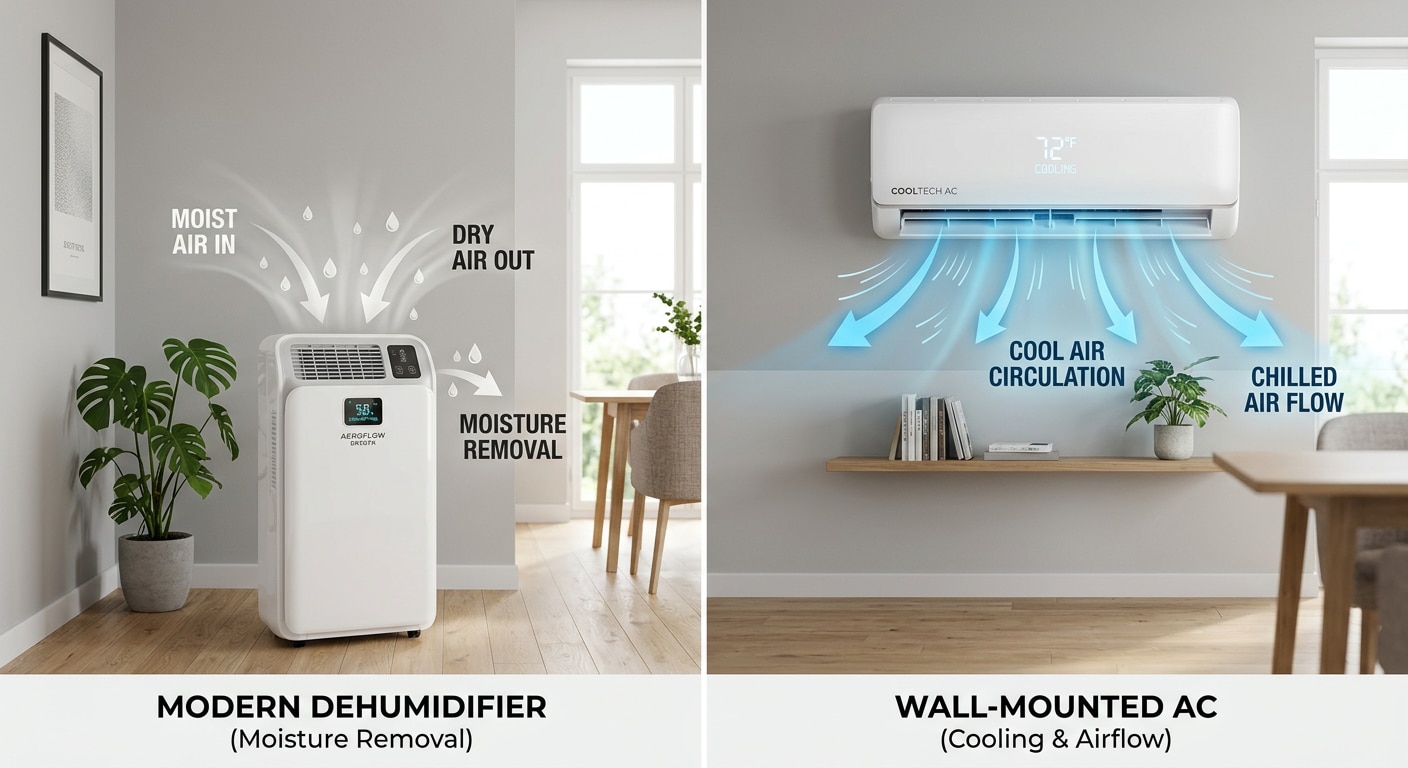
An air conditioner removes water almost by accident. Warm room air passes over a cold evaporator coil, the air chills below its dew point, and water condenses on the coil and drips away. That's the puddle under your split unit's outdoor pipe. Useful, definitely. But it's a by-product, not the mission.
The mission is temperature. Your AC has exactly one instruction from its thermostat: get the room to 24°C. The moment it hits that number, the compressor shuts off. And a compressor that isn't running isn't drying anything. So on a mild, drizzly monsoon day — 26°C outside, 88% relative humidity — the AC satisfies its thermostat in a few minutes and then sits idle while the humidity stays exactly where it was. Cool and clammy. You've felt it.
There's a second issue. Air conditioners are usually sized generously so they cool fast. Fast cooling means short run cycles, and short run cycles mean less contact time between air and coil, which means less condensation. An oversized AC can actually leave a room more humid than a right-sized one. Not what most people expect.
What a dehumidifier does differently
A dehumidifier is built around moisture removal from the first bolt. Room air is drawn in and pushed across a refrigerated coil, water condenses out and collects in a tank or drains away continuously — and then, crucially, the now-dry air passes over the condenser coil and is reheated before it returns to the room.
That reheat step is the whole story. Because the machine gives the heat back, it isn't fighting your temperature. It just removes grams of water per hour and leaves the thermostat alone. It's controlled by a humidistat, not a thermostat, so it runs until the air reaches the RH you asked for — 50%, 45%, 35%, whatever your process needs — and holds it there.
An air conditioner might drop a room from 80% RH to 65% on a good day, in passing. A dehumidifier will take it to 45% and keep it there through the night, through the monsoon, and through the winter when the AC isn't even switched on. That last one matters more than people realise: December and January in coastal India are damp, cool months. Nobody runs the AC. Everybody's stock still absorbs moisture.
Where the difference starts costing real money
If this were only about comfort, you could shrug it off. It isn't.
Above roughly 60% RH, mould and mildew spores start colonising surfaces. Above 65%, corrosion rates on bare steel climb sharply. Cardboard cartons lose compressive strength and stacks start leaning. Powders cake. Tablets soften. Adhesive labels lift at the corners. Electronics develop tracking faults nobody can diagnose. Wooden floors cup. Paint blisters. And a cold store with high humidity doesn't just spoil product — it grows ice on the evaporator, which chokes airflow and pushes the refrigeration bill up month after month.
Then there's the energy argument, which surprises people. Trying to dehumidify with an air conditioner means overcooling the space so the compressor keeps running — you're paying to remove heat you didn't want removed, and often paying again to reheat. A dehumidifier removes a litre of water for a fraction of that energy because that's the only job it's doing. In a room where humidity is the actual problem, the dedicated machine is almost always the cheaper machine to run.
The honest summary: use an air conditioner when people are too warm. Use a dehumidifier when things are getting damp. Most Indian facilities need both, and they work beautifully together — the AC handles sensible heat, the dehumidifier handles latent load, and neither one has to do the other's job badly.
Choosing the right size for the space
Capacity is measured in litres of water extracted per day, and picking it isn't guesswork. It depends on room volume, how much outside air leaks in, how many people or wet processes are inside, and how low you need the RH to go. A sealed archive room is a very different animal from a loading bay with doors opening every four minutes.
For homes, small offices, server rooms, clinics and single storerooms, the compact AWHD range is usually the right starting point. The AWHD-12L, 12 Litres/Day suits a bedroom, wardrobe room or small record store. The AWHD-20L, 20 Litres/Day steps up for a living area or small lab. For medium rooms with a steadier moisture load, there's the AWHD-306L, 30 Litres/Day and the AWHD-307L, 30 Litres/Day, and where you need a little more headroom the AWHD-40L, 40 Litres/Day handles basements, gyms and larger clinics comfortably.
Once you move into commercial territory — packing halls, hotel basements, indoor pool decks, mid-sized cold rooms, printing floors — the WDE mid-capacity units take over. The WDE 606, 60 Litres/Day and the WDE-603T, 60 Litres/Day both cover this band with continuous drainage, while the WDE 702, 70 Litres/Day gives you extra margin for spaces with frequent door traffic or a wet process running through the shift.
For genuine industrial duty — warehouses, food processing lines, pharma storage, seafood and cold-chain facilities, data centres, museum and archive vaults — you want the heavy units. The WDE 100 - 100 Litres/Day is a solid workhorse for large halls. The WDE-110P - 110 Litres/Day and WDE 110S - 110 Litres/Day add capacity in portable and stationary configurations. Where the moisture load is relentless, the WDE150S - 150 Litres/Day and the flagship WDE-190S, 190 Litres/Day are built to run continuously without complaint.
Not sure which band you fall into? Browse the full Industrial Dehumidifier range — or simply tell us your room dimensions and target RH and we'll size it for you. That takes about ten minutes on a call and saves a lot of guessing.
A simple way to decide
Ask yourself what's actually bothering you. If people are complaining about heat, that's an air conditioning question. If you're seeing condensation on walls, rust on fittings, a musty smell that returns every year, soft cartons, clumping powder, spotted labels or a hygrometer sitting stubbornly above 60% — that's a humidity question, and no amount of extra tonnage will fix it.
Buy the machine that matches the problem. It's cheaper, it works, and you stop replacing damaged stock.
Talk to Our Team
Not sure whether you need a dehumidifier, an air conditioner, or both? Our engineers will look at your space, your process, and your target humidity level and recommend the right capacity — no obligation.
Call us: 08048038959. Please keep 0 before dialling the number.
Free consultation with a humidity control specialist
Free demo of the product — available in Mumbai only. Call us to book a slot.
Explore Our Industrial Dehumidifiers
