

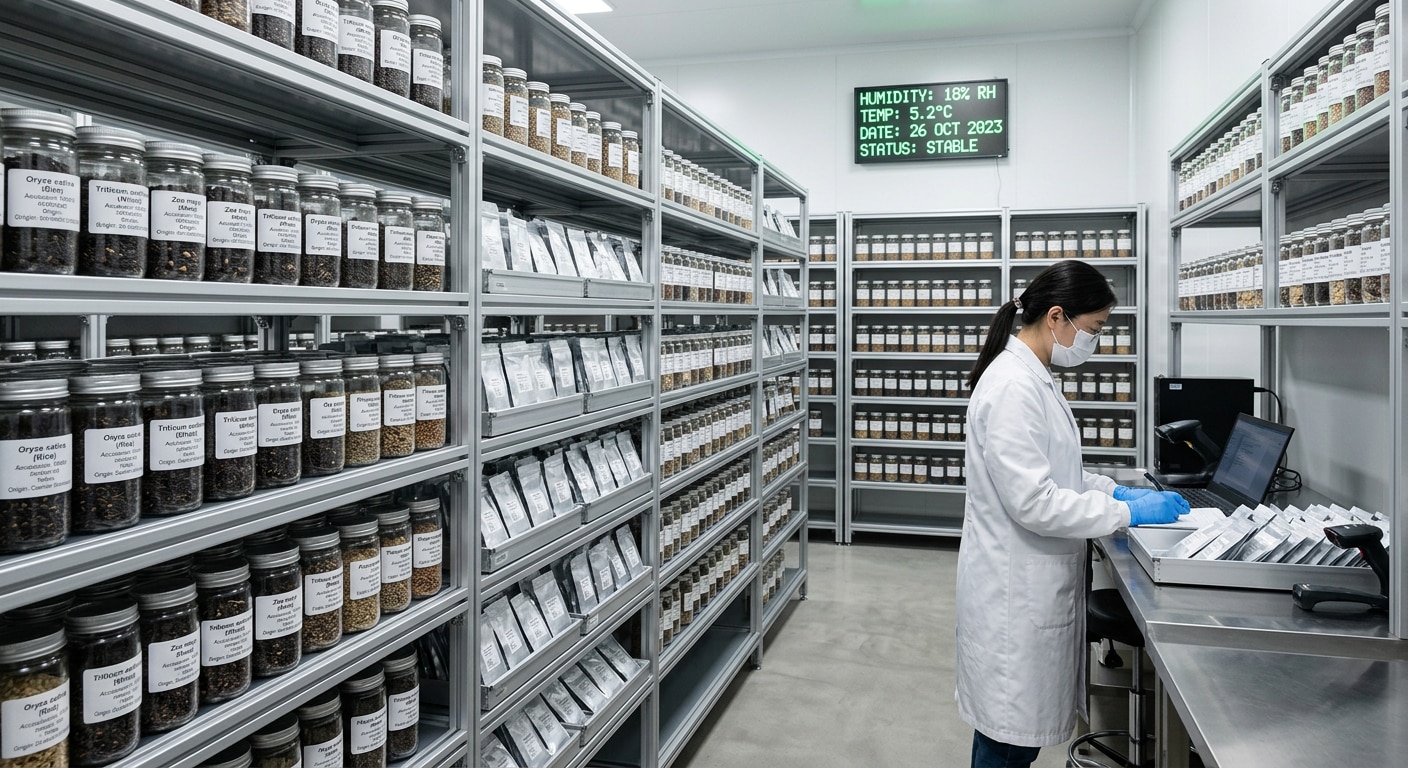
Practical humidity-control guidance for seed companies, genebanks, farmers, nurseries and researchers across India.
Every seed is a small, living package of the next harvest. Inside its coat sits an embryo that is quietly breathing, ageing and waiting for the right moment to grow — and how long it can wait depends, more than anything else, on the moisture in the air around it. Whether you are a seed producer protecting a season's inventory, a genebank safeguarding rare varieties, or a farmer holding back grain for next year's sowing, viability is your real asset. Lose it and you lose
germination, vigour, yield and money. In India, where warm, humid and monsoon-heavy conditions push relative humidity well above 70–80% for months at a time, uncontrolled humidity is the single biggest threat to stored seed.
Seeds Are Alive — And Moisture Decides How Long They Last
Most crop seeds — cereals, pulses, oilseeds, most vegetables and many flowers — are what scientists call orthodox seeds: they tolerate drying and store best when kept dry. Because seeds are hygroscopic, they constantly exchange moisture with the surrounding air until their internal moisture content reaches equilibrium with the room's relative humidity. The higher that humidity, the more moisture the seed holds — and the faster it breathes, burns through its stored energy reserves, and ages. Damp seed respires harder, self-heats, and loses germination capacity long before any mould is visible. Keeping the storage air dry is therefore not a luxury; it is the most powerful, most affordable lever you have over seed life.
What High Humidity Does to Stored Seed
When seed is held in humid air, the damage stacks up quickly and is usually irreversible:
• Loss of germination and vigour: high moisture accelerates seed ageing, so even seed that still sprouts produces weaker, slower, less uniform seedlings.
• Mould and fungal growth: storage fungi colonise damp seed, discolouring it, killing embryos and, in crops like groundnut and maize, raising the risk of harmful aflatoxins.
• Insect and pest activity: weevils, borers and mites all breed fastest in warm, humid grain, hollowing out seed and spreading through a store.
• Heating and caking: respiration and microbial activity release heat and moisture, causing seed to clump, crust and form hot spots inside bags and bins.
• Costly rejections: seed lots that slip below the certified germination standard cannot be sold as seed and must be down-graded, wiping out margins.
The Rule of Thumb: Drier and Cooler Doubles Seed Life
Seed scientists use a famous pair of rules of thumb attributed to James Harrington: within the safe range, every 1% reduction in seed moisture content roughly doubles storage life, and every 5°C reduction in temperature does the same. In practice this means small improvements in your storage air pay back enormously over time. For general orthodox seed storage, aim to hold the room at a dry, stable 30–40% relative humidity; long-term genebank storage goes further, drying seed to low moisture content at around 15% RH and cool temperatures. As with any store, stability matters as much as the set-point — seed that is repeatedly re-wetted and re-dried ages faster than seed held steadily dry. A controlled-humidity environment locks in those gains around the clock, monsoon or dry season.
Where Controlled-Humidity Seed Storage Matters
Any operation that holds seed between seasons benefits from active humidity control. The environments we most often help protect include:
• Seed companies — processing halls, packing lines and finished-goods stores
• Genebanks, agricultural universities and research institutes conserving germplasm
• Farmer producer organisations (FPOs) and cooperatives holding sowing seed
• Nurseries and horticulture units storing vegetable, flower and tree seed
• Spice, pulse and grain traders protecting quality and weight
• Home gardeners and hobby growers keeping saved seed viable
Warning Signs Your Seed Store Is Too Humid
You do not need a laboratory to spot trouble. Long before a germination test confirms a loss, a humid store gives itself away. Watch for:
• Seed clumping, caking or crusting together in bags and bins
• A musty, sour or fermented smell around the stored lots
• Visible mould, discolouration or a powdery bloom on seed or packaging
• Insect webbing, frass or live pests inside sacks and containers
• Condensation or damp patches on packaging, walls or the store floor
• Falling germination percentages in routine testing, batch after batch
If any of these appear, the air is already ageing your seed and the time to act is now — not after the next monsoon.
Why a Dedicated Dehumidifier Beats Fans or an Air Conditioner
Fans only move humid air around; an air conditioner cools and removes a little moisture as a side effect, but it is not designed to hold a precise humidity target — and the moment it switches off, damp air floods straight back in. A dedicated dehumidifier does one job supremely well: it extracts water from the air and maintains a set relative humidity continuously, protecting both packed and open seed. Modern units run on a built-in humidistat, so you simply choose the target level and the machine cycles automatically to hold it. They are compact enough for a small seed cold-room and can be scaled up to safeguard an entire warehouse.
Choosing the Right Capacity for Your Store
The correct unit depends on the volume of the store, how well it is sealed, and how much humidity you are fighting. A small seed room or cold-room may need only a compact 12–20 litre/day unit; a mid-sized processing or packing area typically calls for a 40–110 litre/day machine; while a large warehouse or bulk seed store needs 150–190 litre/day units, often several working together. Our White Westinghouse dehumidifier range covers every one of these needs, from portable compacts to high-capacity workhorses:
• WDE 100 White Westinghouse Dehumidifier – 100 Litres/Day
• WDE-603T White Westinghouse Dehumidifier – 60 Litres/Day
• WDE-110P White Westinghouse Dehumidifier – 110 Litres/Day
• WDE 110S White Westinghouse Dehumidifier – 110 Litres/Day
• WDE150S White Westinghouse Dehumidifier – 150 Litres/Day
• WDE-190S White Westinghouse Dehumidifier – 190 Litres/Day
• WDE 702 White Westinghouse Dehumidifier – 70 Litres/Day
• AWHD-12L White Westinghouse Dehumidifier – 12 Litres/Day
• AWHD-20L White Westinghouse Dehumidifier – 20 Litres/Day
• AWHD-307L White Westinghouse Dehumidifier – 30 Litres/Day
• AWHD-306L White Westinghouse Dehumidifier – 30 Litres/Day
• AWHD-40L White Westinghouse Dehumidifier – 40 Litres/Day
• WDE 606 White Westinghouse Dehumidifier – 60 Litres/Day
For large or industrial-scale seed storage — bulk warehouses, cold stores and central seed hubs — we recommend exploring our complete industrial dehumidifier range. These heavy-duty units are built to hold tight humidity set-points across big, demanding volumes, and our team can size and stage them to match your exact floor plan.
A Simple Seed-Storage Routine
The most reliable protection combines the right dehumidifier with a few disciplined habits. Measure first: an inexpensive digital hygrometer — or, better still, a data logger — tells you the real humidity and how much it swings day and night. Dry seed to a safe moisture content before it goes into store, and use moisture-barrier bags or sealed containers for your most valuable lots. Keep doors closed while the dehumidifier runs, seal obvious gaps, and let the humidistat run continuously — seed is harmed by swings, not by steady dry conditions. Finally, run periodic germination tests so you can prove your seed is holding its viability and catch any problem while it is still small.
Protect Your Seed — Talk to Us Today
Seed does not get a second chance. Once germination and vigour are lost, no treatment can bring them back — the value simply disappears. The good news is that prevention is simple, affordable and proven: hold your store at a steady, dry 30–40% RH with the right dehumidifier, and your seed keeps its viability season after season.
Free Demo Available in Mumbai — Book Yours Now
See it before you buy. We offer a free product demo (Mumbai only), plus a free consultation to size the correct unit for your seed store. Contact us / Call for an inquiry, and our specialists will help you protect every batch.
→ Book a Free Demo (Mumbai): Contact Us
→ Free Consultation & Inquiry: Call Us / Get in Touch
→ Explore Industrial Dehumidifiers: View the Range
Dehumidifiers India • www.dehumidifiersindia.com
