

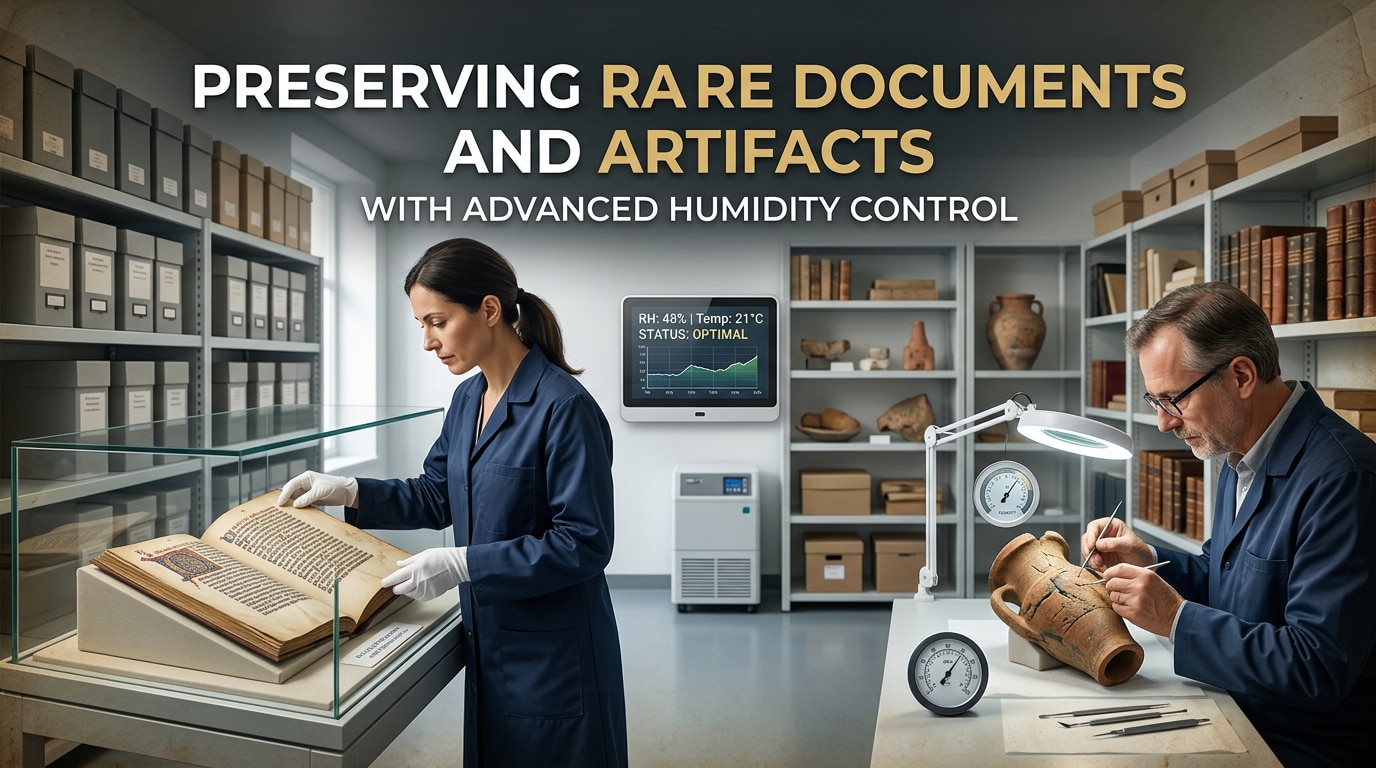
Practical guidance on humidity control for libraries, museums, archives, and private collectors across India.
Some things are as important as preserving history. This is because items like manuscripts, founding charters, rare first-edition books, palm-leaf temple records, antique paintings, and fragile photographic negatives are all very special. Each one of these items is one of a kind. Each one is in danger because of something that people do not usually think about: the moisture in the air.
In India, the air is often very humid. This is especially true in cities near the ocean and during the monsoon season. When the air is too humid, it can be very bad for collections of documents and artifacts. People often worry about dust, light, and pests. The real problem is the water vapor in the air. It is invisible. It can cause a lot of damage.
Why Humidity Is the Silent Destroyer of Collections
Things like paper, parchment, leather, wood, cloth, and even metal can. Release moisture. This happens all the time. When the air is humid, these materials can get damaged. The damage can be cumulative. It can be permanent. Some common problems caused by humidity include:
Mould and mildew: when the air is humid, mould and mildew can grow on organic surfaces. This can cause stains, weaken fibres, and leave a smell.
Foxing: this is when old paper gets brown spots. It happens when the air is humid, and it reacts with metals and other things in the paper.
Cockling and warping: when materials absorb and release moisture, they can contract. Contract. This can cause pages to ripple, inks to crack, and photographs to curl.
Embrittlement: when materials go through cycles of high and low humidity, they can become brittle. This means that paper and parchment can break easily.
Corrosion: when the air is humid, metals like coins and tools can corrode. Adhesives and emulsions on film and photographs can also break down.
Insect activity: insects like silverfish, booklice, and mould mites like to live in air. They can eat paper, bindings and other things.
It is harder to control humidity when you have a collection. This is because different materials have sensitivities to humidity. They can all be damaged if the air is too humid or too unstable.
Warning Signs Your Collection Is Already at Risk
You do not need equipment to know if your collection is in danger. If you notice any of these things, it may be because the air is too humid:
A musty or earthy smell in the room or in storage cabinets
Pages, boards or covers that feel limp, cool or damp
Spots, tide lines or a powdery white bloom on paper, mounts or leather
Photographs that are curling, sticking together or have emulsions and negatives that are
Condensation on windows, walls or display glass
Rusting staples, pins and hinges or a greenish film on bronze and copper objects
If you catch these problems early, you can fix them quickly. If you wait, it can be very expensive and difficult to restore your collection. Some damage can never be fixed.
The Numbers That Matter: Target 45–55% RH
Most experts agree that the best humidity level for collections is between 45 and 55%. This should be combined with a steady temperature between 18 and 21 degrees Celsius. This will protect mixed collections.
The most important thing is to keep the humidity level stable. If the humidity level is always at 55%, it is safer than if it goes up and down between 40% and 70%. Sudden changes in humidity can cause a lot of damage.
Where Humidity Control Is Essential
Any space that stores valuable and irreplaceable items needs to control the humidity. This includes:
Libraries and rare book rooms
Museums and art galleries
Government, legal and corporate record rooms and archives
Temples, gurudwaras and churches with manuscripts and palm leaf texts
Collectors of stamps, coins and art
Photo studios and film archives
Herbaria and natural history specimens
Why a Dedicated Dehumidifier Beats an Air Conditioner
An air conditioner can cool the room. Remove some moisture. It is not designed to control the humidity level. A dedicated dehumidifier is designed to remove moisture from the air and keep the humidity level stable. It can run continuously. It is quiet and compact.
Choosing the Right Capacity for Your Space
The right dehumidifier depends on the size of the room. How humid it is. A small room or display cabinet may need a dehumidifier. A larger room or gallery may need one.
We have a range of dehumidifiers that can meet needs. These include:
For large spaces, we have industrial dehumidifiers. These are designed to control the humidity level in spaces.
Beyond the Machine: A Simple Preservation Routine
The best way to protect your collection is to use a dehumidifier and follow some habits.
First, measure the humidity level in your space. You can use a hygrometer or a data logger.
Then position the dehumidifier where the air can circulate it. Keep the doors and windows closed while it is running.
Set the humidistat to your target humidity level. Let it run continuously.
Finally, keep your valuable items in enclosed cabinets or boxes. This will help to keep them safe.
Protect Your Collection. Talk to Us Today
History is very important. Once a manuscript is damaged, a photograph is ruined, or an artifact is corroded, it can never be restored.
It is easy to prevent this from happening. Just use a dehumidifier to keep the humidity level stable. Your collection will be safe.
Free Demo Available in Mumbai. Book Yours Now
We offer a demo of our dehumidifiers in Mumbai. We also offer a consultation to help you choose the right dehumidifier for your collection.
Contact us to book a demo or to get information.
You can also call us. Get in touch with us to learn more about our industrial dehumidifiers.
