

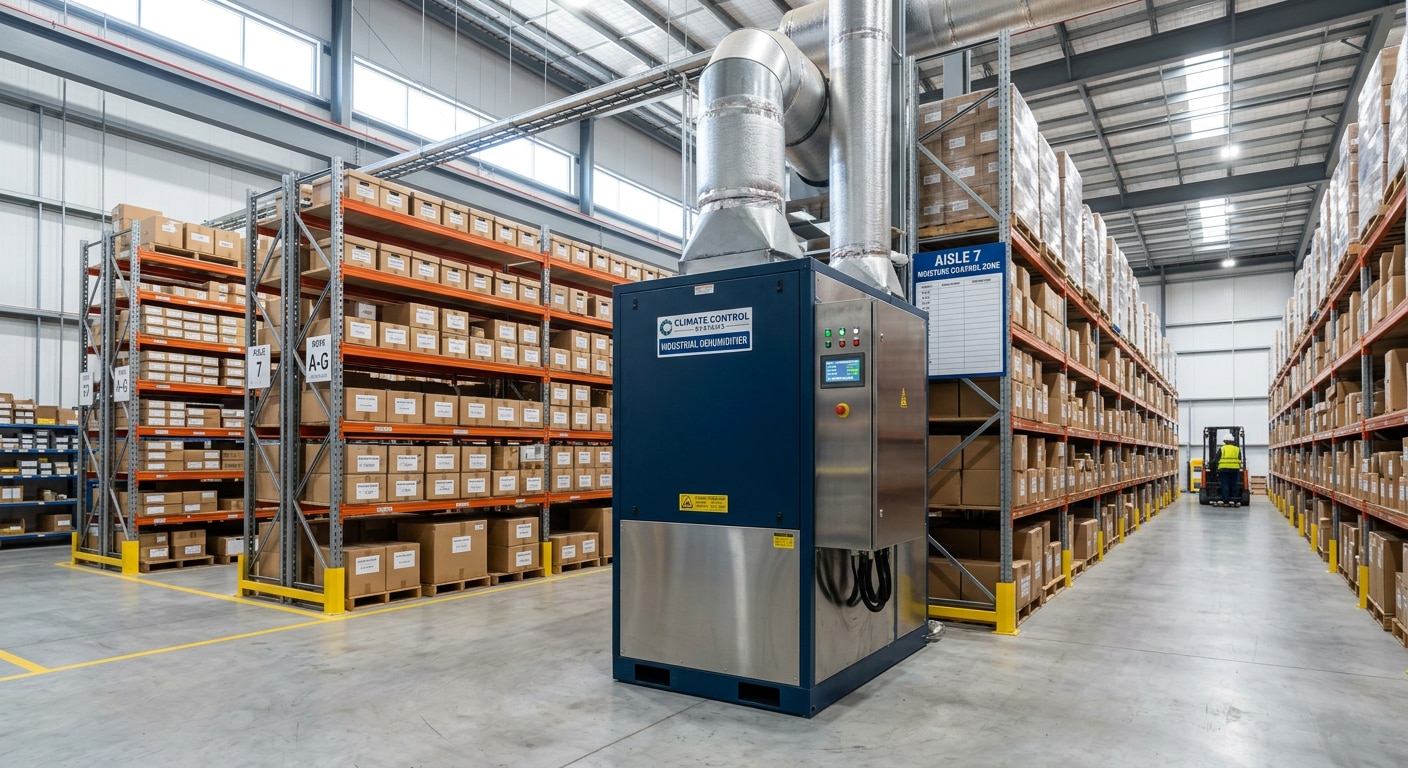
Ask plant managers what a dehumidifier costs and they'll quote you a number from an invoice. Ask them what humidity costs them, and you usually get a pause. That pause is the story. The purchase price sits in one line of the ledger where everybody can see it. The damage humidity does is scattered across a dozen lines. Rejected batches, rusted tooling, a compressor that gave up early, a customer who stopped reordering. And nobody ever adds them up.
So let's add them up. Because once you do, industrial dehumidification stops looking like an expense and starts looking like one of the shortest-payback investments on your capex list.
First, the cost you're already paying.
India is not a climate for stored goods. Coastal cities like Mumbai, Chennai and Kochi sit above 75% humidity for long stretches of the year, and during monsoon the indoor air in an unconditioned warehouse can hover in the high 80s for weeks. Every one of those percentage points is doing something to your inventory whether you're measuring it or not.
Here's where the money leaks:
Spoilage and rework
Moisture-sensitive stock. Powders, spices, grains, tablets, electronics, packaged snacks, paper, leather, textiles. Either goes soft, cakes, clumps, spots,s or grows mould. A 2% rejection rate on a ₹4 crore throughput is ₹8 lakh gone. Not dramatic enough to trigger a board meeting, which's exactly why it survives year after year.
Corrosion and equipment life
Steel starts corroding above roughly 60% RH. Keep a machine shop, a spare-parts store,e or a switchgear room at 80%. You're quietly shortening the life of every asset in it. Replacing a control panel two years early isn't a maintenance cost. It's a depreciation error you paid for in cash.
Energy waste
This one surprises people. When your air conditioning is fighting latent load. Pulling water out of the air rather than heating it. It runs longer cycles harder and delivers less comfort per unit. Handing the moisture load to a dehumidifier lets the AC do the job it was actually designed for, and in many facilities the combined running cost drops rather than rises.
Downtime and labour
Condensation on a floor is a slip hazard and a shutdown. Moisture in a paint booth is a repaint. Damp in a store means ice on the evaporator, defrost cycles that eat hours, and doors that stop sealing. Every one of those is time your people spend fixing or producing.
Reputation
Hardest to quantify, most expensive to lose. A musty hotel room, a spotted carton, a mouldy export consignment turned back at the port. These cost you the next order, not just this one.
Running the numbers on your facility
You don't need a consultant to get a usable estimate. Take twelve months of records. Pull four figures: the value of stock written off or downgraded due to moisture, the maintenance and replacement spend on corrosion-related failures, the hours lost to humidity-driven stoppages, and any customer credits or returns traced back to damp. Add them. Call that your humidity cost.
Now put your dehumidifier investment against it. Unit price, installation, and roughly ₹15,000 to ₹40,000 a year in running and servicing costs per machine,e depending on duty hours.
Divide the investment by the savings, and you have your payback period in years. In our experience across food processing, pharma, warehousing and hospitality sites, that number usually lands somewhere between four and eighteen months. A ₹2.5 lakh installation that stops ₹6 lakh of spoilage has paid for itself before the end of the second quarter, and everything after that is margin you didn't have before.
One thing worth being honest about: the return depends entirely on sizing the machine. An undersized unit runs out,t never reaches setpoint, and gives you a poor result plus a high electricity bill. The worst of both. An oversized one is capital you didn't need to spend. Getting the capacity right is where most of the ROI is won or lost.
Matching capacity to the job
Our full range of White Westinghouse (USA) dehumidifiers spans 12 to 190 litres a day, which covers everything from a server closet to a processing hall. The logic for choosing is simple enough: the more space, the higher the ambient humidity, and the more air changes or open doorways you have, the more extraction capacity you need.
For enclosed spaces. A laboratory, a QC room, a document archive, a small cold room ante-chamber, a telecom or server cabinet room. The compact units do the job at the lowest capital cost. The AWHD-12L, 12 litres/day, and the AWHD-20L, 20 litres/day are the starting points here. Step up slightly. You have the AWHD-306L (30 litres/day), the AWHD-307L (30 litres/day), and the AWHD-40L (40 litres/day), which suit larger offices, hotel basements, gyms, storerooms, and light production areas where the moisture load is steady rather than heavy.
The mid-range is where commercial facilities land. If you're protecting a warehouse bay, a packaging line, a bakery or confectionery area, a pharmacy store or a hotel back-of-house, look at the WDE 606-60 litres/day, the WDE-603T-60 litres/day, and the WDE 702-70 litres/day. These handle industrial duty cycles without being oversized for a single zone, and they're the most commonly specified machines in our commercial installations.
For heavy-duty applications. Godowns, cold storage anterooms, indoor swimming pools, food processing halls, spice and grain storage, textile units, printing floors and pharmaceutical manufacturing areas. You want the high-capacity end of the range. The WDE 100 (100 litres/day), the WDE-110P (110 litres/day), and the WDE 110S (110 litres/day) cover large-volume needs. Where the moisture load is severe. High air exchange, frequent door openings, wet processes, monsoon-season coastal exposure. The WDE150S 150 litres/day, and our flagship WDE-190S 190 litres/day, are the machines that hold setpoint when nothing smaller will.
If you'd rather see the heavy-duty range side by side before deciding, our full industrial dehumidifier collection lists specifications, coverage areas and operating ranges for every unit.
Why the return keeps compounding
The first-year payback is the headline. It's not the interesting part. What matters more is that the savings repeat every year while the cost doesn't. Year one, you recover the capital. Year two onwards, the same reduction in spoilage, corrosion, and downtime drops to your bottom line minus a modest running cost.
Stable humidity also buys you things that never show up in a spreadsheet: product quality that survives an audit, a facility that passes inspection without a scramble, stock you can hold longer without risk, and equipment that reaches its rated life instead of dying early. Controlled air is boring. Boring is exactly what a profitable operation looks like.
Talk to Our Team
Call us: 08048038959. Please keep 0 before dialling the number.
Free consultation — talk through your facility with an application engineer, no obligation.
Free on-site product demo — Mumbai only. See a unit running in your own storage space before you decide.
Site assessment and load calculation for larger warehouses and multi-zone facilities.
Pan-India supply, installation, and service support.
