

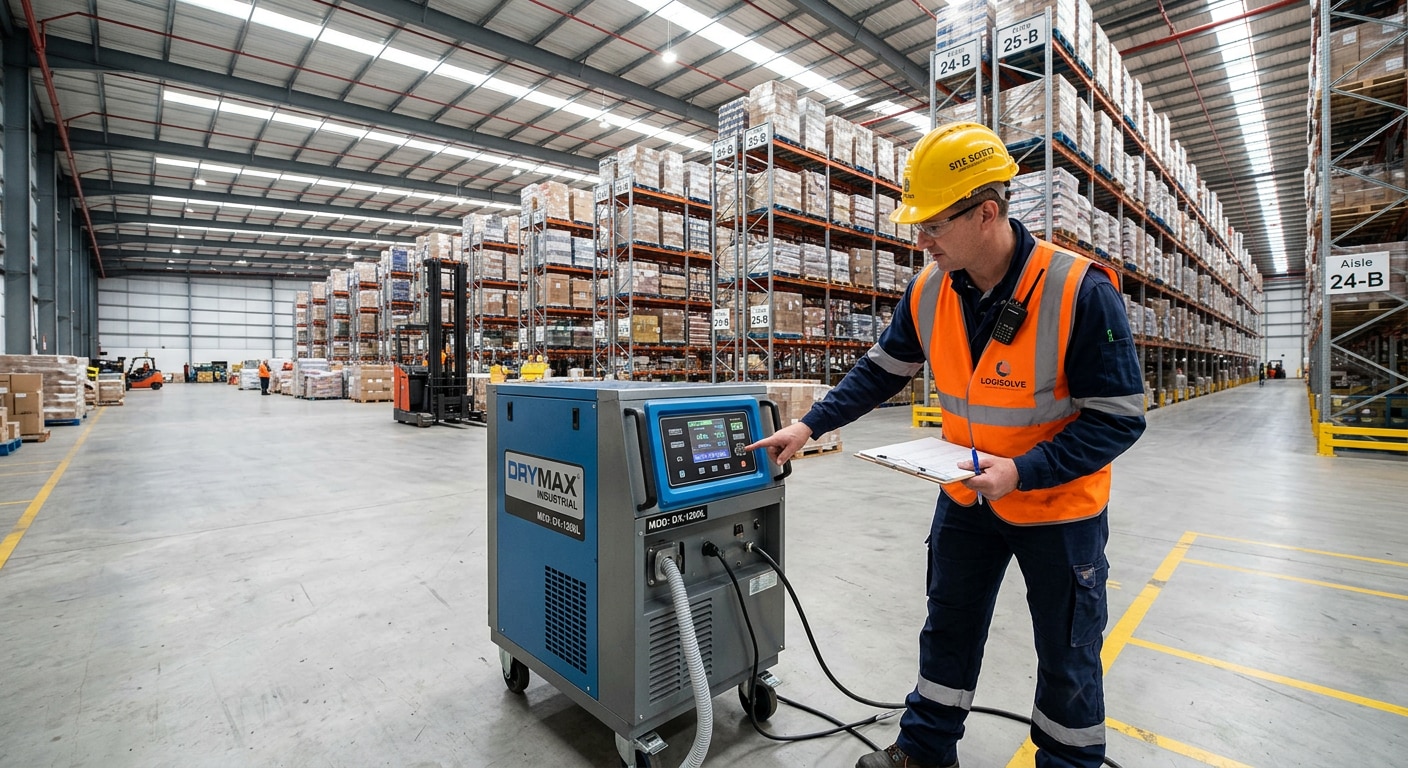
Walk into any large warehouse in India during the monsoon, and you'll notice it before anyone tells you. That heavy sweet smell. Condensation beading on the underside of the roof sheets. Cartons on the pallet row gone soft at the corners. Nobody planned for it. It just crept in one week at a time.
Here's the thing: most facility managers already know a dehumidifier is the answer. What trips them up is the question. How much dehumidifier? Buy small, and you'll run the unit around the clock while the RH needle barely moves. Buy big, and you've spent money on capacity that spends half its life idling. Getting the sizing right is where the whole project either works or quietly disappoints.
So let's walk through how capacity's actually calculated for big spaces. And which units make sense at each level.
What "litres per day" really means
Every dehumidifier carries a headline number: 30 litres a day, 100 litres a day, 190 litres a day. That figure is the amount of water the machine can pull out of the air in 24 hours. Only under the test conditions the manufacturer used.
This matters more than people realise. A unit rated at 30°C and 80% RH will deliver a different result at 22°C and 55% RH because there's simply less moisture in cooler, drier air for the coil to condense. In a Mumbai or Chennai warehouse during July, ambient conditions often sit close to or above the rating point, so you'll see rated performance. In a climate or air-conditioned facility, expect meaningfully less. Always ask what conditions a rating was taken at before comparing two machines on paper.
Start with moisture load, not floor area
The common shortcut. And the most common mistake. Is picking a dehumidifier purely off square footage. Two warehouses of the same size can have wildly different moisture loads. What actually drives the number is how much water is entering the space every day and from where.
Building volume and Air changes - Start with length × width × height. A 30,000 sq ft warehouse with 8-metre height is roughly 22,300 cubic metres of air. Then estimate air changes per hour. How many times the entire volume is replaced by outside air. A tight modern shed with sealed doors might sit at 0.3 to 0.5 ACH. An older building with gaps in the cladding, roof vents, and doors that stay open can easily run 1.0 to 2.0 ACH. Every one of those air changes brings in moisture that your machine has to remove again.
Dock doors - This is the biggest variable in most Indian warehouses. A shutter that opens forty times a shift during monsoon is effectively a hole in your envelope. If your loading bays run continuously, budget extra capacity for that zone alone. Or fit air curtains to cut infiltration before you size the dehumidifier.
The stock itself - Hygroscopic goods. Paper, cardboard, textiles, grain, spices, powders, leather, pharma packaging. Release moisture. A delivered load of damp cartons will offgas water into your air for days.
People, forklifts, and washdowns - Each worker adds 100 to 200 grams of moisture per hour. Floor cleaning, curing in a newly built facility, and any wet process area all add to the total.
Your target RH - Deciding to hold 50% RH of 60% doesn't just cost 10 points. The drier you go, the harder each additional point becomes. General storage is usually comfortable at 50–60%. Electronics, powders and corrosion-sensitive metal parts often need 40–45%. That tighter target pushes capacity up.
A rough worked example
Take that 22,300 m³ warehouse at 0.6 ACH, air at 32°C and 85% RH and a target of 55% RH inside. The infiltration alone works out to over 200 litres of water a day that has to be removed just to hold the line. Before you account for open dock doors, damp incoming stock, or wet floors.
Which tells you something straight away: for a facility that size, one machine is rarely the answer. Distributed capacity is.
Why several mid-size units usually beat one giant one
Large warehouses are not one uniform box of air. There's a zone near the roller shutters, a still pocket at the far end behind the racking, a QC room, an office block, maybe a cold anteroom. Dry air doesn't travel well through packed racking. It takes the path of resistance and never reaches the corners.
Spreading your capacity across several units placed in the zones that actually need them gives you far better real-world RH uniformity than one oversized machine parked by the entrance. It also gives you redundancy: if one unit goes down for service, you're not left with nothing during the week of the year. It lets you match capacity to each zone rather than paying to over-dry the whole shed.
Matching White Westinghouse units to warehouse zones
Our industrial range is here. Explore Our Industrial Dehumidifiers. But here's how the capacities typically get deployed across a large facility.
For the storage floor and high-load bays, you want the heavy hitters. The WDE-190S – 190 Litres/Day is the workhorse for floor plate and areas with constant shutter traffic, and the WDE150S – 150 Litres/Day covers large bays where the load is high but not extreme. In the 100–110 litre band, you have three options depending on layout and mounting preference: the WDE 110S – 110 Litres/Day, the WDE-110P - 110 Litres/Day, and the WDE 100 – 100 Litres/Day. Three or four of these placed strategically will outperform a single monster unit every time.
For dispatch areas, packing halls, mezzanines and secondary bays, the mid-range earns its keep. The WDE 702 – 70 Litres/Day suits a packing zone, while the WDE-603T – 60 Litres/Day and the WDE 606 – 60 Litres/Day are ideal where you need reliable control in a defined section without committing to full industrial capacity.
For enclosed rooms inside the warehouse – QC labs, server and UPS rooms, document archives, spare-parts cages, supervisor cabins, sample storage. Smaller units are the choice, and oversizing here is genuinely wasteful. The AWHD-40L – 40 Litres/Day handles side rooms; the AWHD-307L – 30 Litres/Day and AWHD-306L – 30 Litres/Day cover mid-size cabins and archives, and the AWHD-20L – 20 Litres/Day and AWHD-12L – 12 Litres/Day are right for electrical rooms, record cupboards and compact offices.
Placement, drainage and airflow
Capacity on paper means nothing if the air can't circulate. Keep units clear of walls and racking; intake and discharge aren't blocked, and aim discharge along aisles rather than straight into a stack of pallets. In warehouses, remember that moist air stratifies. The worst condensation often happens at roof level even when the floor reads fine.
Plumb continuous drainage wherever possible. On a 190 litre/day unit, a bucket is not an option; you'll be emptying it several times a shift. Run a gravity drain. Use the condensate pump to a nearby floor drain.
Measure. Put a couple of RH loggers in the zones you care about. Near the dock, deep in the racking at level. And check what's actually happening rather than trusting one meter by the door.
Mistakes worth avoiding
Sizing off a summer afternoon reading rather than worst-case monsoon conditions. Ignoring the dock doors entirely. Choosing a target RH rather than the goods actually require, then wondering why the running cost is high. Skipping filter cleaning until airflow drops and capacity quietly falls with it. And buying one machine because it looked simpler on the quotation, then discovering the far end of the shed never gets dry.
Talk to Our Team
Every warehouse is different, and honestly, a fifteen-minute conversation about your building height, door traffic, and stock type will get you an answer that any online calculator. Our engineers will work out the moisture load for your facility. Recommend the exact combination of units. No guesswork, no over-selling.
Call us: 022 4343 2323
Consultation – Capacity calculation and layout advice for your facility
Free product demo – Available in Mumbai only
Contact us / visit our office – Find us on the map
Explore our industrial range – Industrial Dehumidifiers
Free Consultation | Contact Us | Call for Inquiry | Free Demo in Mumbai | Email Us
Get the capacity right, and the time and humidity stop being a seasonal emergency. It becomes a number, on a display that simply stays where you set it. Your stock, your packaging and your building fabric all quietly benefit.
