

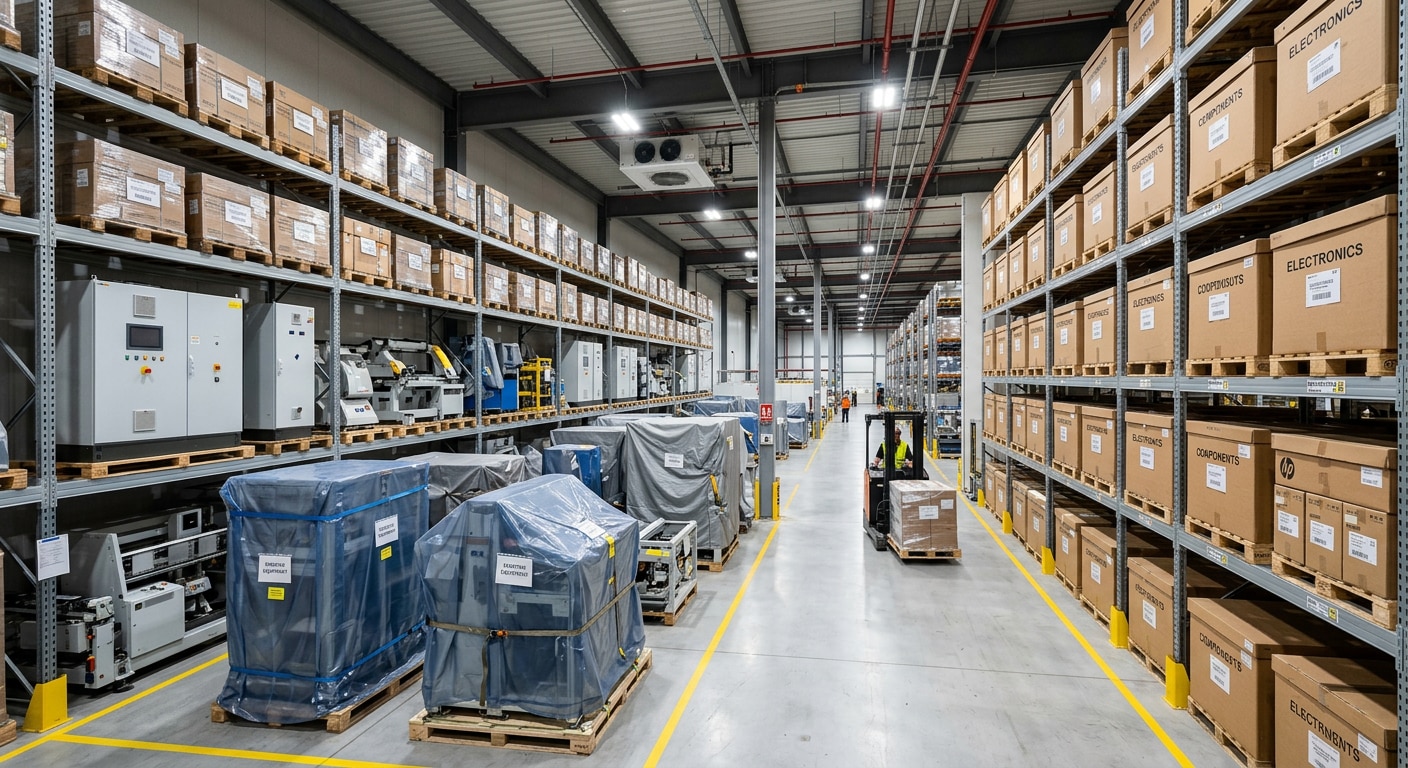
Here's a scenario that happens in warehouses across India every year. A batch of motor drives goes into storage in March, completely working, still in the original box. In September someone takes them out for a line changeover.. Three of the five do not start. Nobody dropped them. Nobody connected them wrong. They simply sat in a room. Quietly stopped working.
The reason is always the same: moisture in the air. Not a leak, not a flood, not a pipe. Normal humid air doing what humid air does over five or six months of monsoon and post-monsoon weather.
If your facility stores electronics, control panels, PCBs, motors, bearings, tooling, dies or any machined metal part this is worth understanding because the damage can be avoided and it is usually much less expensive to stop it than to fix it.
What Humidity Actually Does to Stored Equipment
There are four ways that failure happens, and they happen over different time periods.
Condensation on surfaces – Air can hold a certain amount of water vapour, and that limit goes down quickly as temperature goes down. When warm humid air touches a metal surface that's below the dew point. A machine bed that cooled overnight, a casting brought in from an air-conditioned area, the underside of a metal roof at 4 a.m. The vapour turns into liquid water. You get drops on equipment that was completely dry just a few hours earlier. During Mumbai’s monsoon, when outside air is often at 85–95% RH, the dew point can be within two or three degrees of the temperature. That is a small difference.
Electrochemical corrosion – Steel does not need standing water to rust. At 60% relative humidity, a very thin layer of moisture forms on metal surfaces and starts to act like an electrolyte. Add chlorides from coastal air or sulfur compounds from industrial areas, and corrosion happens much faster. Precision-ground surfaces, bearing races, lead screws and hydraulic rams show it first. As staining, then pitting, and pitting on a bearing race is a scrapped bearing.
Failure inside the electronics – This is the one. Populated circuit boards have leftover flux, solder-mask issues, and tiny ionic contamination. At high humidity, moisture connects adjacent traces and allows electrochemical migration. Metal ions move across the space and make conductive paths. The result is behavior, leakage current, and eventually a complete short. Nothing looks wrong from the outside – It just does not work. Aluminium electrolytic capacitors also break down faster in storage, and connector contacts develop resistive oxide layers that cause problems when the equipment is turned on.
Packaging working against you – Cardboard, wooden boxes, foam inserts and desiccant packs all take in moisture from the air. Hold it near the product. A carton that has been in a 75% RH warehouse for four months is like a sponge wrapped around your equipment. Vapour-corrosion-inhibitor bags and silica gel packets are helpful. Both have limits. Once a packet is full it stops protecting and starts to hold moisture.
The Numbers Worth Targeting
Control humidity and all four problems slow down. Stop. The practical goals are simple.
For machinery tooling, spare parts and bare metal stock, keep relative humidity under 50%. Corrosion rates drop quickly once you go below 60%, and 45–50% gives you some space for the days when a loading door stays open for long.
For electronics, PCBs, instrumentation, drives and control gear aim for 40–50%. Low to stop electrochemical migration high enough to avoid the static-discharge risks that come with very dry air below about 30%.
For long-term storage of high-value items. Spare turbine parts, calibration standards, backup systems. 35–45% Is the goal and it is worth the extra effort to reach it.
The point: these are maximums, not averages. A warehouse that averages 55% but goes up to 85% every night during monsoon is not safe. Consistency is more important than the average over the month.
Why Air Conditioning Is Not the Solution
An idea is that a cooled storage room is a dry storage room. It is not. An air conditioner is made to remove heat; dehumidification is an effect that only happens while the compressor is working. On a wet monsoon day, the thermostat is satisfied at 26°C; the compressor turns off, and relative humidity goes up to 80% in a room that feels very comfortable. Worse cooling: the area brings surface temperatures down. Gets equipment closer to the dew point.
Humidity needs its machine, controlled by its own device working to its own target. That is what a dehumidifier does. It removes moisture as its job and keeps a target RH no matter what the temperature is doing.
Matching Equipment to Your Storage Space
Sizing is where most installations go wrong by being too optimistic. The amount of moisture you need to remove depends on the size of the floor the height of the ceiling how often doors open how well the building is. Whether you are fighting monsoon conditions or just keeping things steady. Here is how our range fits into storage situations.
Cabinets, server rooms, calibration labs and spare parts stores – For a control-panel room, an instrument cabinet, a small tool crib or a compact electronics store, a small unit works quietly and cheaply. The AWHD-12L White Westinghouse Dehumidifier – 12 Litres/Day works for enclosed rooms up to about 200 sq ft, while the AWHD-20L White Westinghouse Dehumidifier – 20 Litres/Day handles server rooms and UPS rooms where heat pushes moisture around. For larger spaces. A 400–600 sq ft spare parts store or a QC lab. The AWHD-306L White Westinghouse Dehumidifier – 30 Litres/Day and the AWHD-307L White Westinghouse Dehumidifier – 30 Litres/Day give you enough space with continuous drainage. Move up to the AWHD-40L White Westinghouse Dehumidifier – 40 Litres/Day where the room is used often and doors open during the day.
Mid-sized stores, workshops and assembly areas – Once you are working with a thousand square feet or a space with roller shutters and regular forklift movement, you need strong removal. The WDE-603T White Westinghouse Dehumidifier – 60 Litres/Day and WDE 606 White Westinghouse Dehumidifier – 60 Litres/Day are the choices here. Strong, continuously draining, and made for daily industrial work. If the moisture is higher, say a store with a wash area or a coastal location, the WDE 702 White Westinghouse Dehumidifier – 70 Litres/Day gives you more space to recover quickly after a shutter has been open.
Large warehouses, machine areas and high-value storage – For warehouse floors, tall storage bays, machine tool storage areas and central spare parts depots, capacity is the most important. The WDE 100 White Westinghouse Dehumidifier – 100 Litres/Day is a start for a single large bay. The WDE-110P White Westinghouse Dehumidifier – 110 Litres/Day offers mobility for facilities that need to move protection between areas, while the fixed WDE 110S White Westinghouse Dehumidifier – 110 Litres/Day suits a permanent spot. For large or very damp spaces. Think monsoon-season warehouses, high-ceiling machine areas or storage near open yards. The WDE150S White Westinghouse Dehumidifier – 150 Litres/Day and the WDE-190S White Westinghouse Dehumidifier – 190 Litres/Day offer the removal rates needed to keep a target level through the worst weeks of the year.
If you want to see the list of technical units side by side, check our commercial and industrial dehumidifier collection. Every unit is listed with capacity, area, and drainage options.
Getting the Installation Right
Good equipment installed incorrectly does not work well, so a few tips.
Place units where the air actually moves. A dehumidifier hidden behind a stack of boxes protects the boxes and nothing else. Central positions with airflow paths or several smaller units spread across areas work better than one big unit in a corner.
Connect the drain. Emptying a tank by hand works for a week. Then someone forgets. Every industrial unit in the range supports gravity drainage. Use it.
Seal the space first. Gaps under shutters, unsealed cable entries and open vents pull in air all the time. Sealing costs little and reduces your running cost a lot.
Measure do not guess. Put a data-logging hygrometer at floor level. One at rack height in each area. Humidity builds up. The number at your desk is not the number at the bottom shelf.
Test during shutdowns. The dangerous time is a long weekend or a plant shutdown when everything else is off and the building cools. Leave the dehumidifiers on their humidistat. Let them work without attention.
Talk to Our Team
Every storage area has a moisture pattern, and the right solution depends on your space, ceiling height, door traffic, and what you are actually protecting. We prefer to get the size than to sell you the wrong unit.
Call us: 022 4343 2323
Free consultation — talk through your facility with an application engineer, no obligation.
Free on-site product demo — Mumbai only. See a unit running in your own storage space before you decide.
Site assessment and load calculation for larger warehouses and multi-zone facilities.
Pan-India supply, installation, and service support.
