

Walk into most Indian factories in July, and you'll feel it before you can name it. The air is heavy. There's a faint musty edge near the packing area, condensation running down a chilled pipe, and someone's already complaining that the boxes are going soft. Everybody blames the heat. Almost nobody blames the moisture.
But moisture is usually the real culprit. Temperature is what your workers feel; humidity is what actually decides whether your indoor air is clean or quietly turning against you. Once relative humidity climbs past roughly 60%, a factory floor stops being just a workspace and starts becoming a growing medium — for mould, for bacteria, for dust mites, for the kind of odours that no amount of exhaust fans will clear.
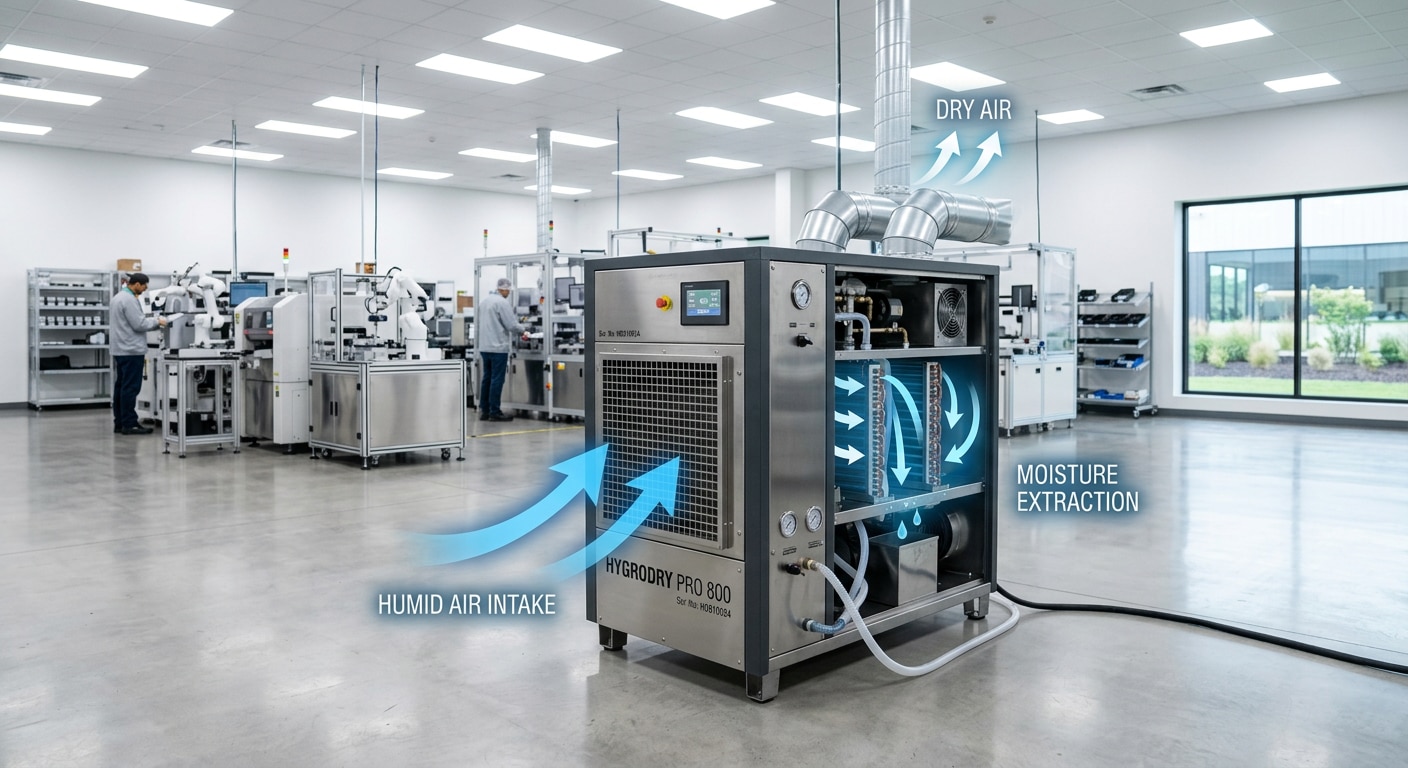
This is where an industrial dehumidifier earns its keep. Not as a comfort appliance, but as a piece of air quality infrastructure. Here's what actually changes when you get the moisture under control.
Humidity is the switch that turns mould on
Mould spores are already in your building. They're in the air outside, they ride in on pallets, they settle into ducting and wall cavities and the gap behind the racking that nobody has cleaned since installation. On their own, they're inert. What activates them is water.
Most common indoor moulds need sustained relative humidity above about 65–70% to germinate on a surface. Keep the air below 55% and they simply sit there, dormant. That's the whole mechanism. You don't need fungicides, you don't need to rip out drywall every monsoon — you need to remove the water from the air so the spores never get their trigger.
And this matters for air quality specifically, not just for the building fabric. Active mould colonies release spores and microbial volatile organic compounds into the air your staff breathes for eight to twelve hours a day. That's what the "old building smell" actually is. It's not the building. It's biology.
Dust behaves differently in damp air
Here's something most facility managers don't expect: humidity changes how airborne particles move. In damp conditions, fine dust clumps together, gains weight and settles onto surfaces — machinery, product, filters — instead of staying in suspension where your extraction system can catch it. It also sticks. Damp dust bonds to duct walls and filter media, choking airflow and turning your ventilation system into a reservoir rather than a cleaner.
Then, when the space dries out temporarily, all of it lifts again in one go. Anyone who works in flour milling, cement, textiles, pharma or powder handling has seen this cycle. Stable humidity in the 45–55% band keeps particle behaviour predictable, keeps filters breathing, and stops your dust load from playing yo-yo with the weather.
Odours, off-gassing and chemical load
Water vapour is a carrier. High humidity accelerates the release of volatile organic compounds from adhesives, coatings, packaging films, solvents, plastics and freshly treated surfaces. It also helps those compounds hang in the air longer instead of dissipating. That's why the same paint shop or lamination line smells sharper in the monsoon than it does in December, with no change in process.
Bring humidity down and you shorten the residence time of these compounds, reduce the microbial contribution to the odour profile, and give your ventilation a fighting chance. Facilities that install proper dehumidification often report the smell problem "just going away" — and they're usually surprised, because they'd assumed it was a ventilation issue all along.
What it does for the people on the floor
Damp indoor air is linked to a very ordinary set of complaints: blocked noses, itchy eyes, throat irritation, headaches, more frequent asthma flare-ups, that heavy, sluggish feeling after lunch. Individually, nobody escalates these. Collectively, they show up as absenteeism, slower line speeds, and higher error rates in QC.
There's a thermal comfort angle too. At 35°C, air at 70% RH feels considerably more punishing than the same air at 50%, because sweat can't evaporate efficiently. Pulling moisture out makes the space feel several degrees cooler without touching the thermostat — which, incidentally, is often cheaper than trying to cool your way to comfort.
Condensation, corrosion and electrical risk
Every surface in your plant that sits below the dew point will collect water. Chilled pipework, cold-store doors, metal ducting, control panels near air-conditioned zones. That condensation feeds rust, degrades insulation, drips onto product and creates slip hazards. Inside enclosures, it's a genuine electrical risk.
Raise the room's dew point margin by dehumidifying and condensation simply stops forming. It's one of the fastest, most visible wins — you can usually see the difference within a day or two of a unit running.
Why your air conditioning isn't already handling this
A fair question. Air conditioners do remove some moisture, but only as a by-product of cooling. Once the space reaches setpoint, the compressor cycles off and dehumidification stops — often long before the moisture load is dealt with. In humid coastal conditions like Mumbai's, an AC system can hold 24°C beautifully while the room sits at 70% RH. Cool and damp. The worst combination for indoor air quality, because now you have condensation and mould-friendly humidity.
A dedicated dehumidifier works on humidity as its target variable, independent of temperature. That's the whole difference.
Matching the machine to the space
Sizing is where most installations go wrong, so it's worth thinking in terms of extraction capacity per zone rather than buying one large unit and hoping.
For enclosed, smaller-volume spaces — QC labs, server and control rooms, instrument cabinets, document archives, small cold-room ante-chambers — the compact range is usually right. Look at the AWHD-12L (12 litres/day) and AWHD-20L (20 litres/day) for tight rooms, and step up to the AWHD-306L (30 litres/day), AWHD-307L (30 litres/day) or AWHD-40L (40 litres/day) where there's more air volume or a steady moisture ingress from doors opening.
Mid-sized production bays, packing halls, storage rooms and workshop floors generally need something in the 60–70 litre bracket. The WDE-603T (60 litres/day) and WDE 606 (60 litres/day) handle steady daily loads well, while the WDE 702 (70 litres/day) gives you extra headroom for monsoon peaks.
For large open floors, warehouses, cold storage anterooms, pharmaceutical and food processing areas — anywhere with high air changes, frequent door openings or a genuinely heavy moisture load — you want serious extraction. The WDE 100 (100 litres/day), WDE-110P (110 litres/day) and WDE 110S (110 litres/day) cover most large-bay requirements, and for the toughest environments the WDE150S (150 litres/day) and WDE-190S (190 litres/day) are the workhorses of the range.
If you'd rather see the full industrial line-up side by side before deciding, browse our Industrial Dehumidifier collection.
Talk to Our Team
Every facility has a different moisture story — the load, the layout, the air changes, the process itself. The fastest way to get this right is to talk it through with someone who has sized these systems before.
Call for inquiry: 08048038959. Please keep 0 before dialling the number.
Free consultation and on-site humidity assessment for industrial clients
Free product demo — available in Mumbai only. Call us to book a slot.
