

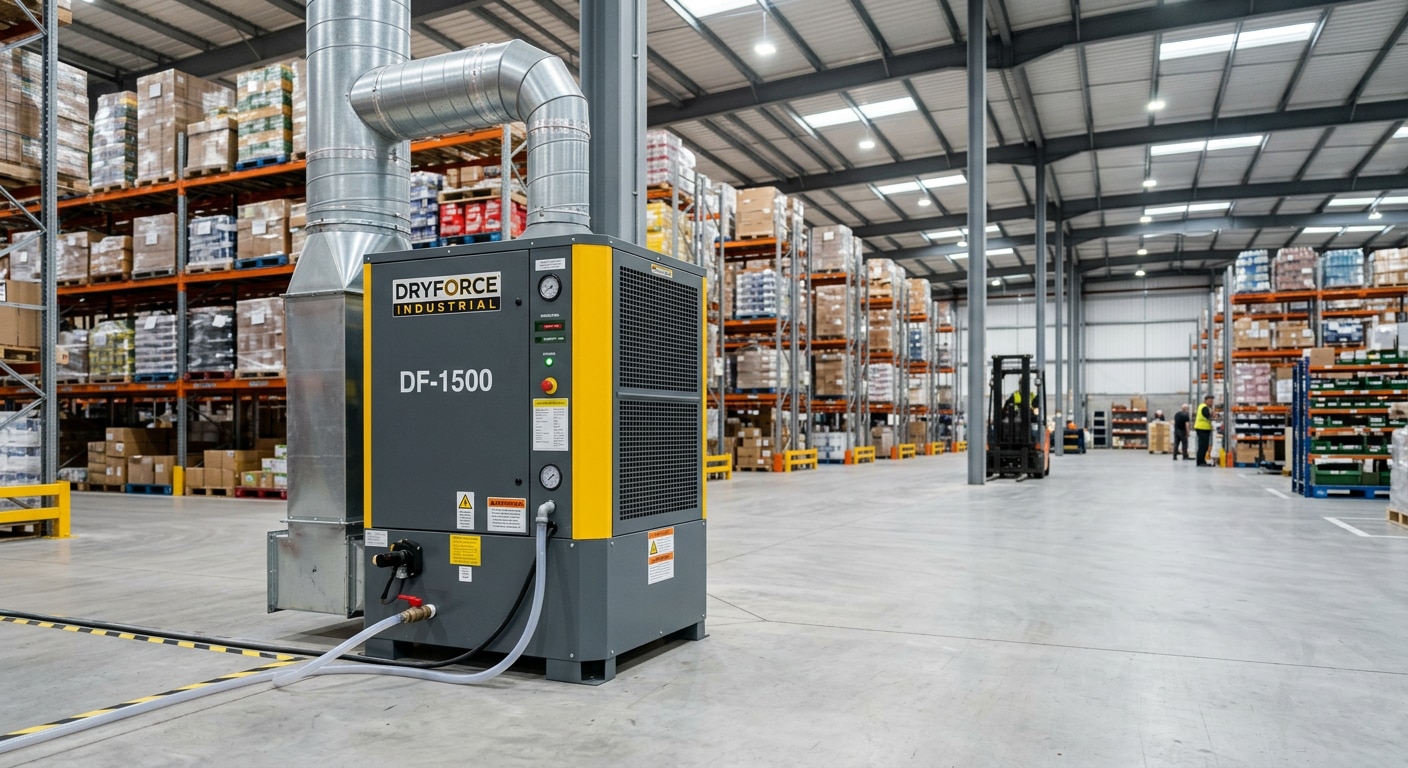
Here's something most people find out the hard way. You can buy the right dehumidifier, size it correctly, pay for it, wheel it in — and still end up with damp walls, sticky packaging and a humidity reading that refuses to drop. The machine isn't faulty. It's just standing in the wrong spot.
Placement is the part of the job that gets the least thought and causes the most complaints. A 190-litre industrial unit pushed into a corner behind a stack of pallets will underperform a properly positioned 100-litre machine every single day of the year. So before you drill a single anchor bolt or run a drain line, it's worth spending twenty minutes deciding where the unit actually belongs.
This guide walks through how we position units on real sites across India — warehouses, cold storage rooms, pharma cleanrooms, hotel basements, server rooms and food processing halls — and what changes from one to the next.
Why Placement Decides Half the Performance
A dehumidifier doesn't dry a room the way a heater warms one. It dries the air that physically passes through it. Every litre it pulls out of the atmosphere has to travel across the evaporator coil first. That means the machine is only as good as the air you feed it.
If the intake is choked, or the discharge blows straight into a wall two feet away, the unit ends up recycling its own dry air in a tight little loop. The sensor sees low humidity, the compressor cycles off, and the far end of the room stays at 78% RH. You get a machine that runs a fraction of the hours it should and a facility that still smells musty. Airflow, not capacity, is usually the bottleneck.
Start by Finding Where the Moisture Comes In
Before you decide where the unit goes, work out where the water is arriving from. In most industrial buildings, it's one of five things: doorways and dock openings, wet-process equipment, fresh-air ventilation, damp floors and walls, or the people and materials moving through the space.
Once you know the source, placement becomes obvious. If humidity is coming in through a loading dock, the unit should be placed near that entry so it intercepts the moist air before it spreads across the floor. If it's rising off a wet washing line or a cooking area, the machine goes downstream of that process in the natural direction of airflow. If it's a sealed cold room where moisture only enters at door-opening events, a unit positioned near the door with its discharge aimed across the opening does far more work than one parked at the back wall.
A quick hygrometer walk-through helps. Take readings at four or five points at working height and note where the numbers spike. That map is your installation plan.
Central, Open and Facing the Long Axis
For general-purpose drying in a warehouse or hall, the best default is a central position with the discharge pointed down the longest run of the room. Air thrown along the length of the space induces a circulation pattern — dry air travels out, mixes, and returns to the intake from the sides. That loop is what gets you an even reading across the whole floor rather than one dry pocket.
Corners are the classic mistake. They kill the return path on two sides and starve the intake. If a corner is genuinely your only option, angle the machine outward at roughly 45 degrees so the discharge has somewhere to go, and accept that you'll need more air movement help from circulation fans.
In long, narrow spaces — corridors, tunnel dryers, storage aisles — two smaller units placed at opposite ends usually beat one large unit in the middle. In tall spaces with racking, remember that moisture and stratified air behave differently at 2 metres and at 8 metres, so plan for the working zone you actually care about.
Give the Machine Room to Breathe
Every industrial unit needs clearance, and it's not a formality. As a working rule, leave at least 300 to 500 mm on the intake side and a clear metre in front of the discharge. Nothing stacked on top. Nothing leaning against the grille. No shrink-wrap, no cartons, no tarpaulin thrown over it during a wash-down.
Filters need to be reachable without moving the machine — if servicing is awkward, filters don't get cleaned, and a blocked filter can quietly cost you 20–30% of rated extraction. Keep the control panel visible at eye level too. An operator who can read the setpoint is an operator who won't randomly override it.
Floor, Wall or Ducted?
Most industrial units sit on the floor, and that's fine for the majority of applications — floor level is where the coolest, densest and often dampest air collects, so the intake gets useful air. Put the machine on a level surface, ideally a small plinth in areas that get hosed down, and lock the castors so vibration doesn't walk it out of position.
Wall-mounting makes sense in swimming pool halls, cleanrooms and areas where floor space is non-negotiable or hygiene rules forbid equipment on the ground. Get the mounting height right: too high and you're drying the ceiling, too low and you lose the space you were trying to protect.
Ducted installation is the option people forget. Where the unit has to sit in a plant room, outside a cleanroom envelope, or away from a noise-sensitive area, ducting the intake and discharge lets you treat a space you can't physically stand a machine in. Keep duct runs short, avoid sharp bends, and remember that every metre of duct costs you static pressure.
Sort Out the Drain Before You Sort Out Anything Else
A 150-litre-a-day machine is producing more than six litres an hour in monsoon conditions. Nobody is emptying that tank by hand. Position the unit where a continuous gravity drain can reach a floor drain or a sump, with a steady fall along the whole run and no low points where water can sit and grow biofilm.
If gravity isn't possible, a condensate pump solves it, but then the unit needs to be somewhere the pump can be inspected. And never route the drain line where a forklift will eventually crush it — we've seen that one more times than we'd like.
Power, Temperature and the Limits of the Machine
Check the electrical supply at the intended location before committing. Larger industrial units may need a three-phase connection and a dedicated circuit; running one off a shared extension is asking for nuisance trips. Keep the cable route clear of the traffic path.
Ambient temperature matters more than people expect. Refrigerant dehumidifiers work best in the 15–35°C band. Below roughly 10–15°C, the coil starts frosting, and you're relying on defrost cycles, which eat into effective output. That's why cold storage and low-temperature rooms usually need either a low-temperature-rated unit, or placement in a slightly warmer adjacent zone with air ducted through.
Matching the Unit to the Zone
Placement and capacity are the same conversation. Once you know where the machine will sit, the size follows from the volume it's expected to treat.
For small enclosed spaces — server rooms, testing labs, electrical panel rooms, archive cupboards, single hotel rooms — a compact unit placed centrally does the job without hogging floor space. The AWHD-12L (12 Litres/Day) and AWHD-20L (20 Litres/Day) suit these tight zones. Step up slightly for larger offices, storerooms and clinic areas with the AWHD-306L (30 Litres/Day), the AWHD-307L (30 Litres/Day) and the AWHD-40L (40 Litres/Day).
Mid-sized production areas, packing halls, gyms, banquet spaces and basement storage generally need a mobile industrial unit positioned along the main airflow path. The WDE-603T (60 Litres/Day), WDE 606 (60 Litres/Day) and WDE 702 (70 Litres/Day) are the workhorses in this bracket.
For warehouses, cold storage anterooms, pharmaceutical and food processing floors, pool halls and large plant rooms, you want high-capacity machines placed centrally or at the dominant moisture entry point. The WDE 100 (100 Litres/Day), WDE-110P (110 Litres/Day) and WDE 110S (110 Litres/Day) handle large open volumes, while the WDE150S (150 Litres/Day) and the WDE-190S (190 Litres/Day) are built for the heaviest moisture loads and continuous-duty operation.
If you'd rather see the full industrial range side by side before deciding, browse our Industrial Dehumidifiers collection.
The Placement Mistakes We See Most Often
Machines parked behind stock that arrived after installation. Units placed directly under a leaking roof section or beside an open shutter that's propped open all day, so they're fighting an infinite outdoor load. Discharge aimed straight at a temperature or humidity sensor, which makes the controller think the room is dry. Two units placed side by side instead of spread across the space. And the quiet one — a unit installed perfectly, then never serviced, because the filter panel ended up facing a wall.
Check It Once It's Running
After commissioning, take humidity readings at the same points you surveyed earlier, at least 24 hours apart, at the same time of day. If one zone still reads noticeably higher, you have a circulation problem, not a capacity problem — reposition, add a circulation fan, or split the load across two machines. Verify the drain is flowing, the filter is clean, and the setpoint is where you agreed it should be. Most facilities in India sit comfortably in the 45–55% RH range; storage and process areas may need tighter control.
Talk to Our Team
Not sure where your unit should go, or which capacity your space actually needs? We'll help you work it out — no obligation.
Call us: 08048038959. Please keep 0 before dialling the number.
Free consultation on placement, sizing, and installation planning
Free product demo — available in Mumbai only. Call us to book a slot
