

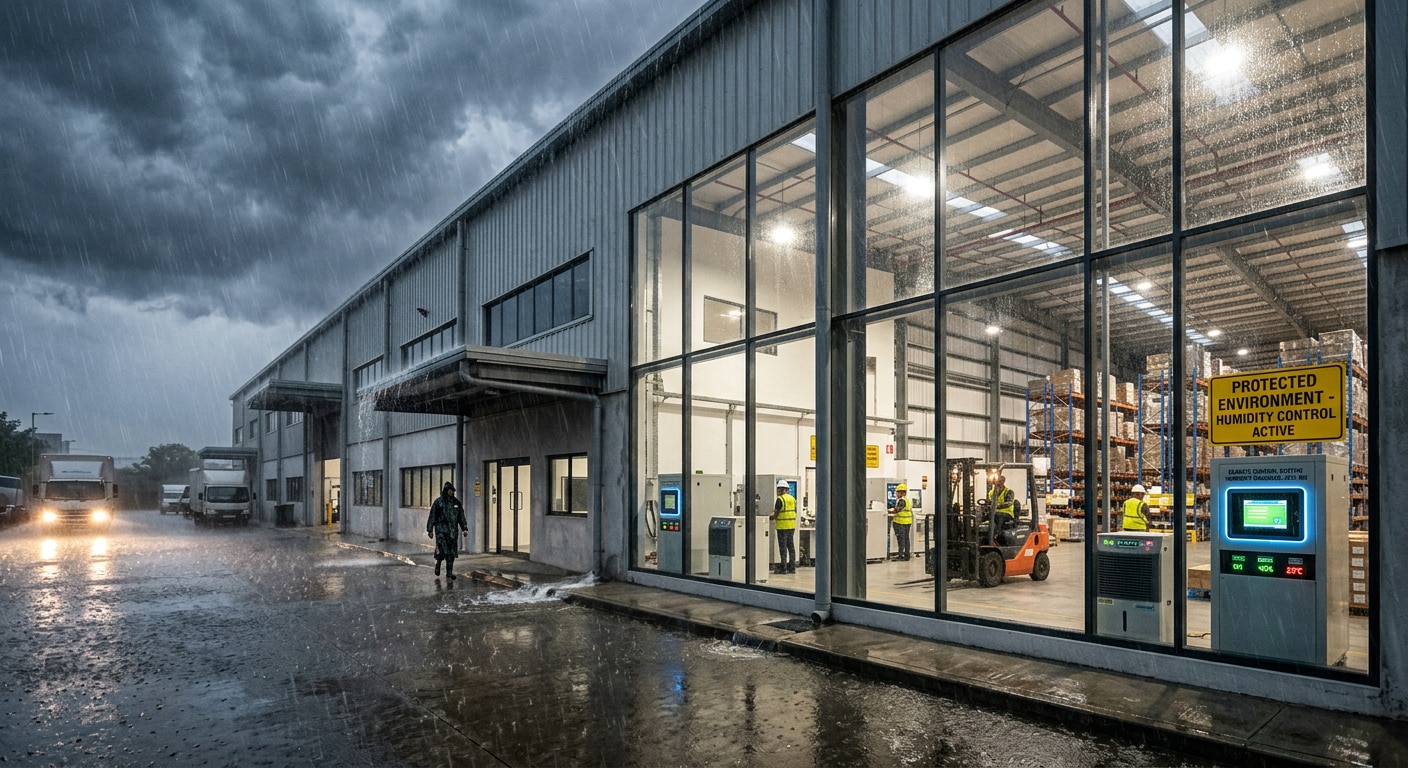
Every year, between June and September, Indian facility managers fight the same battle — and most of them fight it with a mop. Water on the floor is visible, so it gets attention. The far more expensive problem is invisible: the moisture suspended in the air inside your building. When relative humidity climbs past 70%, your facility quietly begins damaging itself. Corrosion accelerates. Cartons soften. Powders cake. Electronics fail intermittently. Mould establishes itself in places you will not find until it has spread.
This checklist is written for plant heads, warehouse managers, maintenance engineers and quality teams who want to walk into the monsoon prepared rather than reactive. Work through it once before the rains, and you will spend the season managing production instead of managing damage.
Why Humidity — Not Rain — Is the Real Threat
A watertight roof does not give you a dry building. During the Indian monsoon, ambient relative humidity routinely sits between 80% and 95% for weeks at a time. Every time a shutter opens, a forklift enters or a fresh-air fan runs, that moisture-laden air comes inside and stays. Concrete floors and walls release stored moisture. People and processes add more.
The consequences are predictable and measurable:
Corrosion and rust — steel begins corroding meaningfully above roughly 60% RH. Tooling, dies, spare parts, fasteners and machined surfaces degrade fastest.
Mould and bacterial growth — mould germinates above about 65% RH. In food, pharma and cosmetics facilities, this is a compliance failure, not just a housekeeping issue.
Packaging collapse — corrugated cartons lose a substantial share of their stacking strength as they absorb moisture, which is why pallet towers lean and collapse in August.
Powder caking and clumping — hygroscopic materials such as sugar, salt, spices, detergents, pigments, cement and API powders absorb moisture and lose flowability.
Electrical faults — condensation on panels, PLCs, drives and server hardware causes tracking, nuisance tripping and intermittent faults that are notoriously hard to diagnose.
Slow drying and rework — paint, coating, printing and adhesive processes take longer to cure, and rejection rates climb.
Document and archive loss — records rooms, sample libraries and museum or library collections suffer irreversible damage.
The target for most industrial and commercial environments is 45–55% RH. Sensitive processes and storage often need 30–40% RH. Reaching those levels during an Indian monsoon requires active dehumidification — ventilation and air conditioning alone will not do it, because AC is designed to control temperature, not moisture load.
Not sure what humidity level your process actually needs? Our engineers will assess your facility and recommend a target RH and equipment plan at no cost.
Phase 1 — The Pre-Monsoon Audit
You cannot control what you have not measured. Start here, ideally four to six weeks before the rains arrive.
Install data-logging hygrometers in every critical zone — not one at the entrance. Log RH and temperature for at least two weeks to establish a baseline and identify daily peaks.
Map your problem zones. Ground floors, basements, north-facing walls, areas near shutters and washdown zones almost always read highest.
Review last year's losses. Pull rejection reports, rust-related maintenance jobs, packaging complaints and mould incidents from the previous monsoon. This gives you the cost baseline that justifies the investment.
Calculate your moisture load, factoring in room volume, air changes per hour, number of people, open door frequency and any wet processes.
Check existing dehumidifiers — clean filters, verify coils, test the humidistat, confirm drain lines are clear and confirm last year's units still deliver rated extraction.
Phase 2 — Seal the Building Envelope
Every rupee spent sealing the envelope reduces the dehumidification capacity you need to buy and run. Do this before you size equipment.
Repair roof leaks, damaged flashing, blocked gutters and downpipes.
Seal wall cracks, expansion joints, cable entries and pipe penetrations.
Fit or replace door seals, strip curtains and air curtains at loading bays and high-traffic doorways.
Apply a damp-proof coating or vapour barrier to floors and walls known to wick moisture.
Insulate cold-water pipes and chilled surfaces to stop condensation dripping onto stock.
Review fresh-air intake — reduce unnecessary outside air during peak humidity hours.
Ensure the site grades away from the building and that external drainage is clear before the first heavy shower.
Phase 3 — Deploy the Right Dehumidification Capacity
This is where most facilities under-invest. A common mistake is buying one large unit for a wide floor plate; moisture control depends on air distribution as much as extraction capacity, so two or three correctly placed units usually outperform a single oversized one.
As a working rule of thumb for Indian monsoon conditions: a well-sealed storage area needs roughly 1 litre/day of extraction capacity per 8–12 cubic metres of space. Facilities with frequent door openings, wet processes or poor sealing need considerably more. For anything beyond a small room, get the load calculated properly rather than estimated.
Matching Capacity to Application
We supply the complete White Westinghouse industrial dehumidifier range, from compact 12 L/day room units to 190 L/day industrial machines. Use the guide below as a starting point.
Compact & Portable (12–40 Litres/Day)
Best for server rooms, QC labs, record rooms, small cold rooms, offices, sample storage, home basements and single-room applications.
Mid-Capacity Commercial (60–70 Litres/Day)
Best for mid-sized warehouses, packaging halls, printing and coating areas, gyms, hotel basements, swimming pool halls, electronics assembly and pharma storage rooms.
High-Capacity Industrial (100–190 Litres/Day)
Best for large warehouses and godowns, production floors, food processing plants, cold storage anterooms, textile mills, pharmaceutical manufacturing, water damage restoration and archive vaults.
Our recommendation for most industrial facilities: the WDE-190S (190 L/day) for large open floors and the WDE150S (150 L/day) for high-ceiling warehouses. Both are built for continuous monsoon duty, offer strong extraction per unit of power consumed, and support continuous drainage so nobody has to empty a tank on the night shift.
Phase 4 — Placement and Commissioning
Position for circulation, not convenience. Place units where discharge air can sweep the whole zone. Keep intakes clear of walls, racking and stacked pallets.
Pipe the drain to a permanent point. Continuous gravity drainage eliminates the single most common cause of a unit being found switched off.
Set the humidistat and lock it. Choose your target RH, then prevent well-meaning staff from adjusting it.
Do not fight the building. Coordinate with HVAC so dehumidifiers and AC are not working against each other.
Keep the zone closed. A dehumidifier cannot dry a room with an open shutter — enforce door discipline in dried areas.
Verify performance after 48 hours and confirm the logged RH has actually reached target before you declare the zone monsoon-ready.
Phase 5 — Monsoon Season Maintenance
Weekly: clean air filters. In dusty environments, do this twice a week — a clogged filter can significantly reduce extraction.
Weekly: review logged humidity data and investigate any zone drifting above target.
Fortnightly: inspect coils for dust and biofilm, and check that drain lines are running freely.
Monthly: walk the facility looking for early mould, rust bloom, softened cartons and condensation on panels.
Ongoing: keep stock off the floor on pallets, maintain air gaps against external walls, and rotate inventory so nothing sits untouched through the full season.
Ongoing: keep one spare unit or a rental arrangement available. Equipment failures during peak monsoon cannot wait for a procurement cycle.
The Business Case in One Line
A single monsoon incident — a collapsed pallet stack, a rejected pharma batch, a corroded tool set, a mould claim from a customer — usually costs more than the dehumidification equipment that would have prevented it. Humidity control is not an operating expense; it is loss prevention with a measurable payback, often within a single season.
Get Your Facility Monsoon-Ready
Dehumidifiers India supplies, installs, and services the complete White Westinghouse dehumidifier range across the country, with capacities from 12 to 190 litres per day for industrial, commercial, and residential applications. Our team will calculate your moisture load, recommend the right units and placement, and support you through the season.
Talk to Our Team
Not sure whether you need a dehumidifier, an air conditioner, or both? Our engineers will look at your space, your process, and your target humidity level and recommend the right capacity — no obligation.
Call us: 08048038959. Please keep 0 before dialling the number.
Free consultation with a humidity control specialist
Free demo of the product — available in Mumbai only. Call us to book a slot.
Explore Our Industrial Dehumidifiers
