

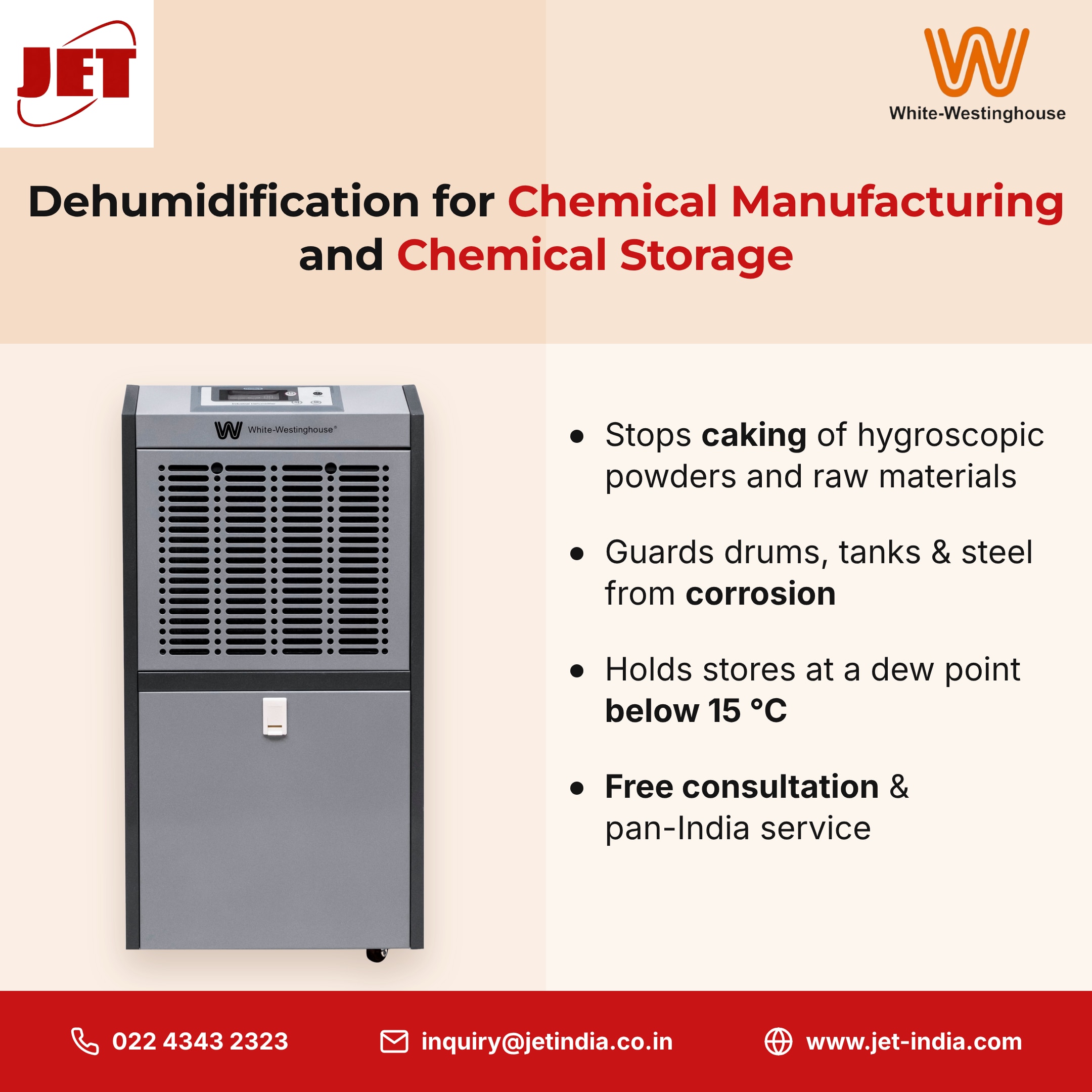
Walk into a chemical godown in Taloja or Vapi in the middle of the monsoon. You will usually see the same scene. Bags of caustic soda flakes that arrived dry and free‑flowing are now a block. A row of drums has orange rings around the base. Somebody’s label has slipped off. Is lying on the floor. Nobody did anything really. The air got in.
Chemicals are more sensitive to water than anything else you store. Some soak up water and cake. Some dissolve in water. A few react with water. That is when a quality problem becomes a safety problem. So controlling humidity in a chemical plant is not about comfort. It is about batches that weigh right, packaging that holds and storage that stay safe to walk into. As an industrial dehumidifier supplier working with plants across Mumbai, Thane, Gujarat, and further afield, we think it through one area at a time.
Wet air does three things to chemicals.
It helps you sort your stock by how it behaves around moisture because the answer changes what " enough" means.
Hygroscopic: it soaks water up.
Urea, acid, many detergent and fertiliser intermediates, powdered resins, precipitated silica. These pull moisture from the air. Hold it. The visible result is caking and powder that bridges in the hopper of flowing. The invisible result is worse. A sack with 2% water by weight puts 2% active material into your batch, and your weighing system doesn't know.
Deliquescent: it dissolves in the water it absorbs.
Past a humidity, some solids take in so much water they turn into a solution. That threshold is called the relative humidity or CRH. At 30 °C, ammonium nitrate sits at 59 % RH and urea at roughly 73 %. Here’s the catch. Mix the two and the blend’s CRH falls to around 18 %. So a store that’s "fine at 65 %" can be fine for one pallet and ruinous for the one beside it. Calcium chloride and caustic soda go liquid at humidities you’ll see indoors on days of the year along the coast.
Water‑reactive: it reacts with the water.
Isocyanates such as MDI and TDI react with moisture to give carbon dioxide and a hard crust which means drums and gelled product. Calcium carbide gives off acetylene. Anhydrous aluminium chloride fumes hydrogen chloride the moment it meets air. For these a dehumidifier is a supporting player, not the plan. Sealed containers, nitrogen blanketing and the storage conditions on your SDS come first. Dry air just takes the pressure off everything
The humidity number on the wall is the number.
Relative humidity only tells you half the story because it shifts with temperature. Dew point tells you the rest. At 30 °C and 70 % RH, an ordinary monsoon afternoon indoors the air holds about 18.7 g of water per kilogram and its dew point is 23.9 °C. Any surface cooler than that gets wet.
Plenty of surfaces are. Steel drums stacked against a shaded wall cool down. Morning comes the shutter goes up air rolls in and condenses straight onto them. Labels lift. Drum bases rust. Woven HDPE bags sweat on the inside, where you can’t see it until the product’s already lumpy. Steel corrosion speeds up noticeably once the surface RH goes past 60 % and on a cool drum that happens long before the room feels damp to anyone standing in it.
Now compare 25 °C at 50 % RH. The dew point drops to 13.9 °C. The air carries about 9.9 g/kg. That’s half the water. Same building, different risk.
Which is why dew point monitoring beats a single RH reading every time. For a chemical warehouse in India we’d aim to keep the dew point below about 15 °C. For hygroscopic or deliquescent stock 10 °C or lower.. Put the sensor where the product is. Most RH meters we’re shown in chemical stores are screwed to a pillar beside the door which tells you a deal about the door.
Where moisture costs you money, room, by room
Material store and bulk godown
The biggest volume of air is usually the leaky. Shutters stay open for trucks all day. You are not aiming for a number. You keep the dew point enough so bags do not cake and drums do not sweat. PVC strip curtains on the dock doors help a lot and cost little; we supply those too.
Batching, weighing and blending
This is where moisture causes batches to be rejected. For powder handling, blending and sieving we keep the room at 40–45% humidity. Above that you get caking, bridging and fill weights that vary. If your formulation is very sensitive go tighter.
Packing and filling
Whatever humidity is in the room goes into the bag with the product. Seal a hygroscopic powder at 75% humidity and it will keep caking on the shelf at the distributor and at your customer’s site with your name printed on the bag. Keep packing at the relative humidity band as batching.
QC lab and retention samples
Analytical balances drift in humid air reagents absorb water. Karl Fischer titrations take longer to settle when the room is wet. Retention samples need to stay exactly as they were on the day of dispatch. There is little point in keeping them. A small unit here is one of the pieces of insurance in the plant.
Finished goods and drum yards
Finished stock often sits for weeks waiting to be dispatched. A month of monsoon air can quietly undo a month of careful production. The targets are the same as the raw material store with attention to drums with bungs and any bag that has been torn and taped.
Check this before you place any unit: flammable areas
Solvent stores, tank farm pump rooms and any area classified as need flameproof electrical equipment. A standard industrial dehumidifier is not flameproof so it does not go inside a zone. There are no exceptions. Talk to your safety officer first. If a room is classified we will help you find a location for a unit or determine if that space needs a different approach altogether.
Refrigerant or Desiccant? Know which job you’ve got
Refrigerant dehumidifiers are efficient in spaces and will comfortably bring a room down to about 40–45% relative humidity. That covers chemical stores batching rooms and packing halls in India. They lose output below about 15°C and can frost up so they are not suitable for rooms.
Below 40% relative humidity or in chilled spaces you need a desiccant system. Some chemistry requires a drier environment. Lithium battery materials and very hygroscopic chemicals can require below 10% humidity often 1–2%, which is a dry‑room job. If that is your need we will say so on the call rather than sell you the wrong machine.
Now pick the dehumidifier for each area
Sizing depends on room volume, how often doors open, how damp incoming material is, and what target you are holding. Treat this as a starting point. We size properly from your floor plan.
Matching a dehumidifier for applications to your plant
QC labs, reagent stores, instrument rooms and retention sample cupboards - The AWHD-12L White Westinghouse Dehumidifier (12 Litres/Day) and the AWHD-20L White Westinghouse Dehumidifier (20 Litres/Day) are the size. They are portable, quiet and easy to move when the lab gets rearranged.
Packing rooms, dispensing areas and small raw‑material stores - Step up to the AWHD-306L White Westinghouse Dehumidifier (30 Litres/Day), or the AWHD-40L White Westinghouse Dehumidifier (40 Litres/Day).
Batching halls, blending rooms and medium godowns - This is where the WDE series is useful. Look at the WDE-603T White Westinghouse Dehumidifier (60 Litres/Day), the WDE 606 White Westinghouse Dehumidifier (60 Litres/Day), the WDE 702 White Westinghouse Dehumidifier (70 Litres/Day) and the WDE 100 White Westinghouse Dehumidifier (100 Litres/Day).
Large chemical warehouses, drum stores and dispatch bays with doors that never really close - The WDE 110S White Westinghouse Dehumidifier (110 Litres/Day), WDE150S White Westinghouse Dehumidifier (150 Litres/Day) and WDE-190S White Westinghouse Dehumidifier (190 Litres/Day) are built for this kind of load. In a building two or three units spread along its length usually beat one giant machine in a corner.
Want to compare them side by side? The whole range is, on our industrial dehumidifier page.
Talk to Our Team
If you are looking for an industrial dehumidifier supplier who will actually walk the plant with you tell us what you store, how large the rooms are and what problems you have seen. We will return with the industrial dehumidifier units sized for your space.
📞 Call for inquiry: 022 4343 2323
✅ Free consultation, wherever your plant is in India
🏭 Free demo of the product, available in Mumbai only
