
Maintaining the right humidity level is essential for
creating a comfortable, healthy, and well-maintained indoor environment.
Whether you are managing humidity in a residential property, office, commercial
facility, warehouse, or industrial space in @location, choosing the right dehumidifier can make a significant difference.
Excess moisture in the air can lead to several problems,
including mould growth, unpleasant odours, condensation, corrosion, furniture
damage, and deterioration of stored products and equipment.
A dehumidifier helps control indoor humidity by removing
excess moisture from the air and maintaining suitable environmental conditions.
However, selecting the right unit involves more than simply choosing a model
based on its capacity or price. Factors such as room size, humidity levels,
ambient temperature, moisture load, application requirements, and operating
conditions must be considered before making a purchase.
From portable units for homes and offices to high-capacity
systems for commercial and industrial applications, understanding your
requirements will help you make the right investment.
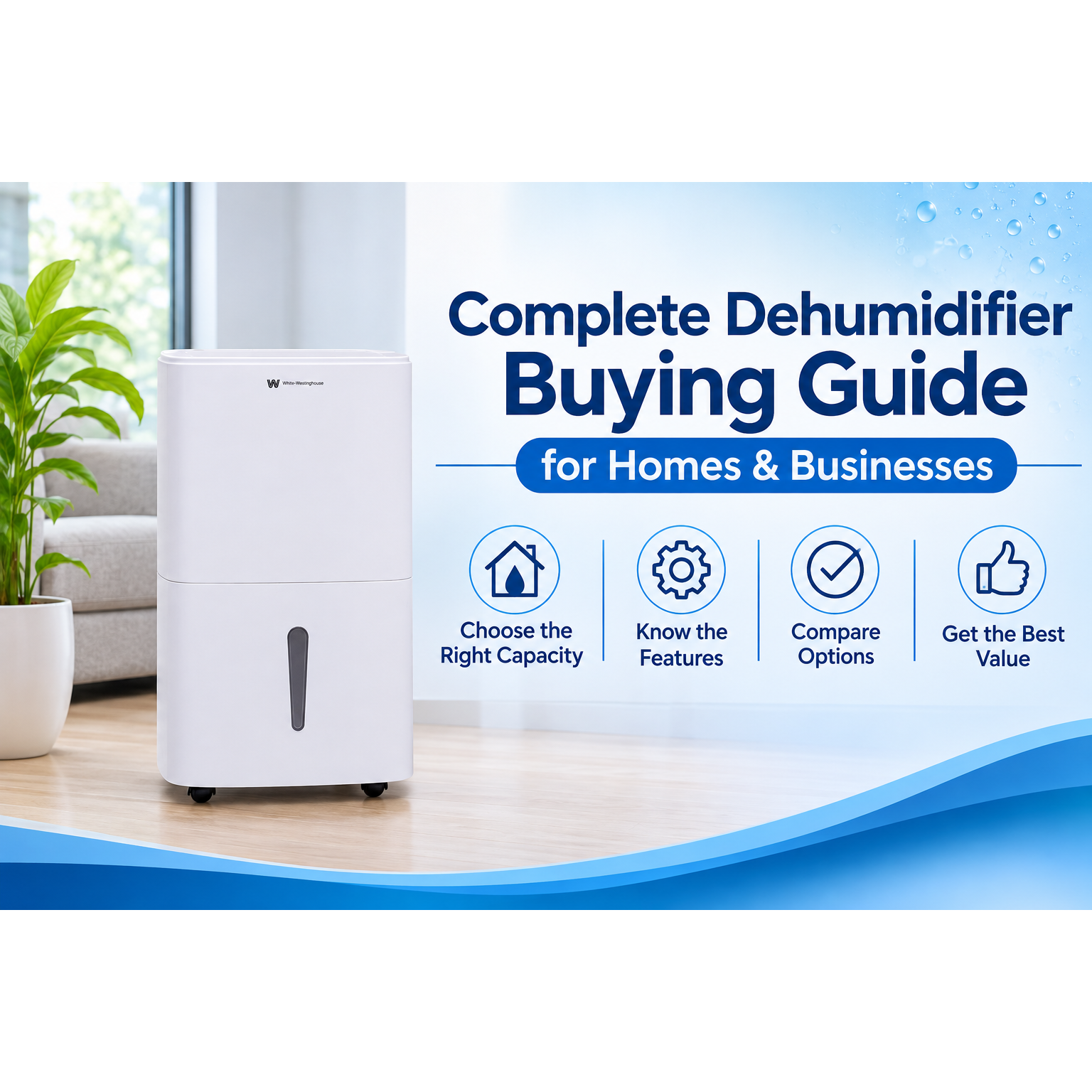
In this comprehensive dehumidifier buying guide, we will
explore the important factors to consider when choosing a suitable
dehumidification solution in @location.
1. Understand Your Dehumidification Requirements
The first step in choosing a dehumidifier is identifying why
you need humidity control. Different environments have different
moisture-related challenges, and the ideal equipment depends on the intended
application.
For residential spaces in @location, dehumidifiers are
commonly used to reduce dampness, prevent mould formation, control
condensation, and improve indoor comfort. Bedrooms, living rooms, basements,
kitchens, and bathrooms are common areas where excess humidity can become a
problem.
In commercial environments, humidity control is important
for maintaining comfortable working conditions and protecting furniture,
documents, electronic equipment, and other valuable assets.
Industrial facilities may require specialised
dehumidification systems to protect raw materials, finished products,
machinery, and manufacturing processes.
Understanding your application will help identify the most
appropriate dehumidifier.
2. Consider the Area Size and Space Requirements
The size of the area is one of the most important factors
when selecting a dehumidifier. A unit with insufficient capacity may struggle
to remove moisture effectively, while an oversized system could result in
unnecessary energy consumption and higher operating costs.
Before purchasing a dehumidifier in @location, determine the
approximate area and volume of the space where it will be installed.
Consider the following factors:
- Room size: Measure the length and width of the area to estimate its floor space.
- Ceiling height: Larger room volumes may require greater dehumidification capacity.
- Layout: Open spaces, interconnected rooms, and partitioned areas can affect air circulation.
- Air movement: Proper airflow helps distribute dry air throughout the space.
- Installation location: Ensure sufficient clearance around the unit for effective air intake and discharge.
- For smaller residential spaces, portable dehumidifiers may be sufficient. Larger commercial and industrial environments may require high-capacity systems.
3. Evaluate the Existing Humidity Level
Understanding the existing relative humidity (RH) level is
essential when selecting a dehumidifier.
Relative humidity represents the amount of moisture present
in the air compared with the maximum moisture the air can hold at a particular
temperature. High relative humidity can encourage mould growth, condensation,
and moisture-related damage.
For many indoor environments, a relative humidity range of
approximately 40% to 60% is a useful general target. However, specific
applications may require different humidity levels.
For example:
- Homes require humidity management to improve comfort and minimise dampness.
- Offices need suitable humidity conditions for a comfortable working environment.
- Warehouses may require controlled humidity to protect stored materials
- Industrial facilities may need precise humidity levels depending on manufacturing processes.
- Using a hygrometer or digital humidity meter can help you understand moisture conditions and determine the required dehumidification performance.
4. Choose the Right Type of Dehumidifier
Dehumidifiers are available in different technologies, each designed for particular operating conditions and applications.
Refrigerant or Compressor Dehumidifiers
These units draw humid air over a cooled coil, causing
moisture to condense and collect in a water tank or drainage system. The dried
air is then released into the surrounding environment.
They are commonly suitable for homes, offices, and
commercial spaces operating at moderate to warm temperatures.
Desiccant Dehumidifiers
Desiccant dehumidifiers use moisture-absorbing materials to
remove water vapour from the air. They can be particularly useful in
lower-temperature environments and applications requiring lower humidity
levels.
These systems are commonly considered for industrial
storage, pharmaceutical facilities, cold rooms, and specialised manufacturing
applications.
Industrial dehumidifiers are designed for larger spaces and
demanding operating conditions. They generally offer higher moisture removal
capacities and can support continuous operation in warehouses, factories,
production areas, and other large facilities.
Choosing the right technology depends on temperature,
humidity level, application, and required performance.
5. Check the Moisture Removal Capacity
Dehumidifier capacity indicates how much moisture a unit can
remove from the air over a specified period, commonly expressed in litres per
day (L/day).
Choosing the correct capacity is essential for achieving the
desired humidity level.
A unit with a low moisture removal capacity may not be
suitable for environments with high moisture loads. Similarly, selecting a
system with excessive capacity may increase the initial investment and
operating expenses.
- When evaluating capacity, consider:
- Total area and volume of the space.
- Existing relative humidity.
- Number of people occupying the area.
- Moisture generated by equipment and processes.
- Frequency of door openings and air exchange.
- Water infiltration or other moisture sources.
- Required humidity level and operating duration.
For industrial applications in @location, a professional
assessment of the moisture load can help determine the appropriate system
capacity.
6. Consider Ambient Temperature and Operating Conditions
Temperature plays an important role in dehumidifier
performance. Different dehumidification technologies perform differently
depending on surrounding temperature and humidity conditions.
Refrigerant-based systems generally work effectively in
moderate to warm environments. However, their performance may reduce in colder
conditions because of changes in condensation efficiency and coil icing.
Desiccant systems are often considered for low-temperature
applications where maintaining effective moisture removal is important.
Before selecting a unit, evaluate the following operating conditions:
- Minimum and maximum ambient temperature.
- Existing humidity levels.
- Continuous or intermittent operating requirements.
- Ventilation and air circulation.
- Dust and other environmental contaminants.
- Availability of suitable drainage and electrical connections.
Considering the local climate and actual operating
environment in @location helps ensure that the selected dehumidifier performs
reliably.
7. Evaluate Energy Efficiency and Operating Costs
A dehumidifier may operate for several hours daily,
particularly in commercial and industrial environments. Therefore, energy
efficiency should be an important consideration when comparing different
models.
Look beyond the initial purchase price and evaluate
long-term operating expenses.
Important factors include:
- Power consumption and rated electrical requirements.
- Moisture removal capacity relative to energy consumption.
- Operating hours per day.
- Maintenance and servicing requirements.
- Automatic humidity control features.
- Energy-saving operating modes.
- A properly sized and correctly selected dehumidifier can help minimise unnecessary energy consumption while maintaining the required humidity conditions.
For businesses in @location, considering long-term operating
costs can help improve the overall value of the investment.
8. Look for Essential Features and Controls
Modern dehumidifiers offer features that improve
convenience, efficiency, and reliability.
Some useful features to consider include:
- Digital humidistat: Allows users to monitor and adjust the desired humidity level.
- Automatic humidity control: Helps maintain the selected relative humidity.
- Continuous drainage: Reduces the need to manually empty collected water.
- Automatic defrost: Supports operation in suitable low-temperature conditions.
- Timer function: Allows users to schedule operating periods.
- Air filters: Help capture dust and airborne particles, depending on the filtration system.
- Safety protection: Features such as overflow protection and automatic shut-off improve operational convenience.
For industrial installations, additional considerations may include remote monitoring, automatic controls, and integration with existing HVAC systems.
9. Consider Maintenance and After-Sales Support
Regular maintenance is necessary to ensure consistent
dehumidifier performance and extend equipment life.
Before purchasing a unit, understand its maintenance
requirements and the availability of technical support.
Common maintenance activities include cleaning or replacing
air filters, inspecting drainage connections, cleaning moisture collection
components, and checking electrical and mechanical parts.
For commercial and industrial applications, professional
servicing can help identify potential issues before they affect operations.
When purchasing a dehumidifier in @location, consider the
manufacturer's warranty, spare parts availability, service support, and
technical assistance.
10. Select a Dehumidifier Based on Your Application
The ideal dehumidifier depends on where and how it will be
used.
Application Important considerations
Homes and apartments Room size, noise, portability, and comfort
Offices Energy efficiency, noise, and automatic controls
Warehouses Storage conditions, moisture load, and operating hours
Factories High-capacity performance and continuous operation
Pharmaceutical facilities Precise humidity control and process requirements
Food processing Product protection and environmental conditions
Cold storage Low-temperature performance and moisture management
Whether you operate a residential property, commercial
establishment, or industrial facility in @location, a proper assessment of your
application ensures that the selected equipment meets your immediate and
long-term requirements.
Find the Right Dehumidifier with JET INDIA
Choosing the right dehumidifier is an important investment
in maintaining indoor comfort, protecting valuable assets, and ensuring
suitable environmental conditions.
From compact portable units for homes and offices to
high-capacity industrial dehumidification systems, the right solution depends
on several interconnected factors, including area size, moisture load,
temperature, relative humidity, and operating conditions.
At JET INDIA, we understand that every application has
unique humidity control requirements. Selecting equipment based on these
factors is essential for achieving effective and reliable performance.
Whether you require a dehumidifier for residential use,
commercial spaces, warehouses, or industrial facilities in @location, our team
can assist you in identifying a suitable solution for your application.
Looking for the right dehumidifier for your home or business
in @location? Contact JET INDIA today for expert assistance in selecting a
suitable dehumidification solution.