
There is a kind of frustration that comes from opening a sealed drum of active ingredient and finding it has turned into a solid block instead of a free-flowing powder. The powder was stored properly. Nobody spilled anything on it. Nobody left it out overnight. It just sat in storage doing what hygroscopic powders do when the air around them carries moisture than it should. Quietly pulling water out of that air one molecule at a time, until individual particles start sticking together into clumps and clumps start sticking together into something closer to a brick.
That is powder caking, and in pharmaceutical manufacturing, it is rarely treated as the process line issue it actually's. It gets logged as a raw material problem, a supplier quality issue, or a "just re-mill it" inconvenience. The real cause is usually sitting in the humidity reading of the room where the powder was stored or handled.
Why does powder cake in the place
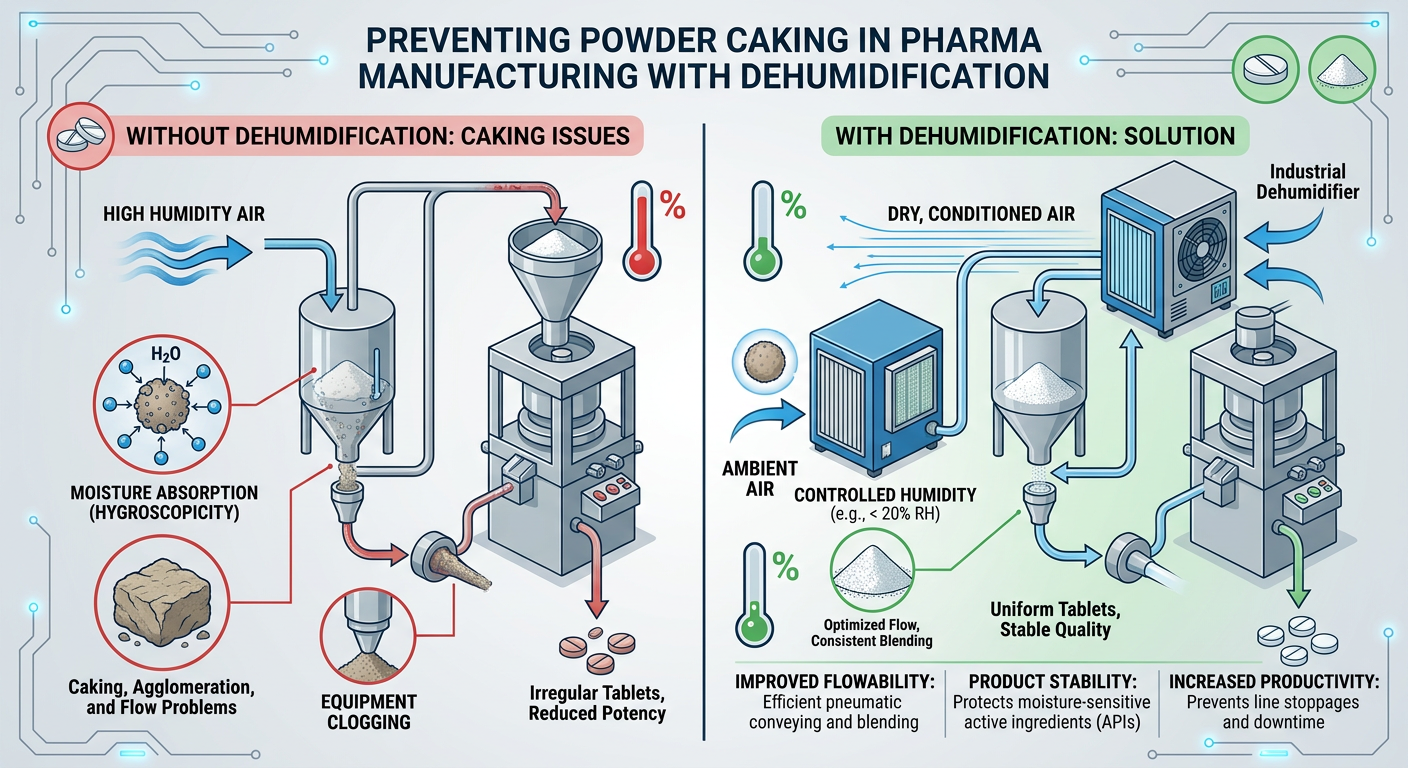
Most active ingredients and excipients used in pharma are at least somewhat hygroscopic, meaning they naturally absorb moisture from the surrounding air. At humidity, that is rarely a problem. The powder stays dry and free-flowing. Once the surrounding relative humidity crosses a certain threshold, specific to that material, the powder starts absorbing enough moisture for individual particles to develop thin liquid bridges between them. Those bridges. Recrystallize as the material settles, effectively welding particles together at a microscopic level.
The tricky part is that this threshold. Often called the relative humidity of a material. Is not the same for every powder. Some ingredients start caking above 45 percent relative humidity. Others tolerate humidity in the 60s before real clumping sets in. A facility running humidity for one product line can be creating a caking problem for another sitting three rooms away, which is exactly why blanket assumptions about room comfort do not hold up in pharma manufacturing the way they do almost everywhere else.
Where it actually causes damage
Powder caking does not just make a powder awkward to scoop. It changes how that material behaves at every step.
In storage, caked material loses the flow properties with which it was tested and approved, which means the next process step is no longer working with the powder its parameters were designed for. In milling and blending, caked chunks resist breaking down leading to inconsistent particle size distribution. Which directly affects dissolution behavior in the finished dose. In compression, clumped or unevenly flowing powder is one of the common root causes of weight variation, capping and lamination defects because the tablet press depends on consistent predictable flow into the die cavity to do its job correctly.
There is also the side that rarely gets enough attention: caked or partially caked powder is significantly harder on equipment. It clings to hopper walls, bridges over feed openings resists conveying and forces operators into manual intervention. Knocking, vibrating, sometimes physically breaking material apart. That introduces its own contamination and consistency risks.
Why is this a humidity problem, not a material problem
It is easy to blame the raw material itself when powder caking shows up especially if a particular batch or supplier seems to cake more than others. Sometimes that is genuinely the case. Different lots can have particle size distributions or surface characteristics that affect how readily they absorb moisture.. Far more often the material is behaving exactly as its specification predicts and the room it is sitting in simply is not holding the humidity that specification assumes.
This is why powder caking complaints tend to cluster. A powder that stored well in February, when ambient humidity outside was manageable starts showing clumping by July. Not because the supplier changed anything but because the storage or handling areas humidity crept upward as the outdoor air got wetter and the general air conditioning was not built to hold a firm target the way dedicated dehumidification is.
What actually prevents it
Holding powder handling, milling and storage areas within the humidity range a material calls for. Rather than whatever range feels comfortable. Is the single most reliable way to prevent powder caking before it starts. That means dedicated, continuously running dehumidification in these spaces than relying on a central HVAC system that is primarily sized for temperature and occupant comfort.
Sizing the unit to the room matters much as having one at all. A smaller powder dispensing or mixing room is often well served by something like the WDE-603T while blending, milling or raw material storage areas typically need the higher extraction capacity of a WDE-100 or a WDE-110P. Undersizing is one of the most common reasons a facility installs a dehumidifier and still sees powder caking during peak monsoon load. The unit simply can not keep pace with the moisture entering a larger space.
For facilities managing powder sensitive areas at different capacities it is worth reviewing the full range of industrial dehumidifiers rather than defaulting to one model across every room. Storage areas, active dispensing booths and milling rooms rarely have moisture loads and treating them identically is how gaps in coverage happen.
Getting ahead of it of reacting to it
The facilities that stop dealing with powder caking altogether are usually the ones that stopped treating it as a raw material inconvenience and started treating it as an environmental control gap. Once humidity is being actively managed at the threshold a material needs. Not just kept roughly comfortable. Powder caking tends to disappear from the deviation log almost entirely along with the rework, re milling and equipment downtime that came with it.
If powder caking has been showing up in your storage or handling areas more in months than others that seasonal pattern is usually the clearest sign that humidity, not the material itself is the root cause worth investigating first.
Seeing powder caking issues that seem to track with the weather Contact JET India TODAY. Call 022 4343 2323 or email inquiry@jetindia.co.in for a facility assessment, from JET INDIA.