

Be honest — when you're scanning a dehumidifier spec sheet, do you actually stop at the line that says "refrigerant: R290" or "refrigerant: R410A"? Most people don't. It reads like a footnote for engineers, so the eye just slides past it. But that little line is doing a lot of quiet work. It shapes how much power your unit burns each month, how it has to be installed, and how much damage it does to the planet if it ever leaks. Worth a second look, then.
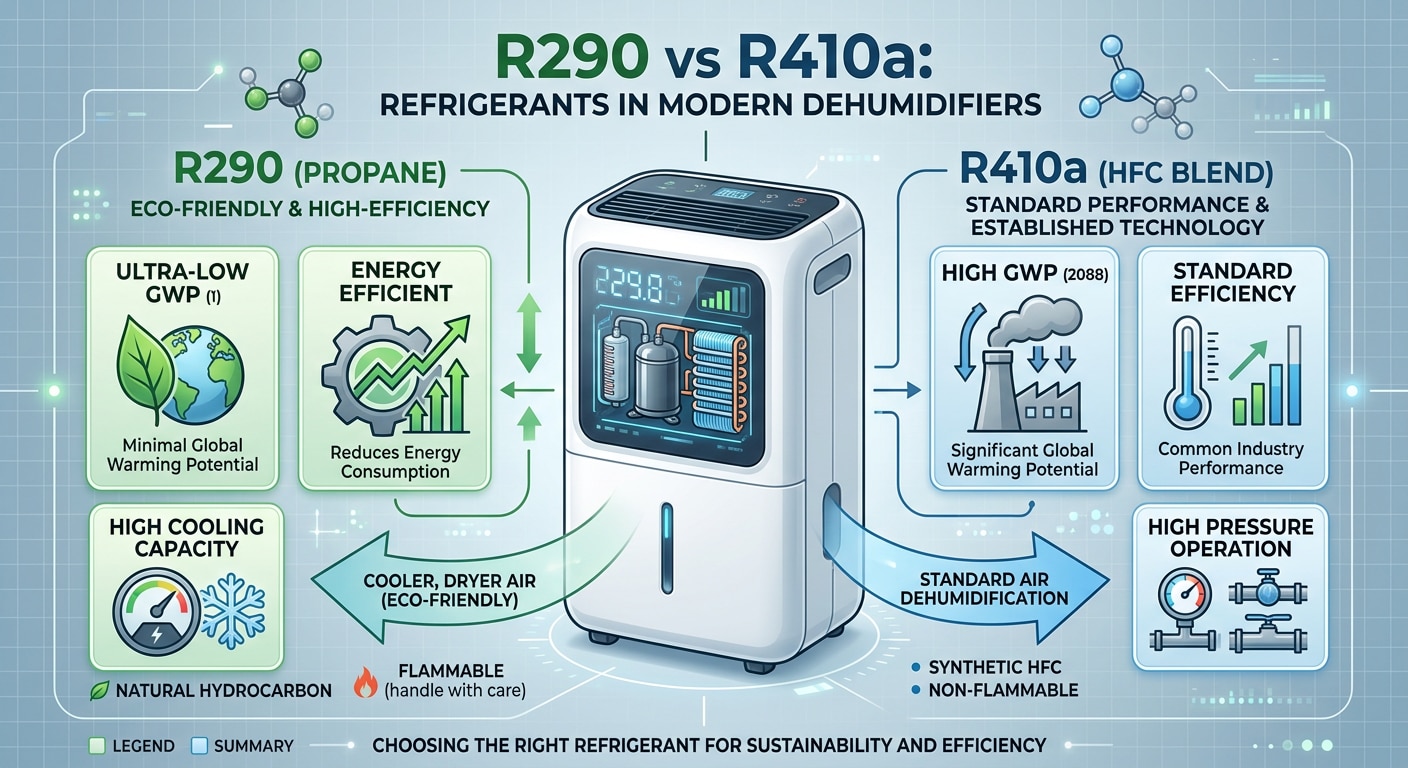
Here's the gist. R290 is a natural hydrocarbon refrigerant — propane, basically — and its Global Warming Potential (GWP) is around 3. R410 is a synthetic HFC blend, and its GWP is about 2,088. Both do the cooling job just fine. The difference shows up in efficiency, in how you handle them safely, and in their environmental footprint. Which one is "better" honestly depends on where you're putting the unit and how hard you plan to run it. If you want to eyeball some R290 models first, take a look at our Portable Dehumidifier Range and then come back.
First off — what is R290?
R290 is just propane doing a different job. It's a natural, hydrocarbon gas that's been kicking around refrigeration chemistry for decades, and lately it's had a real comeback as the favourite for efficient, low-emission cooling. It's colourless, and in the form that goes into appliances, pretty much odourless too. It won't poison you, and it won't eat away at the insides of a compressor — your coils, seals, and copper tubing last just as long as they would on any conventional refrigerant.
The clever bit is how it behaves. R290 has a low boiling point and a high latent heat capacity, which is a fancy way of saying it drinks up a lot of heat as it evaporates in the coil. That's the real reason R290 dehumidifiers usually pull the same amount of water out of the air on less electricity than an R410 unit would. And since it's a single ingredient rather than a mix, it stays predictable across its whole operating range — none of that risk of the components drifting apart during a slow leak, which can trip up some blended refrigerants. Over on our side, R290 powers the domestic and mid-capacity units, including the AWHD-12L, WDE 702, and WDE 100.
And R410? Where does that fit in?
R410A is a lab-made hydrofluorocarbon (HFC) blend, cooked up years back to replace older ozone-wrecking gases like R22 in ACs and dehumidifiers. Its headline feature is that it doesn't catch fire under normal running conditions. For the people installing and servicing these units, that's a genuine relief — no ignition risk to design around, and servicing is that much simpler on the fire-safety front.
It's earned its "workhorse" reputation in mid-to-large systems because it's stable, well understood, and plays nicely with a huge pool of existing compressor tech. It also runs at higher pressures than the gases it replaced, which suits the big industrial compressors built to shift a lot of air in a hurry. The trade-off? R410A is a blend of two HFC compounds, and its recipe was tuned decades ago for stability and compatibility — keeping emissions down was never really the point. On our shelf, the WDE-603T, WDE-110P, and WDE-110S run on R410, chosen on purpose for their higher-capacity compressors.
The environmental gap is wider than most people guess
This one really isn't close. R410A's GWP is roughly 2,088, meaning a single kilo of the stuff, leaked into the air, traps about as much heat over a century as 2,088 kilos of CO2. R290 sits at around 3. Read those two numbers again — that's not a small margin; it's a different league entirely.
It's exactly why R290 keeps getting called an eco-friendly refrigerant, and why regulator after regulator is phasing HFCs like R410A out in favour of natural options. And the thing people tend to shrug off: refrigerant loss isn't some once-in-a-blue-moon disaster. Little leaks happen over a unit's life — at the fittings, during a service visit, when it's finally scrapped. A small R410A leak punches well above its weight on climate impact compared to the same puff of R290, just because of how the two gases sit in the atmosphere. So if your buying decisions come with sustainability targets, carbon reporting, or you're simply trying not to get caught out by tightening rules, R290 is the safer long-term bet. A lot of countries have already put HFC phase-down dates on paper, and whatever you buy now has to stay legal and serviceable for years yet.
Efficiency: which one's kinder to the electricity bill?
R290, more often than not. That low boiling point and high latent heat mean it can wring moisture out of the air with less work from the compressor — and that lands straight on your monthly bill. It counts for most in the units that never seem to switch off: warehouses, server rooms, storage sheds. A dehumidifier chugging away 16 to 18 hours a day through monsoon isn't pocket change, and even small per-litre savings pile up fast at that pace.
That's not a knock on R410A, mind you — it's dependable and steady. It just tends to need a bit more energy to shift the same amount of water, because efficiency was never top of its design brief. So on running cost alone, R290 has the edge. But the right pick still comes down to the capacity and the job at hand, because not every capacity is on offer in both refrigerants.
Safety: R290's flammability vs R410's easy handling
No point tiptoeing around it — R290 is flammable because it is propane. That one fact drives every safety call around it. Units on R290 need the right refrigerant charge limits, decent ventilation, and an installer who actually knows hydrocarbon refrigerant protocols. That's just standard practice across the trade, not some quirk of one brand. The charge limits are baked in at the factory, so a unit that's correctly installed and running within its rated charge carries very little risk in day-to-day use. Treated properly, R290 has a solid safety record — it's non-toxic, non-corrosive, and already humming away safely in millions of appliances, from the fridge in your kitchen to plenty of small split ACs.
R410A's edge is simply that it won't ignite under normal conditions, which wipes the ignition question off the table and makes life easier when you're fitting a unit into a tight or occupied spot — a server room, say, or packed-out storage. Neither gas is "unsafe" in any real sense. They just come with different risk profiles that installers handle in different ways, and both are perfectly standard, regulated refrigerants you'll find right across the HVAC world.
Cost: day one, and down the road
R290 is generally cheaper to make and to buy, since propane is a common industrial commodity, while R410A is a manufactured HFC blend that faces production quotas in a lot of places under phase-down rules. Stretch that over a unit's lifetime and R290 can work out cheaper overall — both on the refrigerant top-ups at service time and on the electricity you save from better efficiency.
R410A units won't necessarily cost more on the day you buy them, but the regulatory squeeze on HFCs has been nudging R410A prices upward in several markets, and that's tipped to carry on as the global phase-down speeds up and quotas get tighter. If you're planning equipment in multi-year cycles, that direction of travel belongs in your total-cost sums — not just the price tag you see today.
R290 vs R410, side by side
So which Jet India models use which?
We pick the refrigerant by capacity and use, not by some premium-vs-budget split. Smaller domestic and portable units go with R290; the bigger industrial ones go with R410. Simple as that.
On the R290 side, the AWHD-12L (12L/day, portable, 45 dB(A), 255W, 8.5 kg) is the one for homes and small rooms, where a quiet unit that sips power is what you actually want. Step up and the WDE 702 (70L/day, up to 7,000 cubic ft, 45 dB(A), 860W, 23 kg) and WDE 100 (100L/day, up to 20,000 cubic ft, 60 dB(A), motor drain pump, 1400W, 40 kg) both stick with R290 for the bigger residential and light-commercial spaces that still like a low running cost.
Cross over to R410 and the WDE-603T (60L/day, holds 30–80% RH, 50–120 m², 7L tank, 35 kg) is your controlled-commercial choice. The WDE-110P (110L/day, 100–130 m², 1450W, 950 m³/hr airflow, 50 kg) and WDE 110S (110L/day, up to 11,000 cubic ft, 60 dB(A), motor drain pump, 1450W, 50 kg) are the heavy hitters, built for demanding industrial and warehouse jobs where shifting a lot of air beats chasing a few points of efficiency.
Everything in between is covered too — the AWHD-20L (20L/day), AWHD-307L (30L/day), AWHD-306L (30L/day), AWHD-40L (40L/day), WDE 606 (60L/day), plus the big WDE150S (150L/day) and WDE-190S (190L/day). If you're sizing up our industrial dehumidifier lineup for a big facility, assume R410 is behind those larger compressors.
Whichever refrigerant it runs on, every model comes with a 12-month warranty and is made in India as part of our White-Westinghouse (USA) partnership. And if your building has several zones pulling different humidity loads, there's nothing odd about running R290 units in the occupied offices and R410 units out in the larger storage or production areas — you match the gas to the room instead of forcing one blanket standard on everything.
Talk to Our Team–
📞 Give us a call at 08048038959. Please keep 0 before dialling the number.
✅ Free consultation - provide us with the details of your cold storage, and we'll give you a recommendation for capacity and placement.
🎯 Free product demonstration - only available in Mumbai; see a dehumidifier in action at your facility before making a purchase decision.
🛠️ Explore our inventory of commercial dehumidifiers.
Explore our complete range of Industrial Dehumidifiers and let our specialists help you choose the ideal solution for your cold storage or processing facility. Visit our Contact Us page today to get started.
