

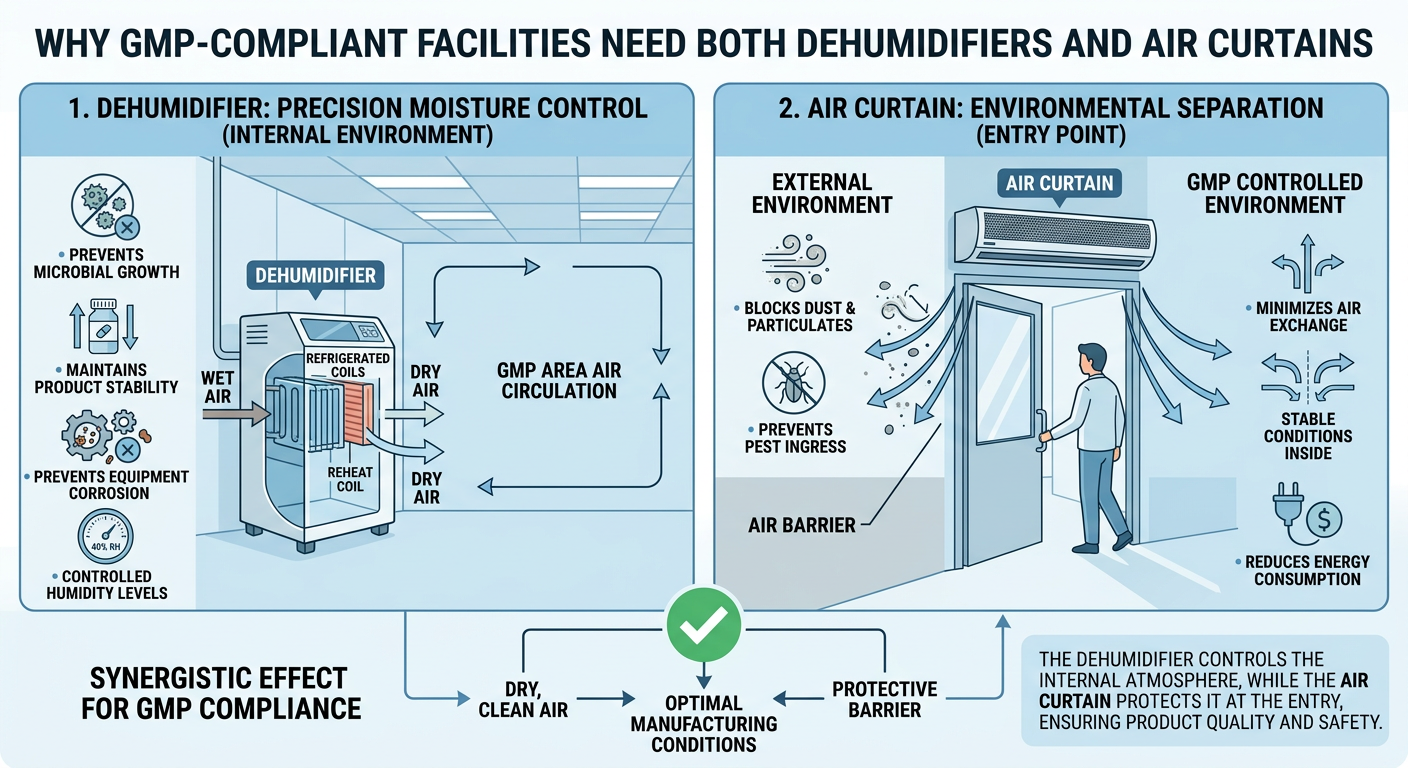
Every GMP facility has a door problem. You can get the humidity in a room right, but when someone wheels a trolley through the entrance, it messes everything up. That one doorway does damage to your environmental controls in seconds that most equipment failures do in a week.
GMP guidelines are very strict about everything, but the entry points where controlled air meets uncontrolled air often get ignored. These are the areas where a facility's environmental control really gets tested every shift.
The part of GMP that's easy to underestimate
Good Manufacturing Practice is about the environment. Temperature, humidity, particulate levels, microbial load. Staying within limits. A dehumidifier holding a room at 50% RH is doing its job. If that room loses its humidity control every time a door opens, the dehumidifier is fighting a losing battle.
Most facilities think of dehumidification and physical barriers as things. One for climate, one for hygiene. They're solving the same problem from different directions. A facility that only invests in one is always going to be working harder than it needs to.
What a dehumidifier actually protects against
A dehumidifier pulls moisture out of the air, holding the room in a humidity band. This is crucial for powder handling, compression, production, and cleanroom storage. Moisture-sensitive materials degrade quickly.
The problem is that dehumidifiers react to moisture that's already in the room. They can't stop humid outside air from entering through a doorway.
What does an air curtain actually protect against
An air curtain creates a high-velocity stream of air across an entrance, acting as a seal. It keeps outside air, dust, insects, and humidity out of the controlled space.
For GMP facilities, this matters in two ways. At production and cleanroom entrances, it reduces particulate load. At loading docks and warehouse doors, it stops humidity swings that would otherwise force the dehumidification system to work
Why is using only one leaves a gap
A facility that installs dehumidifiers but skips air curtains ends up with a system that's constantly playing catch-up. A facility that installs air curtains but skips dehumidification has the problem. It does nothing for moisture already generated inside the room.
Used together, the two systems divide the work. Air curtains handle the doorway dehumidifiers handle everything inside. The result is a flatter, more stable humidity profile.
Where this matters most
Not every doorway needs the treatment. Cleanroom and production entrances benefit most from air curtains. Loading docks and warehouse doors are usually the highest-priority spots to pair an air curtain with a sized industrial dehumidifier.
For the rooms themselves. Powder handling, compression, packaging, and clean storage. Capacity matters most. Undersizing either system is a reason a facility installs the right equipment and still can't hold its target range.
The combined approach pays for itself
The two systems reduce the load on each other. An air curtain that stops air at the door means a dehumidifier that doesn't have to work as hard. This shows up directly in energy costs and equipment lifespan. For a GMP facility, it also shows up in more consistent environmental monitoring data.
Not sure whether your facility's entrances or your humidity control needs the fix first?
Get in touch with JET INDIA for a facility assessment.
Call 022 4343 2323. Email: inquiry@jetindia.co.in