

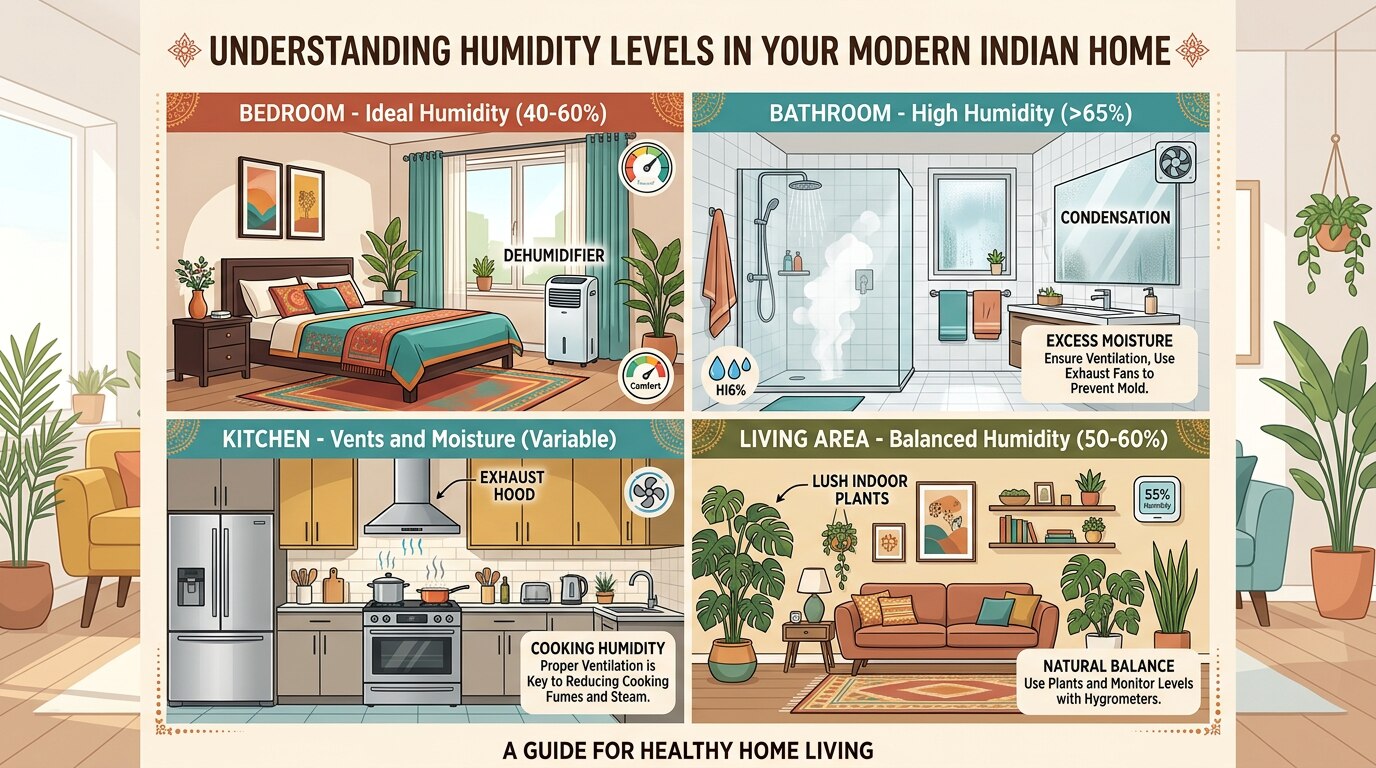
The ideal humidity level for a home is between 30% and 50% relative humidity (RH), though the right number shifts depending on which room you're standing in. A bedroom that feels perfect at 45% RH can be a mould risk in a bathroom at the same reading, because moisture behaves differently depending on ventilation, temperature, and how the space is used. In humid coastal cities like Mumbai, where ambient outdoor RH often sits above 70% for months at a time, hitting these targets indoors takes more than opening a window — it takes knowing what's realistic per room and when mechanical help, like a Portable Dehumidifier From Jet India, becomes necessary rather than optional.
Most people never check their home's RH percentage at all. They notice the damp smell, the fogged-up mirror, or the black spots creeping along a bathroom ceiling — by which point the problem has already been growing for weeks. This guide breaks down the ideal humidity range for every room in an Indian home, what happens when each one runs too high or too low, and exactly how to measure it instead of guessing. Consider it the practical follow-up to any discussion of monsoon damage: the specific numbers to watch for, room by room.
Bedroom Humidity: The 30–50% Rule (With a Sleep-Specific Target)
The ideal humidity level for a bedroom is 30–50% RH, but sleep-comfort research narrows that further to 40–55% RH as the sweet spot for uninterrupted rest. Bedrooms spend more consecutive hours occupied than any other room, so small humidity swings here compound into real sleep quality problems.
Above 55% RH, bedrooms turn clammy. Sheets feel damp, dust mites multiply faster in the moist air trapped in mattresses and pillows, and people with allergies or asthma often wake up congested without knowing why. Below 30% RH, the opposite problem shows up: dry throat, cracked lips, irritated sinuses, and static-prone skin, especially common in rooms running air conditioning all night without any humidity buffering. Mumbai bedrooms with windows facing the sea or ground-floor units near drainage lines tend to run high even with AC on, because the compressor cools the air without meaningfully drying it once RH is already elevated. A compact unit like the AWHD-12L – 12 Litres/Day or AWHD-20L – 20 Litres/Day is sized well for a single bedroom.
Bathroom Humidity: Spikes Are Normal, Staying High Isn't
Bathroom RH should sit under 60% most of the time, and brief spikes to 80–90% during a hot shower are completely normal — the problem is only when it doesn't drop back down within 20–30 minutes of ventilation. A bathroom is the one room in the house designed to tolerate short humidity surges; it's the recovery time that matters.
If your exhaust fan is weak, absent, or you keep the door shut with no airflow, that post-shower spike lingers for hours instead of minutes. Persistent high humidity here is what turns grout lines black, peels paint off bathroom ceilings, and rusts metal fixtures — a pattern that accelerates dramatically during monsoon months when the air entering through any vent is already saturated. Running an exhaust fan for a full 30 minutes after bathing, and wiping down wet tiles, cuts recovery time significantly even without mechanical dehumidification.
Kitchen Humidity: The Room Most Homes Get Wrong
Kitchens should stay under 60% RH, but poor ventilation combined with daily cooking steam pushes many Indian kitchens chronically above that line, especially in compact Mumbai flats without exhaust chimneys. Boiling, steaming, and pressure cooking release large volumes of water vapour in a short time, and without extraction, that moisture settles into cabinets, walls, and ceiling corners.
A kitchen that stays humid long-term becomes an attractive environment for cockroaches and ants, both drawn to moisture, and mould frequently develops behind cabinets and under sinks where nobody checks regularly. This is a slow-building problem — most homeowners only notice once they smell it or move an appliance and find dark staining underneath. Running an exhaust fan or chimney during and after cooking, not just during, is the single biggest lever most kitchens are missing. For an open kitchen-dining space, a mid-capacity unit like the AWHD-307L – 30 Litres/Day or AWHD-40L – 40 Litres/Day handles the moisture load comfortably.
Basement and Storage Room Humidity: Keep It Under 55–60%
Basements, ground-floor storage rooms, and godowns common in older Mumbai buildings should stay under 55–60% RH, since these spaces typically have the least natural ventilation and the most contact with damp foundations or walls. Anything above that range consistently, and you're looking at long-term structural dampness, not just a temporary nuisance.
Storage rooms are particularly vulnerable because the damage is invisible until it isn't — cardboard boxes, files, fabric, and wooden furniture absorb ambient moisture slowly, and by the time you notice a musty smell or visible mould on a stored item, the humidity has usually been elevated for weeks or months. These rooms rarely get opened daily, which means natural airflow alone rarely corrects the problem; they're often the first place in a home where a dedicated dehumidifier makes the most measurable difference. For larger storage areas or godowns, step up to the AWHD-306L – 30 Litres/Day or a higher-capacity commercial model.
Living Room and Common Areas: The General Comfort Target
Living rooms and common areas should stay within the same general 30–50% RH band that applies to the home overall, since these spaces don't have a single dominant moisture source the way bathrooms or kitchens do. Comfort here is more about steady-state control than managing spikes.
Because living rooms are usually the largest enclosed volume in a home and often have the most window and door traffic, they tend to track outdoor humidity closely. In Mumbai during the dry months, this isn't a major issue, but through monsoon and the humid pre-monsoon weeks, living rooms can sit at 65–75% RH for extended stretches, which is enough to make upholstery feel damp, wooden furniture doors stick or warp, and a persistent mustiness settle into curtains and carpets. A larger living room or open-plan floor benefits from a higher-capacity unit such as the WDE 702 – 70 Litres/Day, WDE-603T – 60 Litres/Day, or WDE 606 – 60 Litres/Day.
How to Measure Humidity at Home: Use a Hygrometer, Not Your Nose
The only reliable way to measure humidity at home is with a hygrometer — a small humidity meter that reads current RH% instantly, the same way a thermometer reads temperature. Guessing based on how a room "feels" is unreliable because humans adapt to gradual humidity changes and stop noticing them.
A basic digital hygrometer costs little and gives an instant percentage reading. For an accurate reading: place the unit away from direct sources of moisture like an open window, an active shower, or a stove, at roughly chest height, and let it sit for 10–15 minutes before reading, since the sensor needs time to stabilise to ambient conditions. Cheap hygrometers can drift by a few percentage points, so if a reading seems borderline, check it again at a different time of day before deciding a room has a genuine problem. Buying one hygrometer per major zone — bedroom, kitchen, and any basement or storage room — gives a far more accurate picture than a single reading for the whole house.
Why India's Monsoon Makes Humidity Control Genuinely Harder
During India's monsoon months, outdoor ambient humidity frequently exceeds 80–90% RH, which means opening windows for "fresh air" often makes indoor humidity worse, not better. This is the single biggest misunderstanding homeowners have about ventilation.
Natural airflow works when outdoor air is drier than indoor air. For most of the monsoon season across Mumbai and other coastal cities, that condition simply doesn't exist — the air coming in is already saturated. Rooms with poor cross-ventilation, ground-floor units, and spaces near bathrooms or kitchens are the first to cross into mould-risk territory, often within days of sustained rain. Mechanical dehumidification is the only reliable way to bring a room back into the 30–50% healthy range when outdoor conditions won't cooperate. If your home covers multiple floors or you want one powerful unit for a large area, the high-capacity WDE 100 – 100 Litres/Day, WDE 110S – 110 Litres/Day, WDE-110P – 110 Litres/Day, WDE150S – 150 Litres/Day, and WDE-190S – 190 Litres/Day models cover the largest spaces. For commercial and industrial spaces, browse the full industrial dehumidifier range.
Ideal Humidity Chart by Room
Simple Steps to Check If a Room's Humidity Is a Problem
Check windows and glass surfaces for condensation, especially in the morning or after the AC has run overnight.
Do a smell test — a persistent musty odour, even faint, usually means RH has been elevated for a while.
Place a hygrometer in the room for 15 minutes and note the reading against the target range for that room type.
Inspect corners, behind furniture, and under sinks or cabinets for visible mould spots or discolouration.
Check wooden doors, windows, and furniture for sticking, swelling, or warping, which points to sustained high humidity.
Note how the room feels after 10 minutes — a clammy, heavy feeling is a reliable sign even before you check a number.
Track the hygrometer reading across a few days, not just once, since a single reading can be misleading during a temporary spike.
If two or more of these checks flag a problem, that room's RH percentage is very likely outside the healthy range and worth acting on before it becomes visible damage.
Frequently Asked Questions
What is the ideal humidity level for a bedroom?
The ideal humidity level for a bedroom is 40–55% RH, which is the range most associated with comfortable, uninterrupted sleep. Below 30% causes dry throat and skin; above 55% leads to a clammy feeling and higher dust mite activity, both of which disrupt sleep quality without an obvious cause.
What is the ideal humidity level for a bathroom?
Bathrooms should stay under 60% RH most of the time, though temporary spikes to 80–90% during a shower are normal and expected. The concern is only when humidity fails to drop back below 60% within 20–30 minutes of ventilation, since that's when mould and paint damage begin.
How do I know if my home's humidity is too high?
Common symptoms include condensation on windows, a musty smell, visible mould or mildew spots, peeling paint, and wooden furniture or doors that stick or warp. A hygrometer reading above 60% RH in most rooms confirms the problem rather than leaving it to guesswork.
How do I measure humidity at home without a hygrometer?
You can't measure it accurately without one — a hygrometer is inexpensive and gives an exact RH% reading, unlike relying on how a room feels. If you don't have one yet, look for physical signs like condensation, musty odour, or mould as an interim indicator, then confirm with a hygrometer as soon as possible.
Why is my home more humid than the recommended range even with the AC running?
Standard air conditioners cool air but aren't designed to remove significant moisture, especially once ambient humidity is already high, which is common in Mumbai and other coastal Indian cities. During monsoon particularly, AC alone often isn't enough, and a dedicated dehumidifier is needed to bring a room back into the 30–50% healthy range.
Do you offer a product demo?
Yes — Jet India offers a free product demonstration in Mumbai. Contact us to book a demo or to get sizing help for homes elsewhere in India.
