

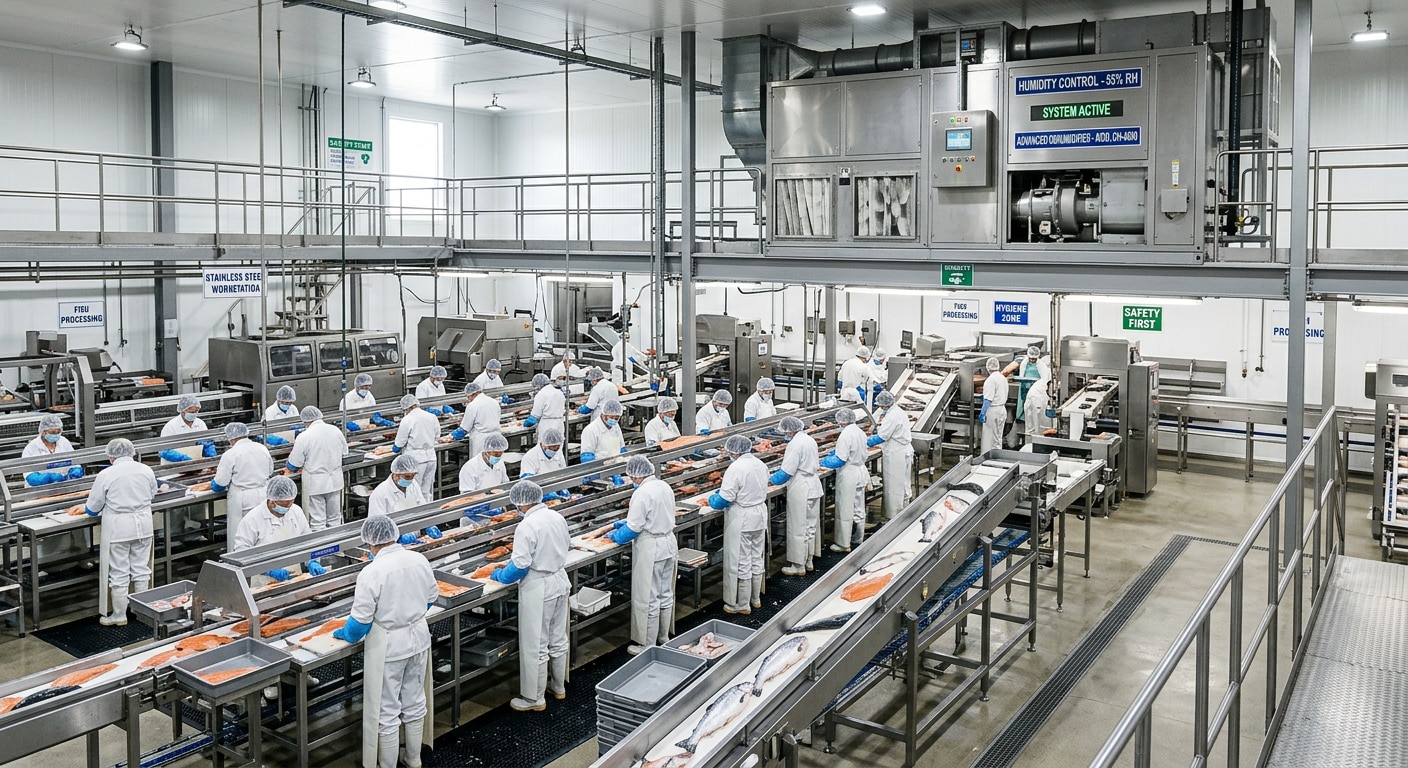
Ask any production manager at a seafood plant what keeps them up at night, and you'll hear the same handful of answers. Yield. Audits. Rejected consignments. What you probably won't hear is "humidity" — and that's exactly the problem, because in most Indian fish processing units, humidity is quietly behind all three.
Think about how much water moves through your facility on an ordinary day. Flake ice on the receiving floor. Chilled water tanks. Hoses running during washdown. Steam off the cooking line. Brine. Thaw water. And then the fish itself, which is roughly 70% water and giving some of it up at every stage. Now put that building on the coast — Veraval, Mangalore, Kochi, Visakhapatnam, Mumbai, Porbandar — where the air outside is already sitting at 80% RH before you've opened a single door.
The result is a plant that operates permanently at the edge of saturation. And when air can't hold any more moisture, it starts putting that moisture somewhere. Usually on your ceilings, your coils, your packaging, and your product.
Where the money actually leaks out
The dripping ceiling. This is the one everybody recognises. Warm humid air touches a cold surface — a refrigeration duct, a steel beam, the underside of a mezzanine — and condenses. Then it falls. If it falls onto a grading table or an open carton, you've got a hygiene incident on your hands, not a housekeeping issue.
EIA inspectors look for condensate above exposed product specifically. So do buyer auditors from the EU and the US. It's a critical finding under HACCP, and depending on where the drop landed you're either reworking, downgrading, or dumping. In an export unit, one condensation observation during the wrong audit can put your approval number in question. That's a risk that has nothing to do with the quality of the fish you bought.
Weight walking out of the chill room. Chilled fish held in dry, badly controlled air loses moisture through evaporation. You're literally selling water weight, and it's leaving through the evaporator. At the same time, swinging humidity causes surface drying, dull colour and texture change — which is how a consignment of pomfret or seer fish slips down a grade. On high-value species, losing one grade across a single shift costs more than most people realise until they sit down and price it.
Ice where it shouldn't be. Every time a cold store door opens, humid air walks in with the trolley. That moisture doesn't stay in the air at −20°C. It freezes onto your evaporator coils, your ceiling, your racking and your floor. Iced coils transfer heat badly, so the compressors run longer and your power bill climbs. Defrost cycles come more often, and each one nudges product temperature up — which means more freezer burn and more drip loss when the customer finally thaws it. Meanwhile, frost sitting on cartons softens the board and the stack starts to lean. And ice on a floor where forklifts operate is an accident waiting for a date.
Seals and labels that quit on you. Vacuum sealing and heat sealing both need a dry sealing surface. A thin film of condensate is enough to give you a weak seal, a leaker, or a pack that's lost vacuum by the time it reaches the buyer. Cartons stored in damp conditions soak up moisture and lose compression strength. And adhesive labels simply won't stick to a frosted or damp surface — an unscannable barcode on an export pallet is a rejection, full stop.
Swabs that come back positive. Wet walls, wet ceilings, standing water around drains — that's where mould and biofilm live, and it's where Listeria monocytogenes gets comfortable. Most environmental monitoring investigations end up pointing at a surface that never properly dried between shifts. A plant that dries fast after washdown is a plant that passes swabs. It really is that direct.
Dried and cured lines. If you're producing dried fish, salted product or fish meal, humidity isn't a nuisance — it's the process itself. Trying to air-dry through a monsoon is a lottery. Dehumidified drying gives you a repeatable moisture content, shorter cycles, no weather dependency, and none of the contamination that comes with drying in the open.
"But we already upgraded the refrigeration"
We hear this a lot, usually from someone who has just spent a considerable amount on new cooling and is still watching water drip off a duct.
Refrigeration is designed to remove heat. It removes moisture only as a by-product, and it does that job poorly at low temperatures. So a bigger chiller gives you a colder room with the same amount of water vapour floating around in it — which, if anything, makes condensation worse, because now you've got more cold surfaces for that vapour to land on.
What actually solves it is lowering the dew point of the air. Get the dew point below the temperature of your coldest surface, and condensation cannot physically form. No dripping, no frost, no film on the sealing jaw. That's the job a dehumidifier does, and it's a different job from the one your chiller is doing.
Once the dew point is under control, the knock-on effects show up quickly. Ceilings stay dry. Cold store coils stay clear, so defrosts drop off and energy use comes down with them. Seals hold. Labels stick. Floors dry within minutes of washdown instead of staying wet till the next shift. And audits get noticeably less stressful.
What we'd recommend for a seafood plant
We supply the full White Westinghouse range, from small 12 litre/day units up to 190 litre/day industrial machines. For processing floors and cold chain areas, start with our Industrial Dehumidifier range — these are built for continuous duty under exactly this kind of moisture load.
Main processing halls, cold store anterooms, packing areas
Your heaviest-load zones. This is where capacity matters most:
Filleting and grading lines, dispatch bays, corridors
Steady moisture load, smaller volumes — mid-capacity units are the sensible fit here:
Packaging stores, dry ingredient rooms, QC labs, offices
Small rooms, but this is where your cartons, films, labels, records and electronics live:
Getting the sizing right
This is where a lot of installations go wrong, and it's worth saying plainly: an undersized dehumidifier is an expensive fan. It'll run all day and never pull the dew point down far enough to change anything. Oversize it and you've spent money on capacity you'll never use, plus the power to run it.
Proper sizing means looking at the volume of each zone rather than just floor area, the temperature and RH you're actually trying to hold, how much water is entering the space from ice and washdown, how much humid air comes in through door openings and fresh-air make-up, how many people are on the floor per shift, and — importantly for coastal plants — what the numbers look like in peak monsoon rather than on a pleasant February afternoon.
We do that calculation zone by zone as part of a free site assessment, and we specify drainage routing, mounting and airflow direction along with the machine. It's a couple of hours of work that saves a great deal of regret.
Does it pay for itself?
Put your own numbers against it. If you're processing a few tonnes a day, recovering even 1–2% of yield that's currently disappearing as drip loss and downgrades adds up faster than most people expect. Then add the electricity you stop wasting on iced-up coils, the rework you don't have to do, the leakers you don't have to replace, and the audit finding that never gets written down.
Looked at that way, this isn't really an equipment purchase. It's a margin recovery project that happens to involve equipment.
Come and talk to us
We've supplied and commissioned White Westinghouse dehumidification across food processing, cold chain, pharma, healthcare and industrial sites all over India. If you're dealing with a ceiling that drips, a cold store that ices up, seals that fail or swabs that keep coming back wrong, we've almost certainly seen your exact situation before — and we can tell you honestly what will fix it.
Get the moisture out of your process — and the product loss off your P&L.
