

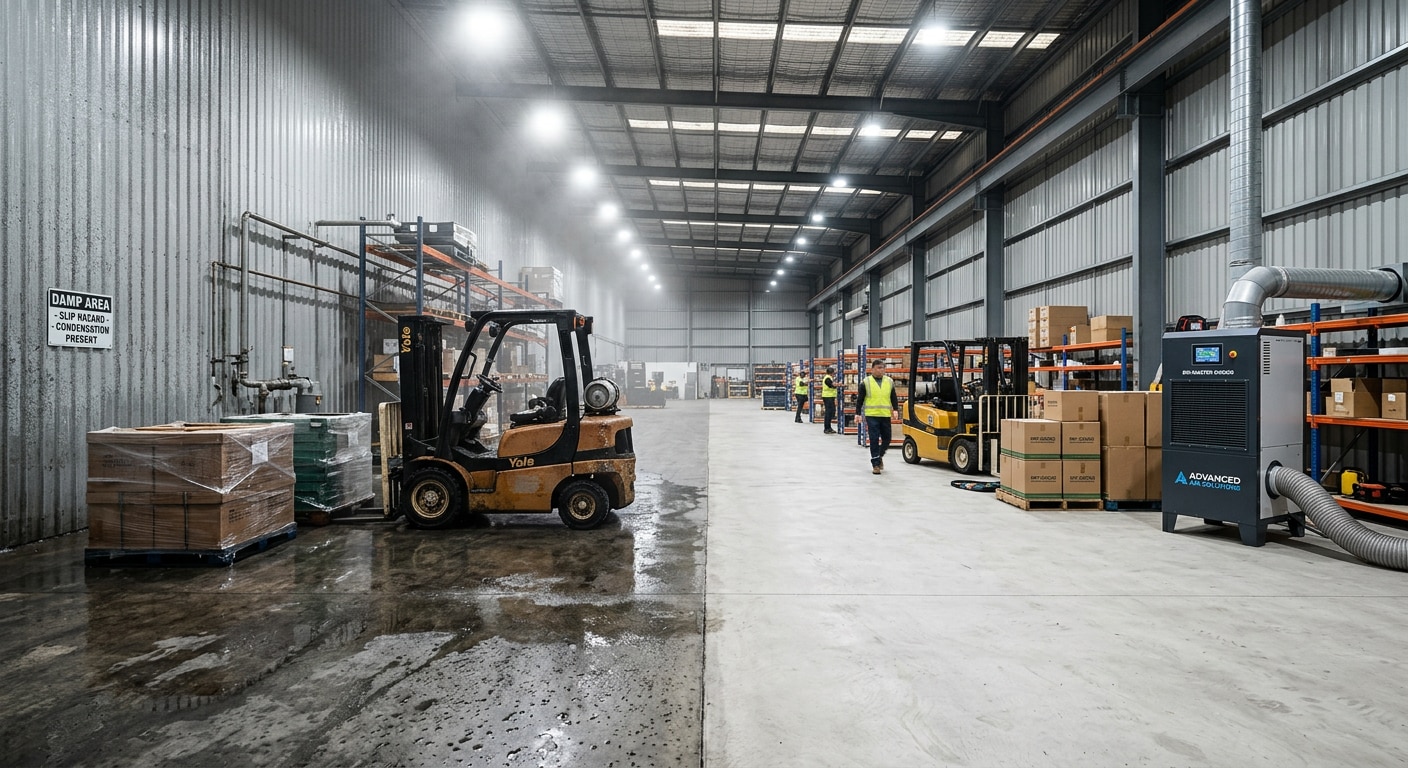
If you run a factory or a godown in Mumbai, you probably know this scene already. It's July, the morning shift has just walked in, and the floor has that dark, slightly shiny look to it. There's water trickling down the inside of the rolling shutter. Somebody touches the panel board and pulls their hand back because it's wet. And no, nobody spilled anything overnight.
The building is sweating.
We get this call a lot. Usually it comes right after something has gone wrong: a worker slipped near the loading bay, the bottom row of cartons went soft, or a machine tripped and nobody could figure out why. The first thing most people do is mop, switch on a big fan, or open all the doors to "let it air out". Which works for maybe an hour. Then it's back, and sometimes worse, because the water on the floor was never really the problem. The water in the air was.
So in this post we'll walk you through why it happens, where it hurts you the most, and how an industrial dehumidifier actually puts a stop to it. We'll keep it simple, but we won't skip the numbers, because the numbers are what make it click.
First thing to know: condensation is about temperature, not leaks
All air carries some water vapour. Warm air can hold more of it, cool air holds less. So when air touches something cold and cools down, at a certain point it just can't hold all that moisture any more, and the extra turns into droplets. That point is called the dew point.
Put another way, if any surface in your building is colder than the dew point of the air around it, it will get wet. Floor, wall, pipe, machine body, doesn't matter.
Let's put real numbers on it. On a typical monsoon day, air at 32 °C and 80% RH has a dew point of around 28 °C. Now, your concrete floor has been cooling all night and it's sitting at about 26 °C. That's two degrees below the dew point, so yes, it's going to get wet. A shaded wall at 27 °C? Same thing. And a chilled water pipe at 10 °C isn't going to sweat a little. It'll drip all day long.
Here's the good part. Take that same 32 °C air and bring the humidity down to 50%. The dew point falls to roughly 20 °C. Your floor is still at 26 °C, but now it's six degrees above the dew point, and it stays dry. You didn't heat anything. You just took water out of the air.
That's really all there is to it. Get the dew point of the air below the temperature of your coldest surface, keep it there, and the sweating stops.
Where condensation causes the most trouble
Floors
Concrete is slow to change temperature. It cools down at night and then takes hours to catch up once the day warms up. So first thing in the morning you've got the coldest floor of the day meeting some of the most humid air of the day. If you've got loading bays, it's even worse, because every time the shutter goes up, a fresh wave of warm, sticky air rolls in and settles right on that cool slab.
What does that lead to? People slipping, for a start. Forklifts skidding on turns. Epoxy coatings that bubble up and start peeling, and floor markings that fade out much faster than they should. Cartons kept directly on the floor soak up moisture from below, and before long the bottom layer gives way and you're rejecting stock. If you're in food processing or pharma, a wet floor is also the kind of thing an auditor will write down.
Walls
Walls go cold for different reasons. Maybe they don't get any sun, maybe there's a cold room on the other side, or maybe they're basement walls below ground level. Once the air right up against the wall stays above about 70% RH, mould moves in. You'll first spot little grey or black patches in the corners or behind the racks, and a while later you'll notice the smell.
After that, the paint starts bubbling, and the plaster goes soft and flaky. And that flaking doesn't stay on the wall, it ends up as dust in your production or storage area. In cold storage units, the outside face of the insulated panels near the door is a classic problem spot, with water streaks that eventually leave stains you can't scrub off.
Equipment and machinery
This is where it gets expensive. Steel starts corroding much faster once the humidity at its surface crosses about 60%. So machined parts waiting in a staging area pick up a thin layer of flash rust before they even get dispatched, and somebody has to clean them up and redo the job. Dies, moulds, and tooling slowly get pitted too.
Electrical and electronic equipment has even less patience for moisture. A very thin film of water on a circuit board or inside a VFD can cause tracking, random tripping, and sometimes a real short circuit. There's another one we see often: a machine shifted out of an air-conditioned room into a humid shop floor. It's still cold, so within minutes it's sweating on the inside as well as the outside.
Then there are chilled water lines, compressor bodies and motor casings. They all drip, and that water always seems to land exactly where you don't want it.
So how does an industrial dehumidifier fix it?
This might sound a bit odd, but a refrigerant dehumidifier gets rid of condensation by creating condensation. The difference is that it does it inside the machine, in one controlled spot, instead of all over your building.
Inside the unit, there's a cold coil. A fan pulls the humid room air over it, and because the coil is well below the dew point, the moisture turns into water right there on the coil. That water drips down and goes out through a drain pipe (for industrial use, a continuous drain is much better than emptying a tank). The air that comes out the other side is drier and a touch warmer, and it goes back into the room. Keep that cycle running for a few hours and the dew point of the whole space starts coming down.
Most units come with a humidistat. You set the humidity you want, let's say 50% RH, and the machine runs until it reaches that, then switches on and off to hold it. This is more important than people think. Condensation is at its worst late at night and early in the morning, when surfaces are at their coldest. If the dehumidifier gets switched off when the day shift goes home, it's off at exactly the time you need it most. Let it run through the night.
That little bit of warmth in the air coming out also helps. It won't heat your building, but blowing slightly warmer, drier air across a cold floor or wall raises the surface temperature a little while the dew point is dropping. Both changes push in the right direction.
We should be upfront about one thing, though. Refrigerant dehumidifiers work really well in warm spaces and can comfortably hold humidity down to about 40 to 45% RH. But once the room drops below about 15 °C, they lose output and the coils can frost up. So if the problem is inside a chilled room, or you need humidity below 40%, a desiccant dehumidifier is the right choice. If that's your situation, we'll tell you so. There's no point selling you a machine that won't do the job.
A few things that make a big difference
Check your coldest surface, not just the room. Use an infrared thermometer on the floor near the loading bay, on that shaded wall, on the chilled pipe. Then note the air temperature and RH and work out the dew point. You want the dew point a few degrees below your coldest reading. This is where dew point monitoring really pays off. A simple data logger that records dew point through the night will show you exactly when the risk peaks, something one reading at 3 in the afternoon will never tell you.
Size the unit for the moisture, not just the square footage. Two rooms of the same size can need completely different machines. How often doors open, how many people are working inside, wash-downs, wet mopping, fresh air coming in, gaps in the building- all of it adds water. When you're picking a dehumidifier for your industrial application, all of this needs to be counted, not just the floor area.
Point the airflow at the problem. Face the outlet towards the surfaces that sweat, like the area near the loading doors or along that cold wall. In a long hall, two mid-size units placed at different ends will usually do a better job than one big unit pushed into a corner.
Don't let the moisture walk back in. Keep doors closed wherever possible. Put strip curtains or an air curtain on the busy doorways. Get the roof leaks fixed. A dehumidifier is always fighting against whatever moisture the building lets in, so the better sealed the space, the easier its job.
As a general guide, holding 45 to 55% RH keeps most industrial and storage areas well out of trouble. For metal parts, staging areas and tool stores, try to stay below 55%.
Which White Westinghouse industrial dehumidifier is right for you?
We supply the complete White Westinghouse USA range, so you don't have to force-fit a machine that's too big or too small. Here's a rough guide based on the kind of space. We'll always confirm it once we understand your actual moisture load.
For small rooms, electrical and panel rooms, server rooms, labs and record rooms, the AWHD-12L (12 Litres/Day) and AWHD-20L (20 Litres/Day) are a good fit. They're sized for protecting sensitive equipment in compact spaces.
For mid-size stores, QC labs, packing rooms and basements with damp walls, have a look at the AWHD-306L (30 Litres/Day), the AWHD-307L (30 Litres/Day) and the AWHD-40L (40 Litres/Day).
For production floors, godowns, process rooms and loading bay areas, the 60 to 100 litre machines are usually the sweet spot. The WDE 606 (60 Litres/Day), WDE-603T (60 Litres/Day), WDE 702 (70 Litres/Day) and WDE 100 (100 Litres/Day) handle most of these spaces well.
For large warehouses, cold store anterooms and buildings with heavy moisture load, you'll want the WDE-110P (110 Litres/Day), WDE 110S (110 Litres/Day), WDE150S (150 Litres/Day) or WDE-190S (190 Litres/Day). In really big spaces, it's often two or more of these spread across the floor.
If you'd like to see them all in one place, check out our full industrial dehumidifier range here.
The bottom line
Condensation can feel random, like it just shows up on bad days. It isn't random at all. It happens every single time a surface is colder than the dew point of the air around it. Fix that one thing, and you fix a whole list of problems at once: slippery floors, mouldy walls, rusty parts, and tripping panels. Bring the humidity down, keep it down through the night, and your building stops sweating.
Talk to Our Team
JET INDIA is an authorised distributor and industrial dehumidifier supplier for White Westinghouse USA, and we deliver all over India. Tell us what's happening with your floors, walls, or machines, and we'll help you choose the right unit.
Call us: 022 4343 2323
Free consultation on sizing and placement
Free product demo, available in Mumbai only
