

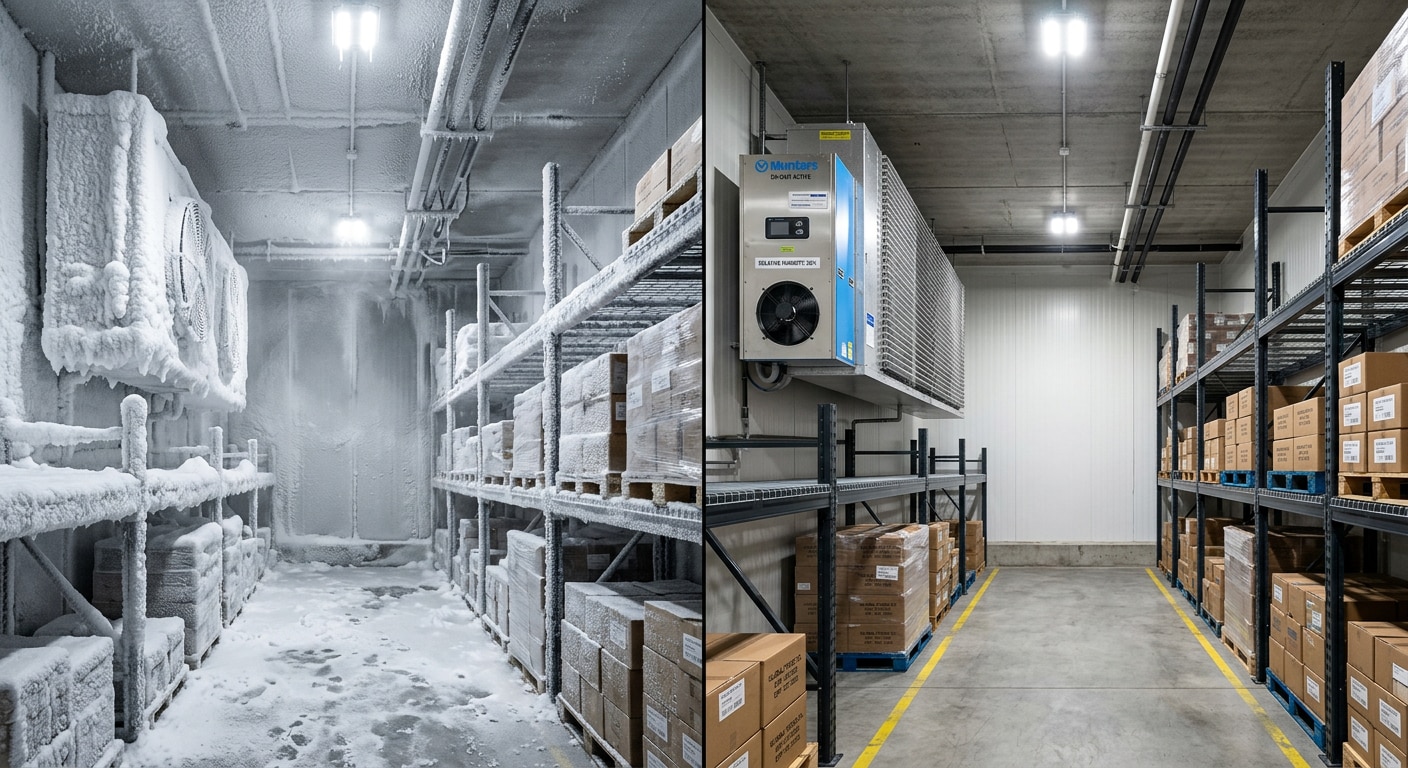
Walk into any cold storage in India during the monsoon, and you will see it - the telltale sign of white frost creeping up evaporator coils, the frozen residue on door seals, the slippery patches of ice near the dock levellers that nobody wants to drive the forklift over. Frost is one of those things that cold storage managers know to be inevitable. Coils freeze, so they're defrosted. Doors are sealed shut with ice, so they get pried open. The floor is slippery, so they lay down mats and hope nobody hurts themselves.
Frost is normal. Frost is part of the process. Unless you're one of the few cold storage owners who've invested in a dehumidifier. Frost is a symptom. One that has a disease and drains your budget in the process.
If you're running a cold room that houses frozen seafood in Navi Mumbai, a pharma cold chain warehouse in Pune, or a potato store in Uttar Pradesh, chances are, the frost forming on your coils every day is an indicator of a larger issue - moist air infiltrating cold storage spaces that aren't supposed to have it. This excess moisture is costing you in ways you might not have considered, and industrial dehumidification could be the solution.
In this blog, we take a look at the science behind frost formation, the costs associated with it, and explore how industrial dehumidification can eliminate the problem at the source.
Why Does Frost Even Form?
Here's the physics of it - cold air holds less moisture than warm air. That's why it's so easy to see a frosty layer forming on top of your evaporator coil. You've either walked into your cold storage on a particularly breezy day and seen it for yourself or have watched a forklift driver slide open the door and have the refrigerated air greet him with a sharp burst of cold. The physics behind this is simple - you're pushing warm, moist air into a cold storage chamber. The warm air contains much more moisture than the cold air - and when it hits the cold storage, it can no longer hold onto it.
Say it's the monsoon in Mumbai and the ambient temperature hovers around 300C with 85% relative humidity. The air contains roughly 23 grams of water vapour per kilogram of dry air. When you push that air indoors into a cold storage chamber maintained at -20oC, that number plummets to 0.6 grams per kilogram. The 22+ grams of moisture had to go somewhere - and it did, freezing onto your evaporator coils, walls, racks, and product.
Every time you open a door, or let a forklift driver through the air curtain, or even step into the cold storage yourself, you're letting in warm, moist air that has to be dealt with somehow. Even if you think you've got good door seals, infiltration of air is still a problem that happens even when the doors are shut. Unless you've invested in a dehumidifier, your cold storage's refrigeration system has to deal with this constant influx of unwanted moisture by freezing it, bit by bit, onto your evaporator coils.
The true cost of frost is far greater than you think:
Frost doesn't just form for the joy of seeing something white and pretty on your cold storage walls. It has a financial cost that's far greater than you might expect.
For starters, it reduces the efficiency of your refrigeration system. Frost on evaporator coils acts as an insulator, reducing their ability to absorb heat. This causes compressors to run longer than they should, increasing energy consumption.
Defrosting methods like hot gas or electric heating add unwanted heat to your cold storage, which then has to be shed later. This increases the thermal load on your building, requiring compressors to work harder and longer than they should. And if you have a pharma cold chain or are storing frozen foodstuffs, the defrosting cycle's effect on stability is a regulatory concern as well. Temperature excursions during the defrost cycle contribute to ice crystal formation, freezer burn, weight loss and texture change in frozen foods and, in the case of pharmaceuticals, can trigger a full deviation response.
Slippery floors, dock levellers and other surfaces cause safety concerns, leading to potential liability claims. Door gaskets are prone to cracking due to the expansion of ice and require frequent replacements. Fog in freezing rooms caused by temperature differential between the cold storage and surrounding area reduces visibility and causes productivity loss.
And then there's the sheer energy wasted in the constant battle against unwanted moisture. The refrigeration system runs far harder than it should, increasing operational costs, accelerating compressor wear and tear, and contributing to higher maintenance costs.
How Cold Storage Owners Can Stop Frost Formation
The first impulse for a cold storage owner dealing with persistent frost issues is to install more powerful cooling or defrosting mechanisms. Increasing the capacity of the refrigeration machine or the defrost cycle counter-intuitively results in more frost formation. While more powerful compressors may cool the coil faster, the reduced temperature promotes more condensation in the evaporator. Similarly, increasing the frequency or intensity of a defrost cycle also results in more heat being added to the cold storage, increasing the thermal load and making it harder to shed.
The correct solution is to dehumidify the cold storage, not over-cool it. By removing moisture from the air, you can prevent condensation and subsequent frosting on coils.
Industrial dehumidification is the best way to control humidity in cold storage, especially in transition areas like anterooms, docking bays, and dispatch counters. Dehumidifiers placed strategically can reduce the amount of moisture that the evaporator coil has to deal with, reducing frosting.
Key areas to consider in a cold storage facility include:
Dispatch, docking bay: These are the main entry points for humid air, and need to be kept dry.
Anterooms: Similar to transition areas around cold rooms.
Packing hall: These are often high-traffic areas where product is moved around at chilled temperatures, causing condensation of moisture on product surfaces and packaging.
Corridors and other transition areas: Any area that borders a cold storage chamber falls under this category.
Industrial dehumidification for cold storage requires a special set of considerations. While typical industrial processes have a rough idea of how much moisture needs to be extracted per day based on the square footage being kept dry, in cold storage, door openings, foot traffic, ambient conditions, and temperature differentials contribute to a far more complicated calculation. The most important consideration is matching the unit to your requirements - undersized machines lead to constant cycling and inability to maintain ideal conditions.
Choosing the Right Industrial Dehumidifier for Your Cold Storage
As an authorised distributor for White Westinghouse USA dehumidifiers in India, JET INDIA offers a comprehensive range of commercial-grade dehumidifiers, including industrial units perfect for cold storage use. You can view all our models here: Industrial Dehumidifiers
For large dispatch bays, anterooms and other transition areas, we recommend the following high-capacity commercial dehumidifiers:
WDE-190S White Westinghouse Dehumidifier – 190 Litres/Day dehumidification capacity: Our largest capacity commercial dehumidifier, best suited for large dispatch bays and multi-door docking bays.
WDE150S White Westinghouse Dehumidifier – 150 Litres/Day dehumidification capacity: Another excellent choice for large areas like the ones mentioned above.
WDE-110P White Westinghouse Dehumidifier – 110 Litres/Day dehumidification capacity: Portable unit, suitable for smaller transit areas and anterooms. Can be moved from room to room.
WDE 110S White Westinghouse Dehumidifier – 110 Litres/Day dehumidification capacity: Non-Portable unit, ideal for smaller anterooms, corridors or areas with lesser foot traffic.
WDE 100 White Westinghouse Dehumidifier – 100 Litres/Day dehumidification capacity: An excellent workhorse for medium-sized transition areas.
For medium-sized corridors, packing halls or similar areas:
WDE 702 White Westinghouse Dehumidifier – 70 Litres/Day dehumidification capacity
WDE-603T White Westinghouse Dehumidifier – 60 Litres/Day dehumidification capacity
WDE 606 White Westinghouse Dehumidifier – 60 Litres/Day dehumidification capacity
For smaller rooms, QC labs, control rooms or electrical rooms:
Most cold storage facilities require a combination of all three: high-capacity dehumidifiers at the docking bay, medium-sized dehumidifiers in transitional areas, and low-capacity units for smaller control rooms.
Immediate Steps You Can Take To Reduce Frost Formation
While it's always ideal to install dehumidifying equipment as soon as you spot persistent frost formation on your evaporator coils, here are some steps you can take in the short term:
Keep doors closed for as long as possible. Install strip or air curtains at entrances. Keep a close eye on door gaskets and replace torn or damaged ones. Avoid stacking product in front of evaporator coils to avoid disrupting airflow and encourage localised frost formation. Keep track of how often you have to defrost your system - if the number is going up, you have a moisture ingress problem.
Dehumidification reduces the burden on your refrigeration system, reduces the load on your compressors, and reduces the frequency of defrost cycles. It also reduces product loss due to temperature fluctuations, improves safety and reduces overall maintenance and operational costs. In addition, it reduces the likelihood of regulatory scrutiny, especially for pharma cold chain warehouses.
Speak To Our Cold Storage Experts Today
JET INDIA has been a preferred supplier of dehumidification equipment to cold storage, pharma, food processing, and warehousing facilities across India for two decades. Our engineers can assist you in selecting the right equipment for your requirements.
📞 Give us a call at 022 4343 2323
✅ Free consultation - provide us with the details of your cold storage and we'll give you a recommendation for capacity and placement.
🎯 Free product demonstration - only available in Mumbai, see a dehumidifier in action at your facility before making a purchase decision.
📍 Contact Us / Visit Our Office
🛠️ Explore our inventory of commercial dehumidifiers
Stop paying to freeze water you don't want in your cold storage. Dry it out and the frost will take care of itself.
