

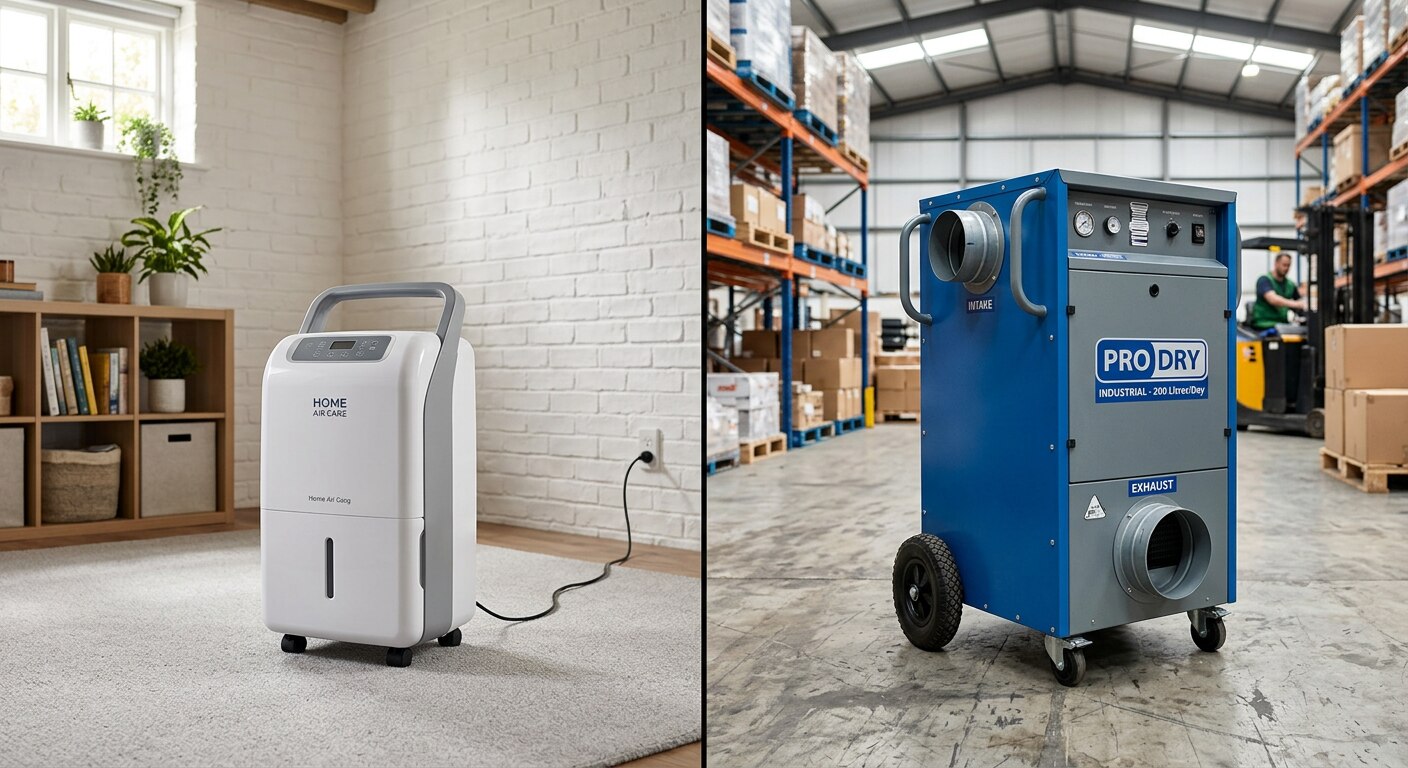
Let me give you the short answer first, then we'll dig in. A Portable Dehumidifier is the right shout for a home, a bedroom, or a small office under roughly 2,000 square feet — somewhere humidity is an annoyance, not an emergency. An Industrial Dehumidifier is what you reach for in warehouses, hospitals, cold storage, and hotels, where humidity settles in above 70% RH and simply won't shift without something running non-stop, usually with nobody standing over it. Get this wrong and it goes one of two ways: you overpay for capacity you'll never touch, or you're forever nursing a machine that can't keep up. So let's work out which side of that line your space is on — using real numbers from Jet India's range, not fluffy marketing figures.
So What Actually Separates the Two?
It really comes down to one thing: how much water a unit pulls out of the air per day. Jet India's portables handle 12 to 70 litres a day. The industrial units do 60 to 110 — and, crucially, they're built to hold that output around the clock. That last bit is the whole game. An industrial unit isn't just a portable that ate its vegetables. It's heavier-duty compressors, far bigger airflow (up to 950 m³/h against the 210–600 m³/h you'll find on portables), and parts rated for continuous duty rather than the start-stop rhythm of a home.
Even the weight gives it away. Portables run 8.5 to 23 kg; industrial units land between 35 and 50 kg. That extra bulk isn't padding — it's copper, steel, and compressor muscle meant for spaces a home unit was never designed to take on.
Litres Per Day, Explained — And Why the Box Can Fool You
Litres per day tells you how much moisture a unit shifts under standard test conditions, and honestly it's the single most useful figure when you're sizing one. But here's the trap most people fall into: manufacturers rate capacity at two points — a moderate one (26.7°C, 60% RH) and a high-humidity one (30°C, 80% RH) — and the gap between those two numbers tells you almost everything. Take the AWHD-12L: it pulls 10L at the moderate mark and 12L at the extreme one. Barely any headroom for sustained high humidity. Now look at the WDE 100, which jumps from 60L all the way to 100L across the same range. That leap tells you it's built to ride out humidity spikes without stalling.
It's also why two dehumidifiers with near-identical headline numbers can behave completely differently in the same room. A unit that only hits its top figure under perfect lab conditions falls apart the second real humidity spikes — peak monsoon, say, or a room with no proper ventilation. So when you're comparing spec sheets, look at both benchmark figures together, never just the biggest number on the front of the box.
Matching Litres/Day to Room Size
A handy rule to carry around: every 1,000 cubic feet of space wants roughly 10–12 litres/day of extraction under moderate humidity — and more once RH creeps past 60%. The AWHD-12L covers up to 1,200 cubic feet, so think single bedroom, home office, or a small storeroom. The WDE 702 steps up to 7,000 cubic feet — a big basement, a retail floor, a multi-room flat. Cross into industrial territory and coverage gets measured a bit differently: the WDE 100 handles 20,000 cubic feet, while the WDE-603T and WDE-110P get rated by floor area instead — 50–120 m² and 100–130 m² respectively, both at a 2.6m ceiling.
And don't overlook the ceiling, because it quietly changes the maths. Those coverage figures all assume 2.6m, which is standard for commercial and warehouse builds in India. Go taller and there's more air volume packed into every square metre, so a room with 4m ceilings needs more capacity than floor area alone would suggest. Always check ceiling height alongside floor area before you settle on a model — especially with mezzanine warehouses or double-height storage bays.
Home vs Commercial: It's Really About How You Use It
A home dehumidifier is made for stop-start use — run it when a room feels damp, empty the tank, switch it off. A commercial or industrial unit is made to just keep going, often unattended, which is exactly why models like the WDE 100 and WDE 110S come with a motor drain pump as standard. That pump pushes collected water out through a hose to a drain, so the unit never needs emptying by hand — which isn't optional for a warehouse running 24/7 or a hospital storeroom nobody's checking hourly. Home units, on the other hand, lean on a removable tank (3.1L on the AWHD-12L, 8.5L on the WDE 702) that you empty yourself. If someone's wandering past the unit every few hours, a tank's perfectly fine. If it's running overnight or all weekend in an empty room, you need that drain-pump capability. No two ways about it.
Duty cycle shapes what the machine costs you over time, too. A home unit ticking over a few hours a day barely troubles its compressor and will happily last years under normal domestic use. An industrial unit grinding away continuously faces a completely different load — which is precisely why the industrial models get the beefier compressors, tougher refrigerant circuits, and 24/7-rated components. Buying a portable and expecting it to survive commercial-grade continuous running is far and away the most common sizing mistake we see from first-time buyers.
The Full Line-Up, in Plain English
Rather than bury you in a grid, here's how the core six actually stack up. On the portable side, the AWHD-12L pulls 10L at 60% RH and 12L at 80%, covers up to 1,200 cubic feet, whispers along at 45 dB(A), sips just 255W, and runs on R290. Its bigger sibling, the WDE 702, steps that up to 50L/70L across the same benchmarks, covers 7,000 cubic feet, stays at the same quiet 45 dB(A), draws 860W, and is also R290.
Then you move into the industrial tier. The WDE-603T does a steady 60L/day across 50–120 m² (at that 2.6m ceiling) and runs on R410 — it's a controlled-environment workhorse rather than an indoor-comfort unit. The WDE 100 is the big mover: 60L climbing to 100L, up to 20,000 cubic feet of coverage, 60 dB(A), 1400W, R290, plus that motor-driven drain pump for unattended runs. The WDE-110P delivers 110L at 80% RH across 100–130 m², at 60 dB(A) and 1450W on R410. And the WDE 110S rounds it out with 90L/110L across the benchmarks, up to 11,000 cubic feet, 60 dB(A), 1450W, R410, and its own drain pump for continuous, hands-off operation.
Two patterns jump straight out once you line them up like that. First, noise climbs with capacity — the portables sit at a bedroom-friendly 45 dB(A), while the industrial units run at 60 dB(A), which is nothing on a warehouse floor but very noticeable in an occupied office. Second, power draw roughly triples going from the smallest portable to the smallest industrial unit, and that hits both your circuit planning and your monthly bill. Weigh that in — don't just fixate on the sticker price.
Refrigerant deserves a glance as well. Four of these six run R290, while the WDE-603T, WDE-110P, and WDE-110S use R410. Both are widely used, code-compliant refrigerants, but they matter for servicing — so check that your installer or maintenance provider actually stocks the right one for your model before you commit, especially for industrial units you expect to keep for years. And beyond these six, the wider range fills every gap in between: the AWHD-20L (20L/day), AWHD-307L (30L/day), AWHD-306L (30L/day), and AWHD-40L (40L/day) for mid-sized rooms, the WDE 606 (60L/day) for commercial spaces, and the high-capacity WDE150S (150L/day) and WDE-190S (190L/day) for the biggest facilities.
Where Industrial Units Actually Earn Their Keep
Industrial dehumidifiers prove their worth in the places where humidity control isn't a nice-to-have — it's operational risk management. Cold storage, pharmaceutical warehouses, hotel basements, hospital equipment rooms: all of them need sustained RH control that a portable simply can't hold. Jet India's industrial range has gone into environments spanning pharma, hospitality, healthcare, and logistics, including facilities run by names like Alkem Laboratories, Taj Hotels, DHL, and Kokilaben Hospital — places where corrosion, mould, or spoilage from excess moisture carries a very real cost. If your facility fits any of those, sizing for continuous operation from day one spares you a painful re-purchase later.
The reason these sectors settle on industrial units really comes down to what's on the line when humidity control slips. A pharma warehouse risks stock degrading the moment RH crosses safe storage limits. A hospital risks equipment corrosion and compromised sterile storage. A hotel risks mould in soft furnishings and guest-facing spaces — a reputational hit that dwarfs the price gap between a portable and an industrial unit. Every time, paying to size it right the first time beats the cost of humidity damage you'd otherwise discover later.
Why Portables Fall Short in a Warehouse
A warehouse needs an industrial unit because a portable physically can't sustain the output — not at that scale, and not in high humidity. Warehouses routinely run 10,000+ square feet with high ceilings, doors swinging open all day, and stored goods quietly off-gassing moisture, all of which keeps RH above 70% for long stretches. A portable like the WDE 702, capped at 7,000 cubic feet and 70L/day, will run flat out and still lose ground. The WDE 100's 20,000 cubic foot coverage and 100L/day extraction, paired with that motor drain pump, is built for exactly this — long, unattended runs across a big open floor. Run an undersized unit here and it doesn't just underperform; the constant overwork chews straight through the compressor's lifespan.
How to Choose: A Five-Step Framework
Work through these in order — each one trims your shortlist before price ever comes up.
Measure your space. Work out square or cubic footage. Under 1,200 cu ft points to the AWHD-12L; up to 7,000 cu ft to the WDE 702; anything beyond, you're in industrial territory.
Assess your humidity. If RH regularly tops 70%, favour a unit with a wide gap between its 60% and 80% RH ratings — the WDE 100 and WDE 110S handle that swing far better than any portable.
Define your usage pattern. Intermittent, attended use suits a tank-based portable. Continuous, unattended running — overnight, weekends, 24/7 — needs a motor drain pump, standard on the WDE 100 and WDE 110S.
Check your noise tolerance. Bedrooms and offices want the 45 dB(A) portables. Warehouses, plant rooms, and back-of-house can shrug off the 60 dB(A) industrial units.
Set budget against power draw. Industrial units pull 1400–1450W versus 255–860W for portables. Confirm your circuit can take it, and fold running cost into the total, not just the price tag.
Quick Answers by Space Type
Want to cut to the chase? Match your space to a model class like this: a single bedroom or home office under 1,200 cu ft → AWHD-12L. A basement, retail unit, or multi-room flat up to 7,000 cu ft → WDE 702. A mid-sized commercial space of 50–130 m² — small warehouse bay, server room, storage → WDE-603T or WDE-110P. A large warehouse up to 20,000 cu ft → WDE 100. A hospital, hotel back-of-house, or logistics facility up to 11,000 cu ft running unattended → WDE 110S. Every model carries a 12-month warranty and is made in India as part of Jet India's authorised White-Westinghouse (USA) partnership.
Talk to Our Team–
📞 Give us a call at 08048038959. Please keep 0 before dialling the number.
✅ Free consultation - provide us with the details of your cold storage, and we'll give you a recommendation for capacity and placement.
🎯 Free product demonstration - only available in Mumbai; see a dehumidifier in action at your facility before making a purchase decision.
🛠️ Explore our inventory of commercial dehumidifiers.
