

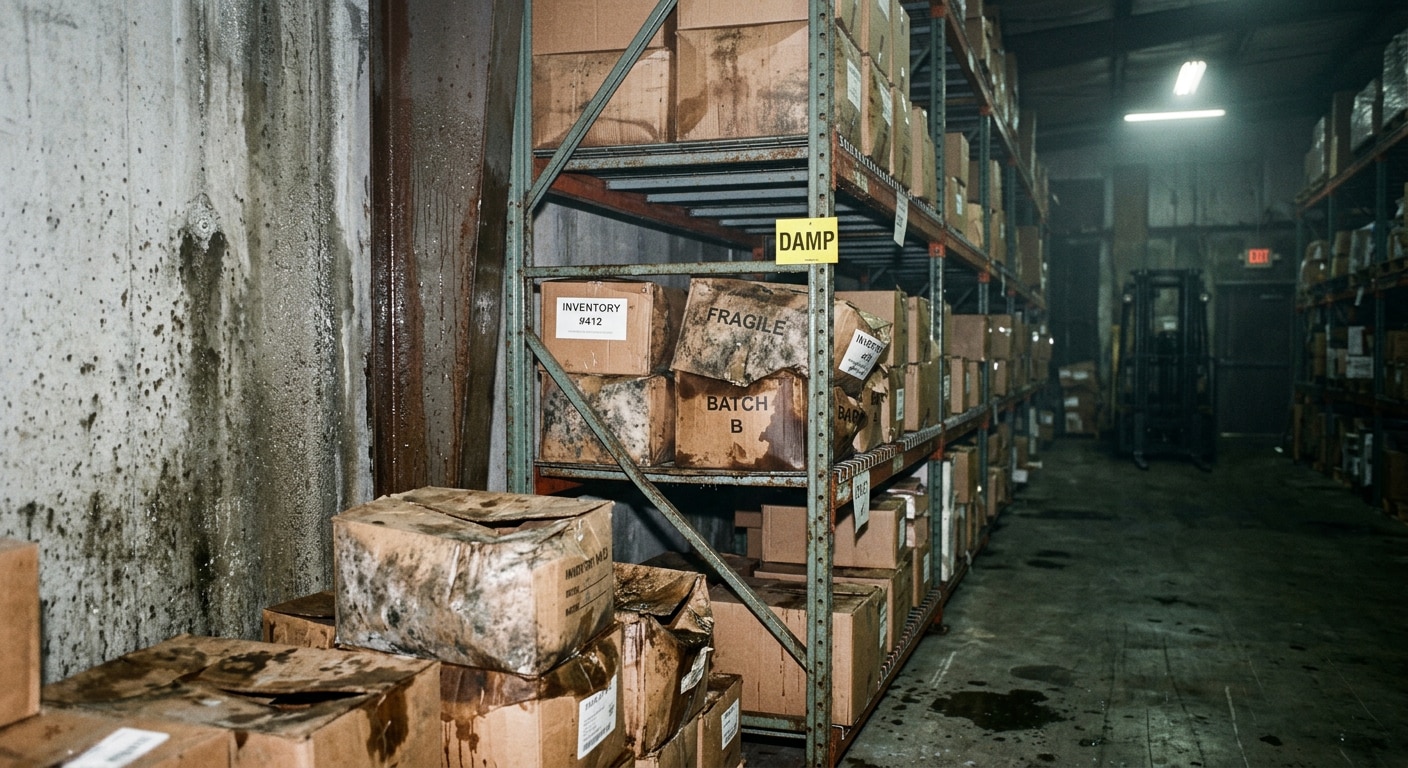
A fire in a warehouse is easy to see. A theft appears in the stock count. Humidity? Humidity works in a way. It does not set off an alarm. It does not leave a mark on the CCTV footage. And by the time you can actually see the damage. The rust on a machined part, the spots on a carton, the caked powder inside a sealed bag. The loss has already been sitting on your shelves for weeks or months.
For warehouse and facility managers across India, this is one of the uninsured, unbudgeted, and largely invisible line items on the P&L. Mumbai, Chennai, Kochi, Kolkata, Goa, and most of coastal India routinely have 70–90% relative humidity for a large part of the year. Even inland cities have levels during the monsoon. A warehouse. A large, poorly ventilated temperature-cycling concrete box full of hygroscopic material. Is close to the worst possible building type for that climate.
This article breaks down how moisture attacks stock, why the damage stays hidden, and what level of humidity control actually solves the problem.
Why a Warehouse Is a Humidity Trap by Design
Three things make warehouses uniquely vulnerable.
1. Moisture gets in constantly - Every time a shutter opens for a dispatch, thousands of feet of humid outdoor air rush in. Moisture also moves up through concrete floors, through wall cracks, and arrives inside the goods themselves. Cardboard, wooden pallets, and paper sacks all carry water with them.
2. Nothing takes the moisture out - Warehouses rarely have air conditioning, and exhaust fans simply exchange indoor air for humid outdoor air. In monsoon, ventilation actively makes the problem worse.
3. Temperature swings create condensation - A metal roof heats the air during the day; at night the structure cools rapidly. When warm, moisture-laden air touches a surface. A steel rack, a cold metal component, a shrink-wrapped pallet. It hits the dew point, and water condenses directly onto your stock. This is why goods stored in the middle of a looking warehouse still turn up damp.
The result is a building that continuously absorbs moisture and has no mechanism to release it. Relative humidity inside sits at 75–85% for months. That is above the threshold at which almost every material starts to degrade.
The Silent Damage: What Actually Happens to Your Stock
Corrosion on metal and machined goods
Steel begins to corrode when relative humidity crosses roughly 60%. Above 70% the rate accelerates sharply. Bearings, fasteners, tools, dies, automotive spares, electrical panels and machined components develop surface oxidation that turns a first-quality part into a second or into a customer rejection. Applying oil or VCI paper only slows it. It does not stop moisture already present in the air.
Cardboard and packaging failure
Corrugated cartons lose a share of their compression strength as they absorb moisture. Stacked pallets start to lean, bulge and collapse. Damaged outer packaging alone triggers customer rejections when the product inside is perfectly fine. And in e-commerce and FMCG, packaging is the product presentation.
Mould, mildew and odour
Mould germinates above about 65% RH. It attacks textiles, leather, paper, food ingredients, furniture, plywood and pharma cartons. Beyond the spotting it leaves a musty odour that never fully clears and can put you out of compliance in food, pharma and export supply chains.
Caking and clumping of powders and granules
Salt, sugar, spices, detergents, fertilisers, cement, polymer granules, milk powder, chemicals and pharmaceutical APIs are hygroscopic. They pull moisture out of the air through packaging. The result is caking, lump formation, weight gain, altered flow properties and in industries, a failed QC batch.
Electronics and electrical assemblies
PCBs, connectors, sensors, cables and control panels suffer contact oxidation, growth and latent short-circuit faults from long-term moisture exposure. These are the failures of all because the board tests fine at dispatch and fails at the customer's site. Turning a storage problem into a warranty claim and a reputation problem.
Labels, barcodes and documentation
Adhesive labels lift, thermal print fades, barcodes fail to scan, and inkjet batch codes smudge. Your WMS starts throwing errors, and picking slows down. Traceability records become unreliable.
Wood, leather, textiles and paper
These materials constantly equilibrate with moisture. Wood. Warps; leather grows mould and stiffens; textiles develop mildew stains and paper cockles and loses print quality.
The Cost Nobody Puts on a Report
The reason humidity damage stays hidden is that it never appears as a line item. It disperses into:
Shrinkage and write-offs that get logged as "damaged in storage"
Customer rejections and returns attributed to quality, not storage
Rework and repacking labour absorbed into operations
Slower picking from failed barcodes and collapsed stacks
Higher maintenance on racking, MHE and building steel
Failed audits in GMP, HACCP, ISO and export inspections
Insurance disputes because gradual moisture deterioration is frequently excluded from standard policies
Add these together across a year, and the number is almost always many times the cost of the humidity control equipment that would have prevented it.
Why Air Conditioning and Exhaust Fans Don't Solve It
This is the most common mistake we see. An air conditioner is designed to control temperature; dehumidification is a side effect that occurs while the compressor runs. In a warehouse, the AC Isn't there at all, or it cycles off once the setpoint is reached. And moisture immediately climbs back. Worse cooling: the air raises humidity, which is why an over-cooled godown can feel clammy.
Exhaust fans and turbo ventilators move air. They move humid air in from outside. Desiccant sachets and silica gel handle a sealed carton, not a 20,000 sq ft building.
The only reliable approach is dehumidification: a machine that continuously pulls moisture out of the air and holds relative humidity at a target. Typically 45–55% RH for general warehousing and lower for electronics, powders and pharma.
Choosing the Right Dehumidifier for Your Warehouse
Capacity is measured in litres of water extracted per day. Sizing depends on floor area, ceiling height, how often shutters open, the moisture load of the goods and your target RH. Here is a practical starting point from the White Westinghouse range.
Large warehouses, godowns and distribution centres
For high-volume spaces, high shutter traffic or aggressive RH targets, start at the top of the range:
WDE-190S White Westinghouse Dehumidifier – 190 Litres/Day. Our highest-capacity unit, ideal for distribution centres and cold-chain anterooms
Browse the full Industrial Dehumidifier range for heavy-duty warehouse and plant applications.
Medium warehouses, storerooms and packing halls
Small stores, spare-parts rooms, QC labs and record rooms
Not sure which capacity fits your space? Book a consultation and our team will size the unit against your actual floor area, stock type and RH target.
A 60-Second Self-Check for Your Warehouse
You likely already have a humidity problem if any of these are true:
Cartons at the bottom of stacks look soft, stained or bulged
Metal parts show surface rust despite oiling
The warehouse smells musty, especially in the mornings
Barcode labels peel or fail to scan
Powders or granules show clumping before expiry
Condensation appears on racks, walls or shrink-wrap
You have no hygrometer. And therefore no idea what your RH actually is
Start by measuring. Put a hygrometer at floor level at rack height and near the shutter and log readings morning and evening for a week. If you are consistently above 60% RH, moisture is already costing you money.
Protect Your Inventory. Talk to Us Today
Dehumidifiers India supplies White Westinghouse industrial dehumidifiers from 12 to 190 litres/day to warehouses, plants, pharma facilities, data centres and cold storages across India with installation support and after-sales service.
Free Consultation – Get an expert humidity assessment and capacity sizing for your warehouse at no cost.
Contact Us — Share your floor area and stock type. We'll recommend the right model.
Call for Inquiry – Speak to our team for pricing and availability.
Free Demo of the product available in Mumbai. Call us – See the unit running in your facility before you buy.
