

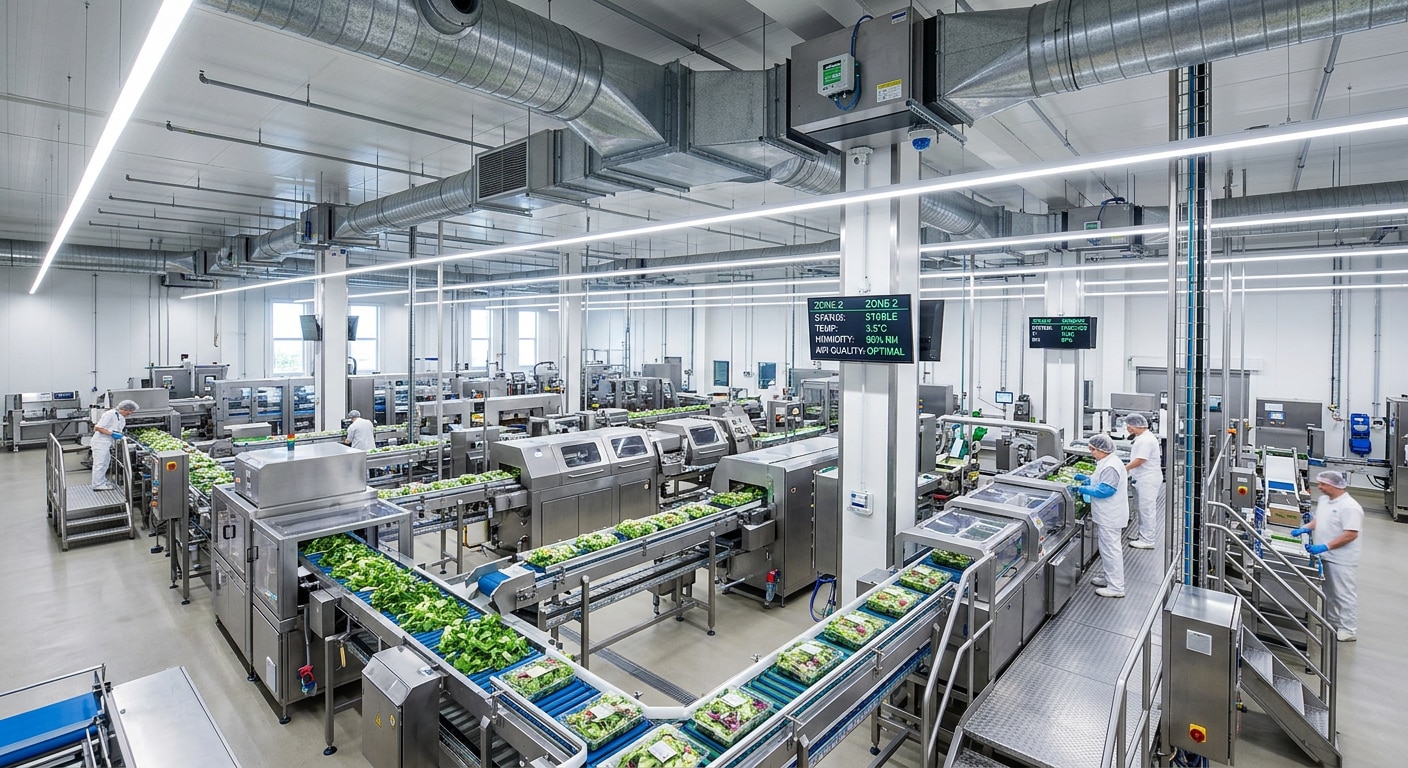
In a food processing plant, the quality of a processed food product is only as good as the air in which it has been manufactured. You could use the freshest produce, have spotless machinery, and perfectly sealed packing - but if the moisture content in your manufacturing halls has crept into your finished product, it will fail the shelf-life test. With humidity being this invisible silent killer, it is hard to troubleshoot why one lot of your product is failing while another passes unless you can trace it to a faulty sealer or chiller.
This is especially true for manufacturers in India, where monsoon season swells relative humidity (RH) to over 80% RH, while coastal manufacturing hubs like Mumbai, Chennai, Cochin and Kolkata see figures of 65% RH even in winter. While air-conditioners can reduce temperatures, they do not necessarily get to the right level of dehumidification that a food manufacturing plant requires. The latter is an important consideration for any plant that wishes to improve its product quality.
Why Humidity Impacts Shelf Life
All food items have a water activity value, or the amount of free water available for supporting microbial growth and chemical activity. Shelf-life is dictated by this value, which tends to rise as food products absorb moisture from the ambient air during processing, cooling, weighing and packing. The impact of excess moisture on a product’s shelf-life is not random - the science is all there.
Here are a few established ways in which moisture cuts short a product’s shelf-life:
Microbial activity: Above 0.61 aw, most moulds become active. Bacteria, on the other hand, can grow on food at 0.85 aw and higher. Both of these impact shelf-life negatively.
Loss of ‘crispness’: Biscuits, namkeen, extruded snacks, breakfast cereals and papad turn soggy or lose their crunch when exposed to moisture-laden air.
Loss of ‘flowability’: Milk powder, spice mixtures, instant mixes, protein powders, and sugar-based products tend to cake or bind together when exposed to moisture.
Condensation: Cold products exposed to warm/humid environments experience condensation as soon as they enter the warmer room. This condensation is detrimental to the product’s quality and shelf-life.
Packaging defects: Surface moisture can impede heat sealing of packaging material, cause adhesion defects in labels, and weaken the corrugated box in storage.
Each of the above mechanisms reduces shelf life individually, and collectively they can
reduce the stated shelf life of a product by two-thirds, with the reduction only being discovered when the product shows up in the market with complaints.
Zones Where Relative Humidity Needs to be Controlled
When it comes to controlling humidity, blanket solutions for an entire factory are wasteful. Different zones within a food manufacturing plant have unique needs when it comes to humidity:
Drying / Post-bake / Post-fry conveyors
Product that has been dried, baked, or fried needs to be cooled to a manageable temperature. The cooling conveyor is the prime location for a food product to absorb moisture from the ambient air.
Powder handling and blending
Grinding spices, handling milk powder, premix, and nutraceuticals requires low RH to avoid clumping and adhesion.
Packing hall
This is the last environment that the packaged product encounters before being shipped out. Unless the RH in the packing hall is controlled, the moisture content of the packing material will dictate the product’s shelf life.
Cold storage anteroom, loading and receiving docks
These facilities are the gateway for raw materials, finished goods, and deep-frozen seafood. Temperature transitions cause condensation of moisture in the air inside these facilities, and it is important to dehumidify these to avoid ice formation on equipment and the floor.
Ingredient and finished goods warehouse
The warehouse is where the shelf life of the product is maintained. Unless the warehouse RH is controlled, cartons will weaken, and labels peel off during storage.
Ingredient / Finished goods warehouse / Packing hall
Why an Air-Conditioner is not a Humidity Controller
When it comes to dehumidification, an air-conditioner is a two-step process. First, an air conditioner reduces the temperature of the room it has been installed in. Once a set-point temperature has been reached, the compressor shuts off, and the dehumidification process stops as well. In practical terms, an air-conditioner can only dehumidify a space up to the temperature at which it has been set. In many manufacturing plants, this set-point temperature is low to begin with, making an air-conditioner’s ability to remove moisture from the air limited.
Worse, the amount of moisture an air conditioner removes depends on the room's ambient temperature. In other words, if the room is at a higher temperature than the set-point, the air conditioner will dehumidify more aggressively, and less so when the temperatures are close to the set-point. Finally, moisture ingress is always a concern in enclosed spaces - the temperature differential caused by an air conditioner encourages cold air to move out and hot air to flow in, bringing in moisture with it. The only way an air conditioner can truly dehumidify a room is by reducing the temperature to the desired level and holding it steady. Still, such a large temperature differential is usually undesirable in most places in a food manufacturing plant.
Dehumidifiers offer a much more focused approach. They remove latent moisture from the air independent of temperature differentials, and are ideal for controlling humidity without impacting ambient temperatures. This makes them suitable for use in most enclosed spaces.
Specifying a Dehumidifier for Enclosed Spaces
The capacity of a dehumidifier is ideally matched to the volume of the space it needs to dehumidify, the amount of moisture ingress, and the target relative humidity. White Westinghouse offers a broad range of dehumidifiers to suit almost all applications.
Small capacity dehumidifiers (for QC labs, small stores, tasting rooms and similar enclosed spaces):
Medium capacity dehumidifiers (for spice blending, processing rooms and packing stations):
High capacity dehumidifiers (for production halls, cooling conveyor, cold storage anteroom):
Large capacity dehumidifiers (for packing hall, warehouse and high moisture ingress spaces):
For complete plants and multi-zone solutions, we recommend looking at our entire Industrial Dehumidifier range.
Humidity control is an area where a food processing plant can derive high cost and quality benefits while simultaneously bolstering its compliance credentials. A good commercial case can be made by comparing the cost of product recall and rejection against the cost of a dehumidifier.
Costs associated with excessive moisture include:
Loss of rejected batch
Loss of distributor returns
Re-working of caked or clumped powders, pastes, etc
Waste of packaging material on defective seal
Shelf life loss - if a product is stated to last 12 months but is only good for 3, it reduces the potential reach of a distributor
On the flip side, a dehumidifier allows you to extend shelf life beyond the current norm, while also saving on the cost of maintenance and energy for a food manufacturing plant. Most food processing plants find that a dehumidifier pays for itself within a season of usage. Moreover, humidity control improves your FSSAI and HACCP compliance by reducing the frequency of cleanings and checks for mould growth in ducts and crevices. It also improves the working conditions of your plant by reducing odours and dampness, and prolongs the life of your own infrastructure by reducing condensation on sensitive equipment like stainless steel and electrical panels.
In addition to lowering costs, humidity control helps you grow since it allows you to extend shelf life beyond current norms and, therefore, reach new markets. A longer shelf life also allows for listing at modern trade retailers who require extended dating.
The most common specification mistake occurs when a buyer looks at the capacity of a dehumidifier in isolation, failing to consider the size of the room, target RH, ambient conditions, and the number of air changes per hour among other factors. Our team can advise you on the most suitable dehumidifier based on the unique characteristics of your enclosed space.
Talk to Us
White Westinghouse dehumidifiers are supplied and serviced by us for cold chain operators, food processing plants, packaging companies and warehouses. We are happy to help you with advice and guidance about humidity control for your food manufacturing plant
📞 Give us a call at 022 4343 2323
✅ Free consultation - provide us with the details of your cold storage, and we'll give you a recommendation for capacity and placement.
🎯 Free product demonstration - only available in Mumbai; see a dehumidifier in action at your facility before making a purchase decision.
