

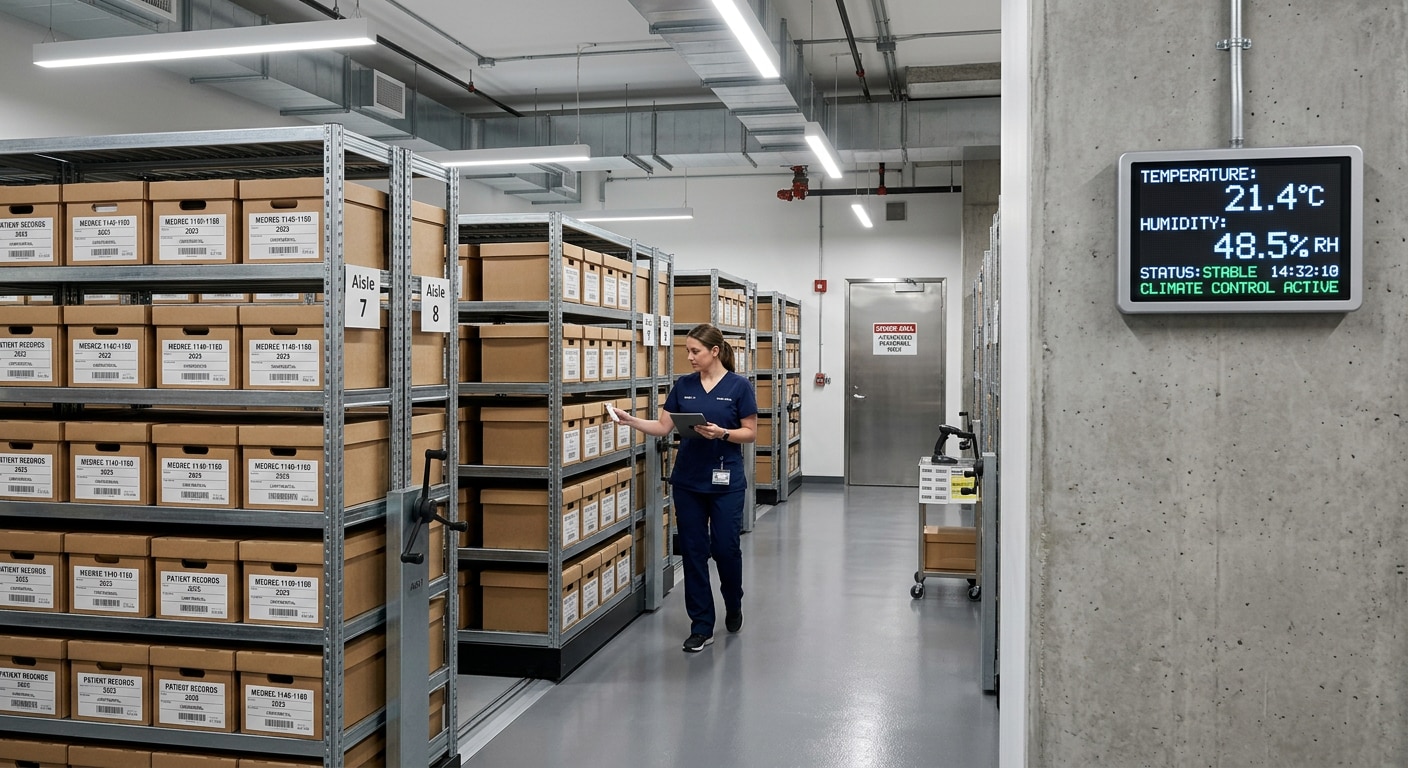
Every hospital, clinic, and pharmacy depends on two assets it simply cannot afford to lose—its medical records and its medicines.
Medical records preserve every patient's history, including prescriptions, diagnostic reports, consent forms, treatment notes, and compliance documents. Medicines, on the other hand, are the foundation of patient care, ensuring timely and effective treatment.
While these two assets serve different purposes, they face the same silent threat: humidity.
Unlike a power failure or equipment breakdown, excess moisture doesn't create an immediate warning. It builds up slowly over weeks and months. One day, archived files begin sticking together. Another day, mould appears on stored documents. Tablet strips become soft, packaging peels away, or labels become difficult to read.
By the time these signs appear, the damage has often already been done—and in healthcare, that can lead to legal issues, financial losses, regulatory problems, and risks to patient safety.
Why Medical Storage Rooms Are Vulnerable
Medical records rooms and pharmacy storage areas often share similar conditions that make them especially prone to moisture problems.
Many are located in basements, interior rooms, or areas with limited ventilation. They're usually kept closed for most of the day and packed with shelves, boxes, files, and medicine cartons that restrict natural airflow.
In cities like Mumbai and other coastal regions, the long monsoon season adds another challenge. Outdoor humidity remains consistently high for months, allowing moisture to seep into enclosed storage spaces gradually.
Unlike laboratories or ICUs, these rooms rarely receive continuous environmental monitoring. Humidity levels can quietly rise well beyond safe limits without anyone noticing until visible damage begins to appear.
This combination of poor airflow, limited monitoring, and high moisture creates the perfect environment for both paper deterioration and pharmaceutical degradation.
How Humidity Damages Medical Records
Paper naturally absorbs moisture from the surrounding air.
When humidity remains high, documents begin to swell, wrinkle, and lose their original shape. Pages stick together, ink starts to fade or bleed, and adhesives used in labels, folders, and bindings begin to weaken.
Perhaps the biggest concern is mould.
Once paper becomes damp, mould and mildew can spread rapidly, permanently damaging patient files while releasing airborne spores that may affect the health of employees handling those records.
For healthcare organisations, damaged records represent far more than an administrative inconvenience.
Medical records are legal documents. They're essential for:
Patient treatment continuity
Insurance claims
Medical billing
Regulatory inspections
NABH and accreditation audits
Medico-legal documentation
Losing patient records—or finding them unreadable when they're needed—can create significant operational and legal complications. Rebuilding years of documentation is often expensive and, in many cases, impossible.
Most document preservation experts recommend maintaining a relative humidity between 35% and 50% for paper archives.
Just as important as the humidity level itself is maintaining consistency. Frequent fluctuations between damp and dry conditions accelerate the ageing and breakdown of paper fibres.
Although hospitals are increasingly digitising records, physical files continue to occupy large archive rooms that require reliable environmental control.
How Humidity Affects Pharmacy Storage
Medicines are often even more sensitive to humidity than paper.
Every pharmaceutical product is tested under carefully controlled storage conditions before it reaches the market. Those conditions almost always include specific temperature and humidity limits.
Ignoring those storage recommendations can reduce a medicine's effectiveness long before its expiry date.
Excess humidity affects pharmaceutical products in several ways.
Tablets and capsules absorb moisture, causing them to soften, swell, crumble, or stick together. Hygroscopic formulations and effervescent tablets are particularly vulnerable and can deteriorate rapidly when exposed to excessive moisture.
Powders begin to cake, affecting dosing consistency.
Labels may peel away, barcodes become unreadable, and cartons lose their strength—all of which create compliance issues during inspections.
Perhaps most concerning is the gradual chemical degradation of active pharmaceutical ingredients. Excess moisture can slowly reduce the potency of medicines, increasing the risk that patients receive medication that no longer performs as intended.
For pharmacies operating under Good Storage Practices (GSP) and regulatory guidelines, uncontrolled humidity isn't simply an inventory problem.
It's a patient safety issue.
Damaged stock often has to be discarded, leading to avoidable financial losses. Dispensing compromised medicines can also expose healthcare providers to serious regulatory and legal consequences.
Cold-chain medicines and other specialised pharmaceutical products require even tighter environmental control, making humidity management an essential part of pharmacy operations.
The Hidden Costs of Poor Humidity Control
Humidity damage rarely happens overnight.
Instead, it builds quietly over time.
A few damaged files.
A handful of spoiled medicine strips.
A mould-affected archive box.
A batch of stock that needs to be discarded.
Individually, these may appear to be small operational issues.
Collectively, they add up to significant costs through:
Written-off pharmaceutical inventory
Damaged medical records
Staff time spent recovering documents
Regulatory non-compliance
Failed audits
Increased maintenance and replacement costs
There's another cost that's harder to measure—trust.
Patients expect hospitals and pharmacies to protect their records and supply medicines that are safe and effective. Any failure in storage conditions can damage that trust far more quickly than it can be rebuilt.
Humidity control may not be the most visible investment in a healthcare facility, but it's one of the most valuable.
Creating the Right Storage Environment
The solution is straightforward.
Maintain your storage rooms within a stable humidity range using a properly sized dehumidifier designed for the actual moisture load of the space.
However, choosing the right equipment is critical.
Factors such as room size, ceiling height, shelving density, occupancy, ventilation, and local climate all influence the amount of moisture that must be removed.
The dehumidifier should also provide:
Continuous operation
Reliable drainage
Quiet performance
Minimal maintenance
Correct placement for uniform airflow
One of the most common mistakes is installing an undersized domestic dehumidifier in a large records room or pharmacy store.
During peak monsoon conditions, these units often run continuously without ever reaching the desired humidity level.
That's why professional sizing is always recommended.
The White Westinghouse Range from JET INDIA
At JET INDIA, we've spent more than two decades providing humidity control solutions across healthcare, pharmaceuticals, hospitality, data centres, defence, and industrial applications.
For medical record archives and pharmacy storage rooms, our White Westinghouse Dehumidifier range offers capacities suitable for everything from compact storage rooms to large central archives and warehouse-scale pharmaceutical stores.
Our available models include:
For large central medical record repositories, warehouse-scale pharmacy stores, and high-load storage facilities, our industrial dehumidifiers are often the ideal solution.
Explore our complete range here:
Industrial Dehumidifiers by White Westinghouse
These systems are designed for continuous operation, stable humidity control, continuous drainage, and robust air filtration—exactly what's needed to protect valuable records and pharmaceutical inventory.
Choosing the Right Dehumidifier
Every healthcare facility is different.
The right dehumidifier depends on several factors, including:
Room dimensions
Storage density
Ventilation design
Existing HVAC system
Local climate
Target humidity level
Because every application is unique, no single dehumidifier fits every storage room.
At JET INDIA, our specialists evaluate your facility, calculate the actual moisture load, and recommend a system that's correctly sized for long-term, reliable humidity control.
That means avoiding both oversized systems that waste energy and undersized units that struggle to keep up.
Protecting medical records and pharmaceutical inventory from humidity is one of those investments that quietly delivers value every single day—through fewer product losses, longer document life, easier regulatory compliance, and greater confidence that your records and medicines remain safe whenever they're needed.
Book a Free Consultation with JET INDIA
Free consultation. Free product demo (Mumbai only). Expert sizing for your records room or pharmacy store.
Talk to our humidity control specialists and let us recommend the right White Westinghouse dehumidifier for your storage environment. A free demo of the product is available in Mumbai—see the performance for yourself before you commit.
👉 Contact Us — Get Your Free Consultation
📞 Call us for an inquiry and to schedule your free demo in Mumbai.
📍 Visit or reach us: Contact JET INDIA
Whether you're protecting a single pharmacy storeroom or implementing humidity control across an entire hospital or pharmacy chain, JET INDIA—authorised White Westinghouse distributor with over 20 years of pan-India experience—is ready to help.
Call us today.
