

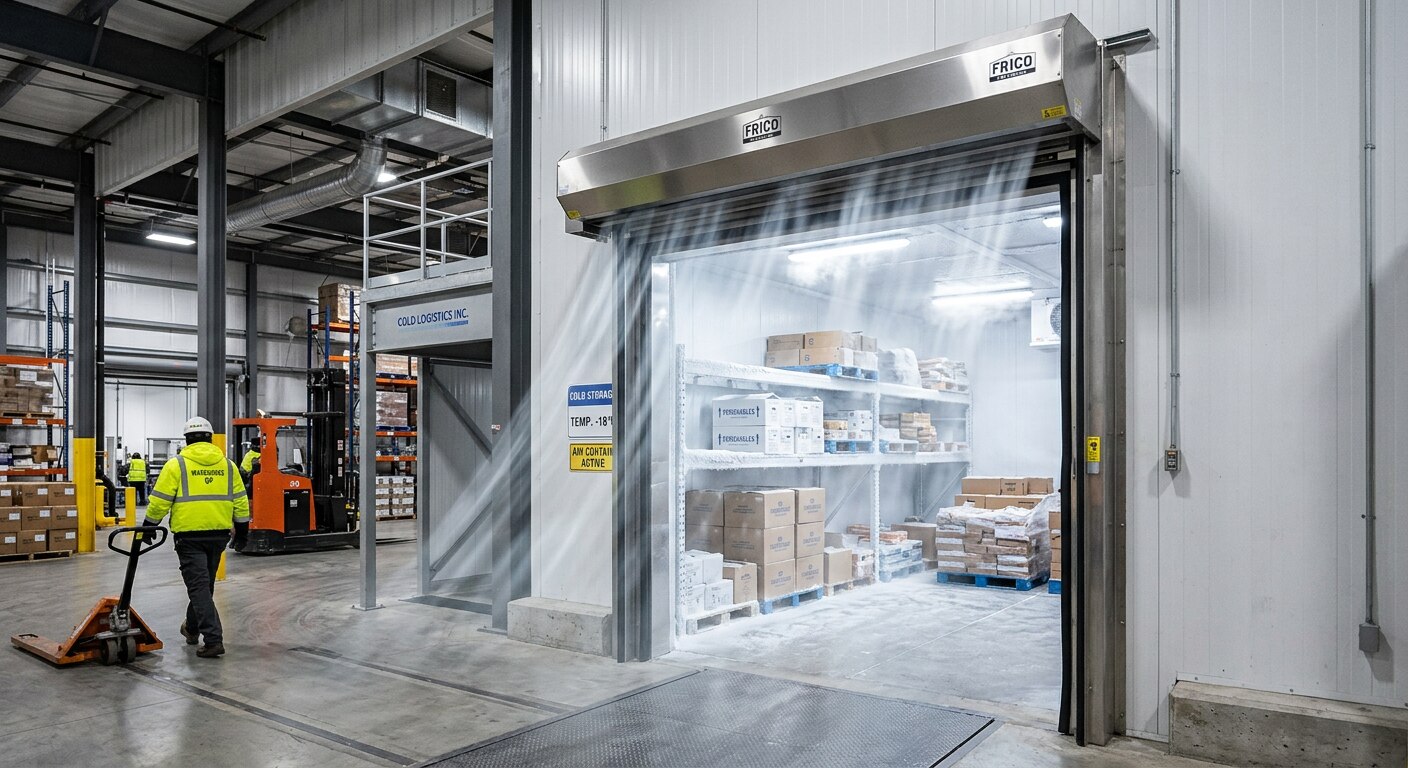
Walk into any cold storage facility in India during the monsoon, and you will see the same drama playing out at each doorway: rolling white mist, icicles forming on the doorframe, and a damp patch on the floor which nobody has time to clean up. That mist isn't just an annoyance - it is money walking away.
Every time a cold room door opens, the outflow of cold air and inflow of warmer air exacts a heavy toll on your refrigeration system. Across Mumbai, Chennai, Kochi and Kolkata, cold storage facility managers report that door infiltration can account for a significant portion of a cold room's total refrigeration load. At high-traffic facilities where doors are opened and closed dozens of times an hour, it can be the single largest determinant of a facility's energy bill.
Air curtains are the first defence. This article explores their role at cold storage doorways, their limitations, and what facilities that have achieved true success in controlling moisture ingress have in common: industrial-grade dehumidification.
The Hidden Costs of Doorway Ingression
When a cold room door is opened, the density difference between warm and cold air creates a natural convection current.
Cold air, being denser than warm air, rolls down along the floor while the lighter warm air rises up along the plane of the doorway. For every cubic metre of cold air exiting the building, between five to ten cubic metres of warm air rush in to replace it. This is magnified exponentially with door height due to the stack effect.
The greater impact is created by the moisture in the incoming air. Air at 32 degrees C and 80% RH carries nearly ten times the moisture of air at 2 degrees C and 5% RH. This surplus moisture will condense and freeze on evaporator coils, flooring, racking, ceilings and product itself,
causing a range of issues:
Evaporator Coil Freezing: Loss of heat exchange efficiency, increased compressor run time, and frequent defrosting events.
Floor Ice: Slip hazards for personnel, loss of adhesion for pallet jacks and forklifts leading to potential injury and operational delays.
Ceiling Frost Drip: Contamination risk due to drip from overhead frosting.
Carton Collapse: Moisture compromises cardboard structural integrity while causing adhesive failure in printed cartons.
Product Quality Loss: Increased risk of freezer burn, ice crystal formation and product degradation.
The list of issues shows why moisture ingress at cold storage doorways is a two-part problem. While the initial convection current can be mitigated, the moisture which makes its way into the cold room requires additional energy to remove.
Air Curtain Fundamentals
An air curtain is a device which throws a jet of air across an opening to form a barrier which reduces the exchange of air between two environments. Mounted above (or occasionally beside) a doorway, an air curtain's fan is set to produce a powerful jet of air which blankets the opening, resisting the natural convection current.
When the jet reaches the lower edge of the doorway, it splits, with some of the air rolling back into the conditioned space and some spilling out and across the threshold to mix with the warmer ambient air. When correctly commissioned, an air curtain can reduce the airflow through an open doorway by up to 90%.
The jet must have sufficient momentum to reach the floor without losing cohesion and momentum - this dictates the necessary CFM (cubic feet per minute) and velocity. Too slow, and the jet will lose shape; too fast, and it becomes turbulent and fails to blanket the doorway.
Jet width must span the full width of the doorway. Lack of jet extension or coverage allows unimpeded airflow through gaps or along the edges of the jet. An air curtain must also be interlocked to the door such that it only operates while the door is fully open. Continuous operation drains energy through constant fan rotation with no useful purpose.
The Limits of Air Curtains: Why They Are Not Enough
Few air curtain manufacturers are completely honest about the limitations of their systems. An air curtain is an effective barrier to airflow, but it does little to prevent the exchange of moisture between the two environments.
Even at 80% efficiency, 20% of the warm air infiltrating a cold room will contain significantly more moisture at warmer temperatures. This surplus moisture must be removed by some means, typically by the evaporators in the cold room or via dehumidification equipment. Even 20% of a large infiltration load will create significant ice on evaporator coils, posing a serious risk to product and personnel.
Real-world limitations also cut into an air curtain's performance:
Doors kept open for longer than recommended by the manufacturer.
Physical interference from forklifts and pallet jacks disrupting the jet.
Cross drafts from adjoining doors or exhaust fans.
Loss of jet momentum caused by fan speed reduction due to filter fouling or fan wear.
Negative pressure within the cold room pulling air through the curtain.
Moisture which was already present in the cold room, such as water vapour released from product, pallets, incoming packaging, washdowns and condensation on walls or ceiling insulation.
This highlights the true role of an air curtain: limiting the volume of warm, moist air which infiltrates a cold room. While it might reduce the overall infiltration load by 50-80%, what does remain must be dealt with by another source of dehumidification.
Why Dehumidification is Necessary for Cold Storage Facilities
By combining an air curtain with industrial-grade dehumidification, a cold storage facility can see major reductions in humidity, pressure, and temperature swings within the chamber. This reduces the workload on compressors, minimising energy consumption while improving the efficiency of the refrigeration system as a whole.
Facility managers who have integrated dedicated dehumidification report the following benefits:
Longer defrost cycles and reduced defrost time
Improved heat exchanger efficiency and reduced compressor run time
Elimination of ice build-up on floor and evaporator coils
No more ceiling frost drip on to product
Superior storage conditions for cartons and other packaging
Consistent, verifiable humidity readings for compliance
Dehumidifiers India is an official distributor for the White Westinghouse range of industrial dehumidifiers. We offer thirteen different models with a moisture extraction capacity from 12 to 190 litres per day, ensuring you select the correct capacity for your application.
Selecting a Dehumidifier for Large Cold Rooms, Bays and High Traffic Doors
For large cold rooms, dispatch bays and doorways with high traffic:
WDE-190S White Westinghouse Dehumidifier – 190 Litres/Day: Our largest commercial dehumidifier, capable of extracting 190 litres of moisture per day. Ideally suited for larger cold storage facilities and high-traffic doors.
WDE150S White Westinghouse Dehumidifier – 150 Litres/Day: A powerful standalone dehumidifier for large cold rooms and chambers with frequent openings.
WDE-110P White Westinghouse Dehumidifier – 110 Litres/Day: Our portable dehumidifier is ideally suited for seasonal use across multiple storage chambers when a dedicated dehumidifier is not required for year-round use.
WDE 110S White Westinghouse Dehumidifier – 110 Litres/Day: Another excellent option for use in a stationary storage chamber, this model provides 110 litres of moisture extraction per day.
WDE 100 White Westinghouse Dehumidifier – 100 Litres/Day: A reliable workhorse for medium-sized cold storage warehouses.
For Medium Cold Rooms, Ante Rooms and Buffer Zones:
The ante room serves as a pressure and temperature buffer to the main cold storage chamber. Installing a dehumidifier in this buffer zone allows the warm, moist air to be dehumidified before
entering the chamber proper, reducing condensation and frosting on surfaces.
For smaller chill rooms, packing areas and control rooms:
Cold storage facilities also have associated rooms which house control panels or packing equipment. Without humidity control, issues such as condensation, corrosion and material degradation can occur. These smaller areas are ideally suited to a compact dehumidifier:
For commercial and industrial-grade cold storage facilities, Dehumidifiers India offers the complete range of Industrial Dehumidifiers. Contact us to discuss your requirements in detail.
Designing the Total Doorway Solution
Many facilities which have successfully controlled the issues associated with doorway infiltration share common design elements:
A cold room air curtain properly sized for the doorway and equipped with full width jet coverage and door interlock to reduce energy waste.
An improved door assembly with faster opening and closing speeds to reduce the time spent in open configuration.
An ante room or buffer zone, where space permits, to reduce the temperature differential across the doorway.
Dedicated dehumidification in the ante room, the chamber proper or both.
Humidity monitoring to allow verification and compliance auditing.
Scheduled maintenance for the air curtain fan, filters and dehumidifier coil cleaning. The efficiency of both systems is often overlooked as a contributor to overall energy costs.
Each element addresses a weakness in the others, and together comprise a doorway solution which addresses infiltration from multiple angles. Without dedicated dehumidification, facilities see no improvement in evaporator coil icing. During the monsoon, most cold storage facilities report having to perform manual defrosting of their evaporator coils at least monthly.
The Business Case
Cold storage represents one of the highest energy consumption sectors in India. With refrigeration accounting for the majority of these costs, even small efficiency improvements can have a major impact on the bottom line. Moisture control is one of the few opportunities to reduce the load on a refrigeration system from multiple sources at once.
Unlike a complete system overhaul, a dedicated dehumidifier can be deployed with minimal disruption to operations, relocated if necessary and its impact easily measured. It reduces the workload on your existing refrigeration system while also cutting energy costs and improving your compliance position.
Are You Ready to Optimise Your Cold Storage?
Whether you operate a single chamber or multiple interconnected facilities, Dehumidifiers India can assist in recommending the correct White Westinghouse dehumidifier to complement your air curtains and eliminate the problems created by moisture ingress.
📞 Give us a call at 022 4343 2323
✅ Free consultation - provide us with the details of your cold storage and we'll give you a recommendation for capacity and placement.
🎯 Free product demonstration - only available in Mumbai, see a dehumidifier in action at your facility before making a purchase decision.
