

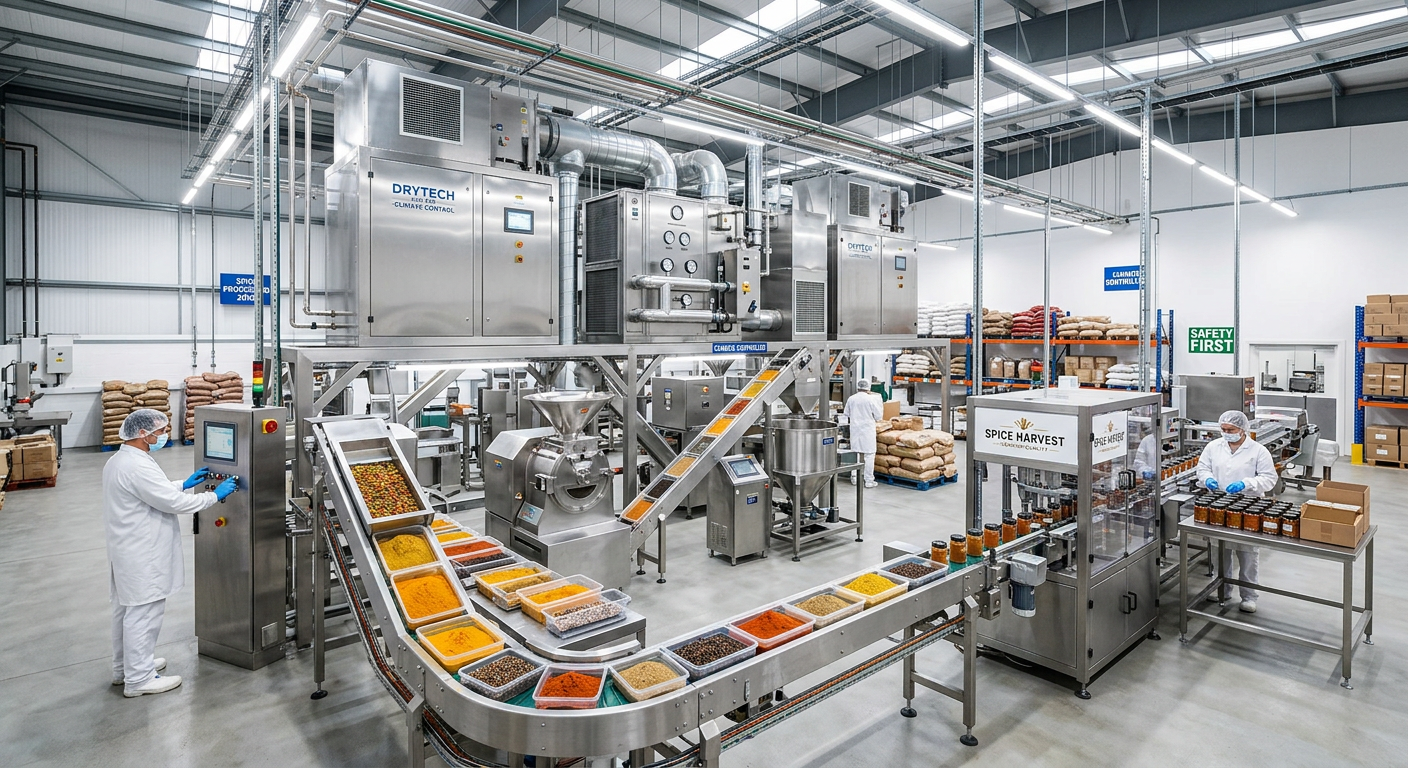
Moisture control is an important part of maintaining product quality, operational efficiency, and storage conditions across the food processing and spice industries. Many food products, spices, powders, and other hygroscopic materials naturally absorb moisture from the surrounding air. When humidity levels are not properly controlled, excess moisture can create a range of challenges during processing, packaging, transportation, and storage.
For businesses operating in @Location, maintaining the right environmental conditions can be particularly important for facilities that handle moisture-sensitive products. A well-designed dehumidification system can help businesses establish a more controlled production and storage environment by reducing excess moisture in the air and supporting stable relative humidity levels.
Why Humidity Control Matters in Food & Spice Processing
Food ingredients and processed products can react significantly to changes in ambient humidity. Products such as spices, powders, grains, dehydrated foods, seasoning blends, salt-based products, milk powders, starches, and other moisture-sensitive materials may absorb atmospheric moisture when exposed to humid conditions.
This moisture absorption can affect the physical characteristics and handling properties of products. In some applications, powders may become sticky or form lumps, while spices and seasoning products may experience caking. Excess humidity can also create challenges for automated filling, conveying, weighing, blending, and packaging operations.
By controlling humidity, manufacturers can create a more consistent environment around sensitive processes. This can support smoother material handling and help businesses maintain more controlled processing conditions.
Preventing Caking and Clumping
One of the common challenges associated with excess moisture is caking. Powdered and granular products can absorb moisture from humid air, causing individual particles to stick together. Over time, this may result in lumps, reduced flowability, and difficulties during processing or dispensing.
For food and spice manufacturers, maintaining suitable humidity levels can help reduce the amount of moisture available for products to absorb. Dehumidification can therefore play an important role in environments where maintaining free-flowing powders is essential.
A controlled environment can be especially valuable in facilities handling products such as spice powders, seasoning mixes, flour, starch, powdered ingredients, and other hygroscopic materials.
Supporting Packaging Operations
Packaging areas can also benefit from effective humidity control. Many products need to be packed in controlled conditions to help minimize their exposure to moisture before the package is sealed.
When ambient humidity is high, products may absorb moisture while waiting for packaging or during filling operations. This can potentially affect product flow, filling consistency, sealing processes, and overall packaging efficiency.
Maintaining controlled humidity around packaging machinery and production areas can help create a more stable operating environment. This is particularly relevant for businesses that use automated packaging systems where consistent product flow and handling are important.
Better Storage Conditions
Storage conditions are another important consideration for food products, spices, and powders. Warehouses and storage rooms can experience fluctuating humidity levels due to seasonal weather, outdoor air infiltration, temperature variations, and frequent door openings.
If humidity remains high for extended periods, moisture-sensitive materials may be exposed to conditions that can affect their physical properties and storage performance.
Dehumidification can help maintain more consistent humidity levels in storage areas. By controlling moisture in the air, businesses can create a more suitable environment for products that require protection from excessive humidity.
Managing Hygroscopic Materials
Hygroscopic materials have a natural tendency to absorb moisture from the surrounding environment. This characteristic makes humidity control particularly important during manufacturing and storage.
The more moisture-sensitive the material, the greater the need for an appropriately designed environmental control strategy. Simply relying on general air conditioning may not always provide the level of humidity control required for specialized applications.
A dedicated dehumidification solution can be designed to address the moisture load of a particular facility and process. Factors such as room size, temperature, product characteristics, air infiltration, production activity, and required humidity levels should be considered when selecting the appropriate system.
Dehumidification During Food Processing
Humidity control can be beneficial at different stages of food and ingredient processing. Depending on the application, controlled humidity may be required in production rooms, processing areas, ingredient handling zones, drying areas, packaging rooms, or finished-product storage spaces.
Maintaining appropriate environmental conditions can help businesses establish greater consistency in their processes. It can also support the handling of products that are sensitive to atmospheric moisture.
Every facility has different requirements. The ideal humidity level depends on the type of product, process conditions, production volume, room characteristics, and specific operational objectives. Therefore, a dehumidification system should be selected based on the application's specific requirements rather than a one-size-fits-all approach.
Dehumidification for Spice Manufacturing
Spice manufacturing is another area where moisture control can be highly relevant. Spices and spice powders can be sensitive to atmospheric moisture, particularly after grinding and during blending and packaging.
Excess moisture may contribute to caking and reduced flowability, potentially making material handling more difficult. Controlled humidity can help create a more suitable environment for grinding, blending, filling, and packaging operations.
For spice manufacturers in @Location, evaluating the humidity conditions within the production and storage areas can be an important step toward improving environmental control.
Benefits for Food & Ingredient Businesses
An effective humidity-control strategy can provide several potential benefits, including:
- Better control of moisture-sensitive production environments
- Reduced exposure of hygroscopic products to excessive humidity
- Support for improved powder flowability and handling
- Reduced risk of moisture-related caking and clumping
- More controlled packaging conditions
- Improved storage environment for moisture-sensitive products
- Greater consistency in processing conditions
- Support for cleaner and more efficient material handling
- Better control of humidity fluctuations caused by seasonal conditions
The actual benefits will depend on the application, product characteristics, and system design.
Why the Right Dehumidification System Matters
Selecting the right dehumidification equipment is essential for achieving effective humidity control. The system needs to be appropriately sized for the facility and designed around the specific moisture load.
Factors such as the required relative humidity, operating temperature, room volume, number of personnel, frequency of door openings, outdoor air infiltration, equipment operation, and product moisture sensitivity can all influence system requirements.
An experienced dehumidification provider can evaluate these factors and recommend a solution suited to the facility.
At JET INDIA, we understand that food processing, spice manufacturing, powder handling, and hygroscopic material storage can require specialized humidity-control solutions. Our objective is to help businesses identify the appropriate dehumidification approach based on their individual application and operating requirements.
Humidity Control Solutions for Your Facility in @Location
Whether you operate a food processing plant, spice manufacturing facility, ingredient warehouse, powder processing unit, packaging facility, or storage area, controlling excess moisture can be an important part of maintaining suitable operating conditions.
If your facility in @Location experiences problems such as powder caking, poor material flow, moisture absorption, packaging challenges, or fluctuating humidity, it may be worth evaluating your current humidity-control strategy.
A properly designed dehumidification system can help reduce excess moisture in the air and provide a more stable environment for processing, packaging, and storage.
At JET INDIA, we can help you understand your humidity-control requirements and explore suitable dehumidification solutions for your application.
Add this: Contact JET INDIA today:
Phone: 08048038959
Email: inquiry@jetindia.com
Contact our team to discuss your requirements and explore the right dehumidifier for your space in @Location.