

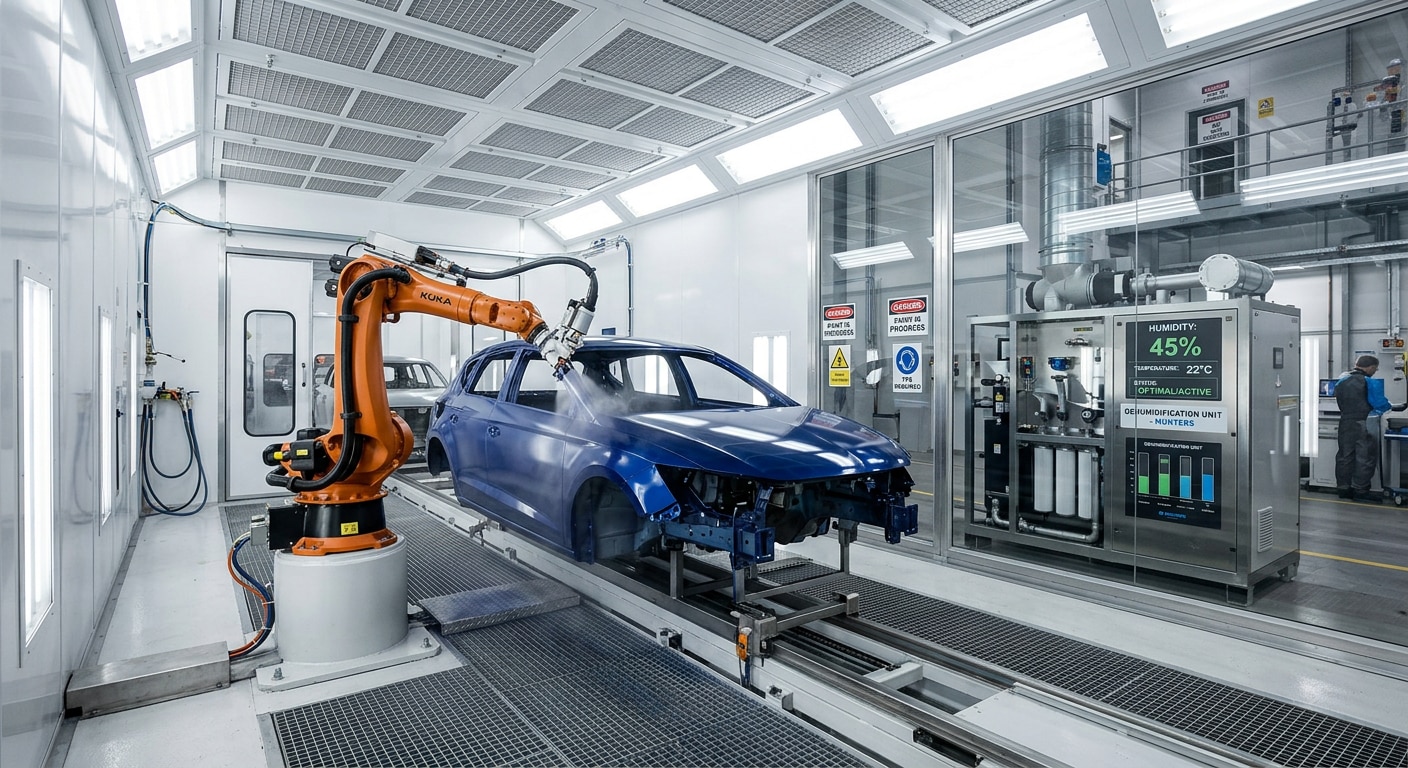
 Ask any paint shop supervisor about their week of the year, and there's a good chance it fell in the monsoon. Same paint. Same guns. Same painters. But suddenly the clear coat goes cloudy, the blasted steel shows specks before the primers even mixed, and the powder in the hopper won't fluidise the way it did in February. Nobody changed anything. Except the air did.
That’s the thing about coatings. They’re chemistry happening on a surface, and the air in the room is part of the recipe whether you've planned for it or not. In Mumbai, Chennai, Kolkata or Kochi, where outdoor humidity sits above 80% for months at a stretch, that recipe gets a lot of water.
As an industrial dehumidifier supplier working with fabrication shops, auto body workshops, powder coating lines, and furniture finishers, we hear about this every season. So here’s what humidity actually does to a finish, what numbers you should aim for, where a dehumidifier belongs in a coating setup (and where it doesn’t), and which unit suits which space.
Humid air doesn't just slow drying. It changes the finish.
Most people assume humid air simply means the paint takes longer to dry. That's the mildest version of the problem. The expensive ones look like this.
Blushing on solvent-based lacquers and clear coats
When solvent evaporates fast, it pulls heat out of the film. The surface can drop degrees below room temperature. If it drops below the dew point of the air, water condenses straight into the film, leaving a milky white haze. On a 30 °C day at 70% RH, the dew point is 23.9 °C. So the film only has to cool six degrees before it starts collecting water. For a flashing thinner that isn’t hard at all.
Flash rust before the primer goes on
Blasted steel is at its most reactive. Leave it sitting in air and rust bloom can appear within hours. Paint over it. You've locked the corrosion under the coating, where it comes back months later as blistering or creep from the edges. The usual rule in coating work is to keep the steel surface at least 3 °C above the dew point before and during application. In a humid shed in July, you often can't hold that margin without air.
Waterborne paints that won't flash off
Waterborne systems dry by releasing water. If the air is already loaded with moisture, evaporation crawls. Flash-off times stretch, films sag on panels and the next coat goes on before the last one's ready. Lines slow down to compensate, which is a cost nobody puts in the budget.
Powder that clumps and won't charge properly
Powder coating has no solvent. The powder itself picks up moisture in storage and in the feed system. Damp powder clumps, fluidises badly, sprays unevenly, and doesn't take a charge well. Then it shows up after curing: orange peel, pinholes, patchy film build, and a longer reject pile at inspection.
Amine blush on epoxies
Amine-cured epoxies react with moisture and carbon dioxide at the surface when humidity is high, leaving a waxy, greasy layer. The next coat won't bond to it properly. Which means an intercoat adhesion failure that might not show itself until the job is already in service.
What numbers should you actually be aiming for?
For paint booths and powder coating areas, we recommend a working band of 45–55% RH. Above it, you'll start seeing pinholes, flow-out, and adhesion loss.
But here's the part people miss: drier isn't automatically better. Some coatings need moisture. Inorganic zinc silicate primers, for example, cure by reacting with humidity. Their datasheets usually state a minimum RH. Waterborne paints dried in dry air can skin over too quickly and trap water underneath. So the goal is control, not "as dry as we can get it."
The second number worth watching is dew point. RH tells you how full the air is relative to its temperature. Dew point tells you the temperature at which water will start condensing on a surface. At 25 °C and 50% RH the dew point is 13.9 °C. At 30 °C and 60% RH it jumps to about 21.4 °C. If your steel came in from a store or the film cools during flash-off that gap decides whether you get condensation on the job or not.
That’s why dew point monitoring beats a wall hygrometer. A basic surface thermometer read alongside a dew point figure tells you in seconds whether you've got the 3 °C margin or you're about to paint onto a surface.. Always check the coating manufacturer's datasheet. Their application limits win over any rule, including ours.
Where the dehumidifier should go (and where it shouldn't)
Safety first: a standard refrigerant dehumidifier isn't an explosion-proof machine. Spray zones using solvent-based paints are classified as hazardous areas so don't place a regular unit inside the spray zone where flammable vapour is present. Keep it outside that zone. Bring the dry air in.
In practice, the biggest wins are usually in the rooms around the booth, not inside it:
Surface prep, masking and blast-cleaned steel staging: Dry air here stops flash rust between blasting and priming.
Powder storage and colour mixing rooms: Keep powder flowing before it ever reaches the hopper.
Flash-off and holding zones: Help waterborne films release water on schedule.
The make-up air side of the booth: Drier incoming air means drier air over the job.
Finished goods storage: Protects cured parts before packing and dispatch.
One honest caveat. A big downdraft booth exhausting thousands of metres of air an hour pulls in that much humid outside air too. Conditioning make-up air at that scale is an engineering job. We'd rather look at your airflow with you than guess. For small and mid-size workshops, though drying the prep, storage, and staging areas fixes the bulk of the defects.
A few simple habits also help a lot: keep doors between the booth area and the outside closed, seal gaps, don't store blasted steel near open shutters, and let cold parts reach room temperature before you spray them.
Matching a dehumidifier to your coating area
All the units below are White Westinghouse (USA) dehumidifiers and capacity is quoted in litres of water removed per day. The right size depends on room volume, how often doors open, and how much outside air the space pulls in so treat this as a starting point rather than a final spec.
Small rooms: powder stores, colour mixing rooms, QC labs, touch-up corners
For enclosed spaces, start with the AWHD-12L (12 Litres/Day) or the AWHD-20L (20 Litres/Day). For a larger powder store or a mixing room that sees regular foot traffic, step up to the AWHD-306L (30 Litres/Day) the AWHD-307L (30 Litres/Day), or the AWHD-40L (40 Litres/Day).
Mid-size areas: masking rooms, flash-off zones, small powder coating sheds
Prep and flash-off rooms carry moisture load, so this is where the WDE range comes in. The WDE-603T (60 Litres/Day). WDE 606 (60 Litres/Day) suits most mid-size rooms. For spaces, the WDE 702 (70 Litres/Day) and WDE 100 (100 Litres/Day) give you extra headroom when the monsoon peaks.
Large high-load spaces: blast staging bays, fabrication halls, powder coating lines
Big volumes with shutter openings need serious capacity. Look at the WDE-110P (110 Litres/Day), the WDE 110S (110 Litres/Day), the WDE150S (150 Litres/Day) or, for the leakiest halls, the WDE-190S (190 Litres/Day). Large floors often do better with two mid-size units spread out than one big unit in a corner.
Want to compare them all side by side? Browse our industrial dehumidifier range here
Talk to Our Team
Not sure where the sensors should go, what set points your process really needs, or which capacity fits your floor area? Tell us about your plant, and we'll work it out with you. No obligation, no pressure.
Free consultation on humidity monitoring and dehumidifier sizing for your facility
Free product demo — Mumbai only. See a White Westinghouse unit running at your site before you commit.
Call for inquiry: 08048038959. Please keep the 0 before dialling the number.
