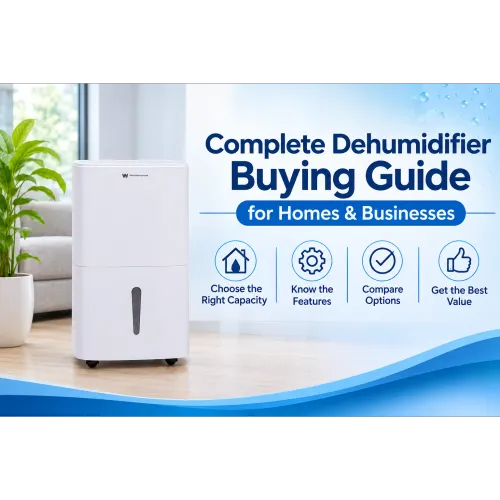


Buying a dehumidifier may seem like a simple decision, but choosing the right model requires careful consideration of several factors. A dehumidifier plays an important role in controlling excess moisture, maintaining indoor air quality, protecting equipment, and preventing moisture-related problems.
Today, the demand for dehumidifiers in India is increasing across residential, commercial, and industrial applications. However, selecting an unsuitable unit can lead to poor performance, unnecessary energy consumption, and higher operating costs.
One of the most common mistakes buyers make is choosing a dehumidifier based only on its price or maximum moisture removal capacity. Every space has different humidity conditions, temperature requirements, applications, and moisture loads. For businesses and homeowners looking for dehumidifiers in Mumbai, where humidity can remain high for extended periods, understanding these requirements is particularly important.
1. Ignoring the Room or Space Size
One of the biggest mistakes when buying a dehumidifier is not considering the size of the area where it will be installed. Every dehumidifier is designed to operate effectively within a specific range of room and environmental conditions.
A unit with insufficient capacity may struggle to control humidity in a large room, warehouse, or industrial facility. On the other hand, selecting an unnecessarily large unit for a small space may increase the initial investment and operating expenses.
Before purchasing, evaluate the total area, ceiling height, room layout, and air circulation conditions.
For example, the requirements of a small office in @location will be different from those of a large industrial warehouse. When exploring industrial dehumidifiers in India, always consider the size and layout of your facility before selecting a model.
2. Selecting a Dehumidifier Without Checking Humidity Levels
Another common mistake is purchasing a dehumidifier without understanding the existing humidity level of the space.
Humidity levels vary depending on geographical location, weather conditions, building design, and ventilation. In humid regions such as @location, excess moisture can create challenges for residential properties, commercial establishments, and industrial facilities.
Without measuring the existing relative humidity (RH), it becomes difficult to determine the actual moisture removal requirement.
Before purchasing, consider:
Existing relative humidity levels.
Desired humidity levels.
Daily humidity fluctuations.
Seasonal moisture variations.
The amount of moisture entering the space.
Understanding these factors helps identify the right dehumidifier in Mumbai or other parts of India based on the actual environmental conditions.
3. Choosing Only Based on Maximum Capacity
Many buyers compare dehumidifiers primarily by their moisture removal capacity, usually expressed in litres per day. Although capacity is an important specification, it should not be the only deciding factor.
A dehumidifier's actual performance depends on operating conditions such as temperature and relative humidity. The maximum capacity mentioned in product specifications may be measured under particular testing conditions and may not represent performance in your actual environment.
For example, a unit rated for high moisture removal under warm and humid conditions may perform differently in a cooler environment.
Businesses operating warehouses and industrial facilities in @location should evaluate the expected moisture load, operating temperature, humidity requirements, and application before selecting equipment.
When comparing industrial dehumidifiers in India, focus on actual operating performance rather than maximum capacity alone.
4. Overlooking Operating Temperature
Temperature is another important factor that buyers frequently overlook.
Different dehumidifiers perform differently depending on the surrounding temperature. Conventional refrigerant-based dehumidifiers are generally suitable for many normal-temperature applications, while their performance can reduce in colder environments.
For applications involving low-temperature storage areas, cold rooms, or temperature-controlled facilities, selecting the appropriate dehumidification technology becomes especially important.
Before purchasing, identify the minimum and maximum operating temperatures of the space.
Consider the following:
Average room temperature.
Minimum operating temperature.
Maximum operating temperature.
Seasonal temperature variations.
Temperature conditions during equipment operation.
For example, businesses managing cold storage facilities in @location may have different requirements compared to offices, hotels, or general warehouses. Choosing suitable commercial dehumidifiers in India requires understanding these operating conditions.
5. Not Considering the Actual Application
Not every dehumidifier is suitable for every application. A residential dehumidifier may not fulfil the requirements of an industrial facility, just as a high-capacity industrial unit may not be the most appropriate choice for a small commercial space.
Different applications have different moisture control requirements.
Some common applications include:
Residential spaces: Controlling excess moisture in bedrooms, living rooms, and basements.
Commercial buildings: Maintaining suitable indoor humidity in offices, hotels, and commercial establishments.
Warehouses: Protecting stored materials, packaging, and inventory from moisture-related damage.
Manufacturing facilities: Maintaining suitable humidity conditions for production processes.
Pharmaceutical facilities: Supporting controlled environmental conditions where required by the process.
Storage rooms: Helping prevent condensation, dampness, and moisture-related deterioration.
Whether you operate a manufacturing unit in @location or manage a commercial property in @location, identifying the intended application before purchasing helps ensure that the selected equipment matches your actual requirements.
This is particularly important when searching for industrial dehumidifiers in Mumbai for specialised manufacturing and storage applications.
6. Underestimating the Moisture Load
Room size and humidity levels are important, but they do not tell the complete story. Buyers must also understand the total moisture load within the space.
Moisture load refers to the amount of moisture entering or being generated inside an area. Even a relatively small room may require a higher-capacity dehumidifier if there are continuous sources of moisture.
Common moisture sources include:
Water leakage and seepage.
Moisture entering through doors and windows.
Poor ventilation.
Wet materials and products.
Manufacturing and industrial processes.
High occupancy levels.
Frequent movement of goods and materials.
For example, a warehouse storing moisture-sensitive products in @location may have different dehumidification requirements compared to an empty warehouse of the same size.
Understanding the moisture load is essential when selecting warehouse dehumidifiers in India, as the right capacity depends on more than just the physical dimensions of the facility.
7. Choosing the Cheapest Available Option
Budget is an important consideration when purchasing equipment, but selecting a dehumidifier based only on the lowest price can become an expensive mistake in the long run.
A low-cost model may not provide the required performance, durability, or operational efficiency for your application. Similarly, an expensive model is not necessarily the right choice if its specifications exceed your actual requirements.
Instead of comparing products only by their purchase price, evaluate the overall value they offer.
Consider factors such as:
Dehumidification capacity.
Energy consumption.
Operating conditions.
Equipment suitability.
Maintenance requirements.
Expected operating hours.
Long-term reliability.
For commercial and industrial businesses in @location, choosing the right dehumidification solutions in India can help avoid unnecessary operating expenses while delivering the required moisture control.
8. Not Seeking Expert Guidance Before Purchasing
With different capacities, technologies, and equipment configurations available, choosing the right dehumidifier can become confusing.
Many buyers make decisions based on general product descriptions without evaluating the specific environmental conditions of their facility.
Consulting an experienced dehumidification solution provider can help identify the important technical requirements before finalising a model.
A proper assessment should consider room dimensions, humidity levels, temperature, application, moisture sources, and expected operating conditions.
Whether you are searching for dehumidifiers in Mumbai, Pune, Delhi, Chennai, Bangalore, or other parts of India, professional guidance can help you identify equipment that matches your requirements.
Make the Right Dehumidifier Buying Decision with JET INDIA
Choosing a dehumidifier is not simply about selecting a model with the highest capacity or the lowest price. It is about understanding your space, identifying its moisture load, evaluating temperature and humidity conditions, and selecting equipment that matches your application.
At JET INDIA, we understand the importance of choosing an appropriate dehumidification solution for different environmental and industrial requirements.
Before purchasing a dehumidifier, take the time to evaluate your actual needs and discuss your application with an experienced team. The right selection can help improve moisture control, protect valuable materials and equipment, and support better environmental conditions.
Whether you need a solution for a commercial property, warehouse, manufacturing facility, or specialised application in @location, making an informed purchasing decision is essential.
Planning to buy a dehumidifier?
Contact JET INDIA to discuss your requirements before selecting a model. Get the right guidance to identify a suitable dehumidification solution for your space and application.
JET INDIA – Making Better Moisture Control Decisions for Your Business.